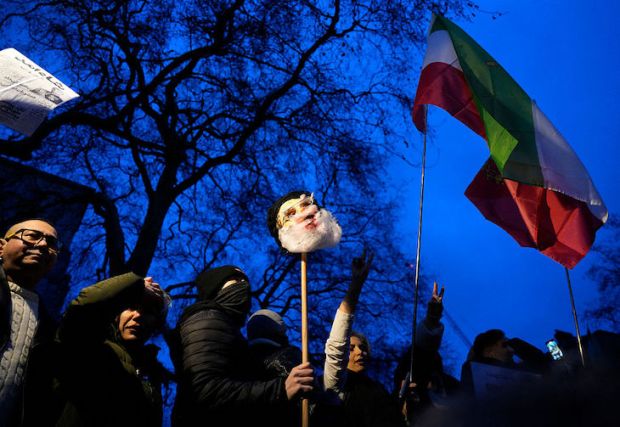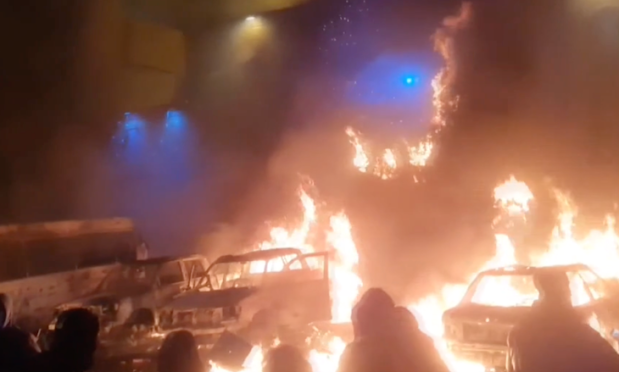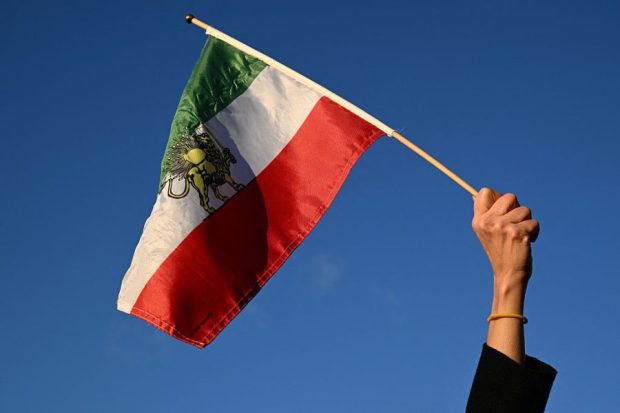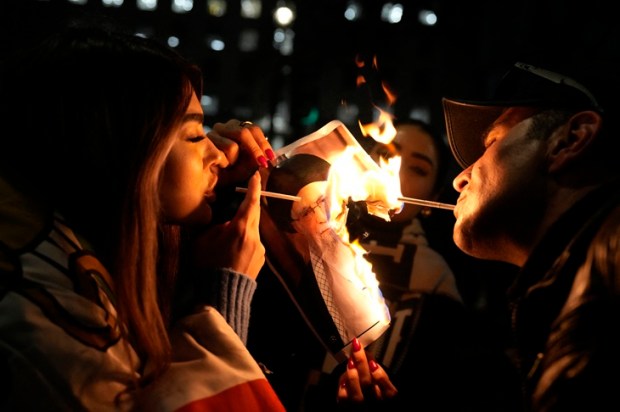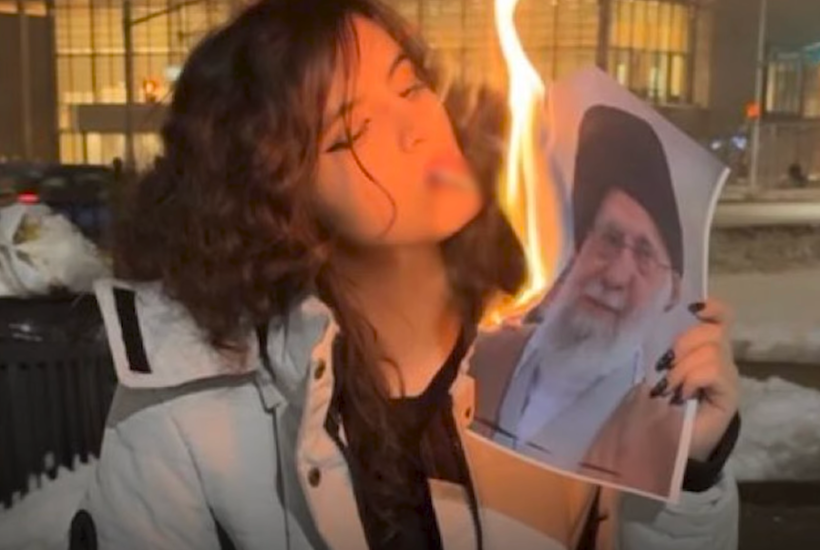
As Iranians revolt against the brutal Islamic theocracy that has throttled their civilisation since 1979, striking images of young Persian women have been circulating online. They are lighting cigarettes by burning photographs of Ayatollah Khamenei. With their insouciant attitude, tumbles of curls, kohl-lined eyes and lolling fags, they could be on the cover of an Arcade Fire album.
These women have reignited the same spirit that sparked widespread protests across the country in September 2022, when Mahsa Amini died in custody following her arrest for disobeying the country’s modesty laws. In the aftermath of this, female protestors burnt their veils, cut their hair in public and chanted ‘Women, Life, Freedom’. Although the grievances of today’s protesters are much broader, with demands for the fall of the Islamic Republic, Iranian women are once again at the forefront of the unrest, demanding their liberation after decades of subjugation.
The stakes for women in Iran couldn’t be higher
The bravery on display is breathtaking. In a devil-may-care act of defiance, young ladies are putting their lives on the line by smoking in public, discarding their hijabs and openly insulting the Supreme Leader’s image – a grave crime that could lead to prison, torture and even death. It is a raised middle finger – sometimes quite literally – to a regime intent on eviscerating women’s rights, suppressing dissent and enforcing Islamic governance, including blasphemy laws, the criminalisation of apostasy and mandatory hijabs.
One might expect choruses of violent assent from liberal women in the West, who make it their mission to dismantle the patriarchy one microaggression at a time. Western cities should be full of ardent feminists, cheering on the courage of their Iranian sisters in the face of vicious oppression. And yet their silence is conspicuous. While the women of Iran are taking back the streets, the women of Islington are tutting into their margaritas.
The Guardian has a weekly column called ‘The Week in Patriarchy’. Given the protests kicked off on 28 December, you might think Iran would have featured. Not yet. We have an article on domestic violence offenders in Tennessee and how Zohran Mamdani is ‘showing what “pro-family” means’. The ‘Feminism’ tag on the Guardian’s website has contained no mention of Iran since the widespread protests began, either. The last entry lauds Brooklyn Beckham for setting an ‘important trend’ by double-barrelling his surname.
Iran is believed to be ‘the world’s number one executioner of women per capita’. Surely the demonstrations would be a more important story in the British press?
Instead, the news cycle in this country has been dominated by stories of men using X’s AI tool, Grok, to edit pictures of women and put them in bikinis. This shouldn’t be downplayed. Digitally undressing women and children raises serious ethical and legal questions. But there is a sense of selective outrage: some feminist issues can be spoken about freely, whereas others come freighted with ideological baggage. The plight of women in Iran is one such issue.
Westerner liberals seem uncomfortable conceding that Islamic regimes are far from feminist utopias or that political Islam is a threat to our own societies. The example of Iran since the revolution of 1979 shows that Islamic radicals can and will conquer once-thriving free countries. A secular monarchy can be transformed into a theocratic Islamic Republic, which implements strict Sharia-based laws, in a terrifyingly short period of time, aided and abetted by useful idiots.
A generation of activists has developed a reflexive anti-Westernism, which presents almost any foe of America, Israel or the West in general as virtuous. This can lead them to take the side of Islamists, rather than the people who suffer under Islamic rule. Confusion reigned supreme in Washington this week, for example, where anti-Khamenei Iranians clashed with a group of pro-Hamas white liberal women. As John Cleese remarked, it could be straight out of Monty Python.
The preoccupation with ‘Islamophobia’ has led many on the left to defend, or even lionise, the veiling of Muslim women. Following Donald Trump’s election in 2016, a Muslim woman in a Stars and Stripes hijab became one of the key images of the so-called ‘resistance’. But Iran’s plight illustrates that many women are not choosing to wear the hijab or burqa. The first thing they do when they take to the streets is burn it.
Moreover, Iran’s predicament highlights the fallacies of treating Islam as a race – or ‘Islamophobia’ as a ‘form of racism’. There is a danger in collapsing critiques of a belief system with a crude prejudice based on skin colour. As the journalist Tahmineh Dehbozorgi has pointed out:
By treating Islam as a racial identity rather than an ideology, Western media strips millions of people of their ability to reject it. Iranian protesters become unintelligible. Their rebellion cannot be processed without breaking the rule that Islam must not be criticised.
An obsession with intersectionality has meant that where sensitivities about faith or culture rear their head, women usually come last. It’s part of a pattern: progressive feminists ignoring the feelings of women who challenge their narratives. Closer to home, we can see this play out in debates about topics such as transgenderism and immigration. #MeToo advocates who insisted that we should simply ‘believe women’ – an absurdly reductive slogan that ignores the core principles of justice – are now smearing women who say they don’t feel safe in their local communities due to unprecedented levels of uncontrolled migration, for example.
Take the criticism levelled at The Pink Ladies, a grassroots movement set up last summer to oppose migrant hotels up and down the country. Despite a string of cases of unvetted men committing sexual offences, the protesters were dismissed and falsely tarred as racist. ‘How anti-migrant groups are hijacking women’s rights to promote their agenda’, ran a headline in one newspaper. In short, don’t believe women – unless the perpetrator is a Western man, in which case the burden of proof goes straight out the window.
The most egregious British example of this tendency to dismiss female voices has been the grooming gang scandal of the past few years, where easing ‘community tensions’ came before calling out the rape of vulnerable white girls. Fears of being labelled racist or Islamophobic won the day over the welfare of the victims.
The stakes for women in Iran couldn’t be higher. If outspoken feminists in the West can’t stand up for the most significant rejection of the Islamic Republic of Iran to date, what will they stand up for? Isn’t it their job to give voice to the voiceless? Now is the time to listen to the brave Iranian women lighting up.