Toward the end of last year (before the Bondi terrorist attack), I was talking with a young woman whose parents were migrants to Australia (as are my own). We were discussing the world and travel, and she took the conversation in a slightly different direction.
‘It’s interesting, people live differently around the world and I don’t think that any culture or way of living is better than any other,’ she said. I asked if she had ever spent time living anywhere other than Australia, to which she responded, ‘No, but I have been on holiday to Singapore.’
I lived in an Islamic country for six months, and I know that many of the women living there and the (male and female) Australians who were with me would express a very different point of view. It is easy to say that all cultures are equal, but until you try living outside of Australia, I’ll take your no-doubt well-intentioned point with a pinch of salt.
This view that all cultures are equal is pervasive among Australia’s elite. Most of our political class, business leaders, and opinion-makers in the media think that there is nothing particularly unique or worthy about Australian culture.
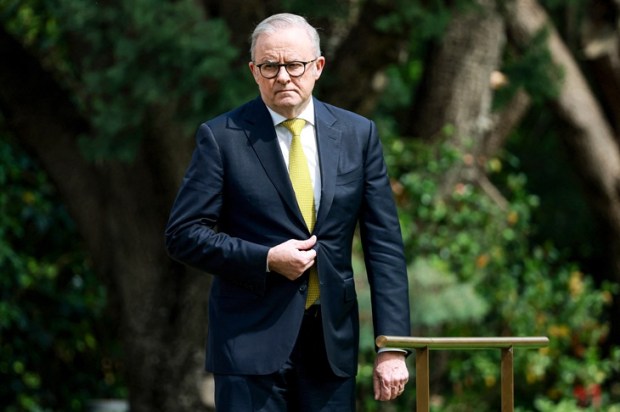
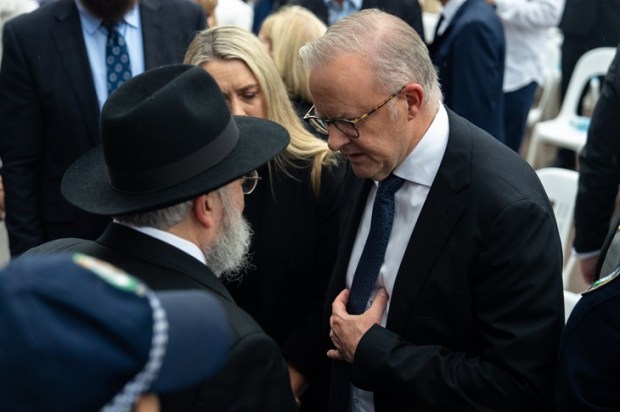
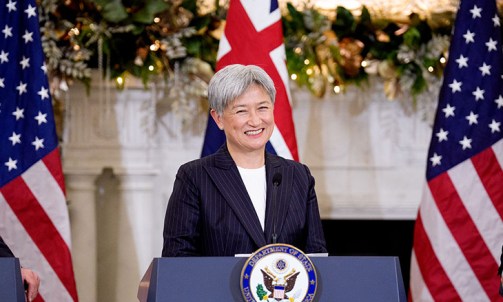
Prime Minister Anthony Albanese made this explicit when he said that the Labor Party’s ‘vision’ was for Australia to be ‘a microcosm of the world’.
It was an alarming statement for those who think Australia is an objectively good country, with a unique culture built upon the best parts of our British inheritance of the rule of law, parliamentary democracy, and individual freedom.
Countless Australians among the more than six million who have migrated and become citizens since the end of the second world war were not only running to Australia, they were running from their country of birth. They want Australia to be Australia, not a microcosm of the sectarian conflict, totalitarian regimes, and arbitrary rule in the countries from which they fled.
Our leaders, from both sides of politics, have made a mistake in forgetting this. They have contributed to the declining sense of national identity and belonging shown by both Australian-born and migrant Australians in recent years.
According to the Scanlon Foundation, almost 70 per cent of Australians born after 1996 do not feel a sense of belonging to their homeland. At a similar time in their lives, only 36 per cent of Millennials said the same thing, meaning that in just over a decade, the share of young people who feel alienated from Australia has almost doubled. The share of Australian-born Zoomers who feel alienated from Australia is only slightly less bad than the share of foreign-born Australian Zoomers, at 74 per cent. We should be alarmed at the fact that we live in a country where, regardless of where they were born, young Australians do not feel a sense of national identity and belonging.
Our political class has failed comprehensively in the wake of the Bondi terrorist attack. In a rushed and highly politicised response to Bondi, the Labor government introduced the Combatting Antisemitism, Hate and Extremism (Criminal and Migration Laws) Bill 2026, which they claimed would ‘further criminalise hateful conduct, and ensure that those that seek to spread hate, division and radicalisation are met with severe penalties’.
But the problem of addressing ‘hate, division and radicalisation’ cannot be fixed with these laws. As I’ve written previously, adding new laws and regulations is a sign of cultural decay: ‘Replacing local cultures with a “cultureless multiculturalism”, [is] the kind of “liberalising” policy which requires a massive expansion in state control to force cohesion.’
In early 2025, the Premier of New South Wales, Chris Minns, said that Australia could not have robust freedom of speech protections ‘and the reason for that is that we want to hold together a multicultural community and have people live in peace’. The Hate and Extremism Bill is just the latest example of this kind of attempt to force cohesion.
But it is impossible to legislate away a cultural problem. It runs deep, and cannot be addressed by a political class that is unwilling to admit that for years they have got it wrong on multiculturalism and tolerance of intolerance.
In his 2026 Australia Day address, Prime Minister Anthony Albanese said: ‘Whether we are Australian by birth or by choice, we all share the opportunity, the privilege and also the responsibility of being part of something quite extraordinary.’
Quite right. The unfortunate thing is that it took Australia’s most deadly terrorist attack for him to say this.