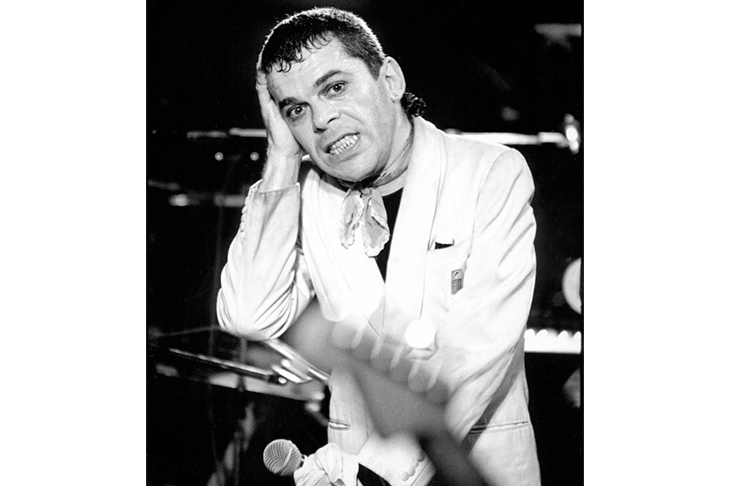
I n 1981, Ian Dury released ‘Spasticus Autisticus’, a song so abrasive that the BBC refused to play it. The International Year of Disabled Persons had produced the usual pageant of institutional tenderness — telethons, posters, managed gratitude. Dury, who walked with a polio-damaged leg all his life, replied not with thanks but with a two-fingered salute. He took every word used to classify and manage disabled bodies and hurled it back in the bureaucrats’ faces. I’m Spasticus! Not a request for inclusion. A refusal to be domesticated.
One line in the song names the world he was mocking: ‘Hello to you out there in Normal Land.’ Normal Land is where well-meaning administrators live — the place that believes it is kind because it is tidy, compassionate because it is organised.
The refusal matters because it names a modern trick — the reduction of a person to a case. Once you are a case, the administrators arrive. They manage you: frameworks, stakeholders, interim findings. The transaction looks like a response. In reality, it is all motion and no verdict.
Dury knew what that machinery felt like. ‘So, place your hard-earned peanuts in my tin,’ he sang, skewering the moral economy of managed pity — the system that thanks you for not being worse while stripping you of standing. And then the line that cuts deepest: ‘You can be my body, but you’ll never read my books.’ You can be spoken about, even protected, but never understood.
That substitution is now the official Australian response to the Bondi massacre.
The terms of reference published this week instruct the royal commission to investigate antisemitism and make recommendations for law enforcement. Fair enough. But buried in the same document is a clause that tells you everything. The commission must conduct itself in a manner that does not ‘undermine social cohesion’.
Read that again. The inquiry into the murder of fifteen people is formally prohibited from producing findings that would disturb the national story of harmonious diversity. Truth is permitted, but only the kind that does not cause trouble. Whatever Virginia Bell finds, it must be compatible with cohesion. This is not oversight. It is the purpose.
On 7.30, Michael Rowland asked Anthony Albanese why it had taken him so long to read the national mood. The Prime Minister replied in fluent bureaucratic dialect: ‘terms of reference’, ‘structures’, ‘proper consultation’, ‘timeframes’, the importance of being ‘orderly’ rather than being ‘run’ by the 24-hour media cycle. He spoke of meetings with families, conversations with rabbis, and engagement with community leaders.
What he did not use was a single word of moral judgment. No evil. No hatred. No war. Not even ‘Islamist’ — though the attack was Islamist in ideology, motivation and target selection. The grammar available to the Prime Minister is the grammar of process. Jihadist murder becomes a cohesion problem. The dead become stakeholders in an ongoing review.
Albanese closed the interview with a familiar formula: the attack was “targeting Jewish Australians, but it was also targeting the Australian way of life”. The sentence is true. But it is evasive, because it does not ask the next question: what, precisely, was targeting that way of life? Not antisemitism in the abstract but a theological and political claim: that Jews are enemies, that the societies that harbour them are illegitimate, and that violence against both is righteous. That claim has a name. It is Islamism. And no royal commission constrained by the requirement not to disturb cohesion will be permitted to say so clearly.
This is where Virginia Bell’s appointment becomes diagnostic. Her critics have called her “left-leaning”, but that is political shorthand, not legal analysis. Her judicial record is specific: she is a stabiliser. Her High Court tenure was marked by consensus, procedural rigour, and alignment with majorities. She dissented less than most of her colleagues. Her reasoning was careful, institutionally respectful, designed to preserve coherence. In a property dispute, these are virtues. In an inquiry into civilisational hostility, they are a signal. Bell is not there to prise anything open. She is there to ensure the vase remains intact, even if something inside it is rotten.
A royal commission led by a stabilising jurist, under terms that forbid undermining cohesion, asked to report on an act of war while a criminal trial proceeds, is not an instrument of truth. It is an instrument of managed absorption.
The families of the dead asked why their relatives were murdered. They were given architecture: a commissioner, a timetable, a set of terms, and a solemn promise that nothing important would be said too loudly.
Dury understood that architecture. His song was not about disability policy, but about what happens when the machinery of concern replaces the encounter with a person. You are no longer spoken to but spoken about. No longer a citizen with standing, but a problem with a file number. The Jews of Bondi — who buried their dead and washed the blood from a promenade — have now been filed.
So, what will the Commission find? The structure tells you in advance. Four safe culprits: social-media algorithms, intelligence-coordination gaps, community-engagement failures, and inadequate hate-speech laws. All politically painless. All blame systems rather than ideas. You will see “opportunities for improvement” and “the need to strengthen coordination”. You will not see Islamism treated as a causal force. You will not see migration policy from high-risk regions named as reckless. You will not see multiculturalism identified as the doctrine that disabled the host culture’s capacity to set boundaries. Those conclusions would shatter cohesion. So, they will be absent — or present only as ‘complex contributing factors’, stripped of causal weight.
The final report will conclude that Bondi happened because systems failed, not because ideas were imported. That formulation is the entire point. It allows the government to say: we listened, we acted, we reformed. It allows no one to say what matters — that Australia invited into itself something that hates it, and the political class was too frightened of being called racist to notice.
The Commission is not a cover-up. It is something more debilitating: a civilisational anaesthetic, administered under terms that guarantee the patient will feel nothing.
Because nothing important will change, the question is not whether there will be another attack, but when. Britain saw it between the 2005 London bombings and the 2017 Manchester Arena massacre; France saw it from Charlie Hebdo through the Bataclan to Nice. Twelve years of reports, reviews, and “community cohesion” initiatives — none of which interrupted the sequence.
When it happens again, the political class that did nothing will look genuinely shocked. They will order another inquiry. They will, once more, speak of cohesion. And they will wonder, with perfect sincerity, how such a thing could possibly have happened.
Got something to add? Join the discussion and comment below.
You might disagree with half of it, but you’ll enjoy reading all of it. Try your first month for free, then just $2 a week for the remainder of your first year.