Our appetite for true crime is nothing new. The Victorians devoured it and, as Lottie Moggach’s fourth novel shows, they were as gawking and prone to erroneous judgments as any crowd on social media.
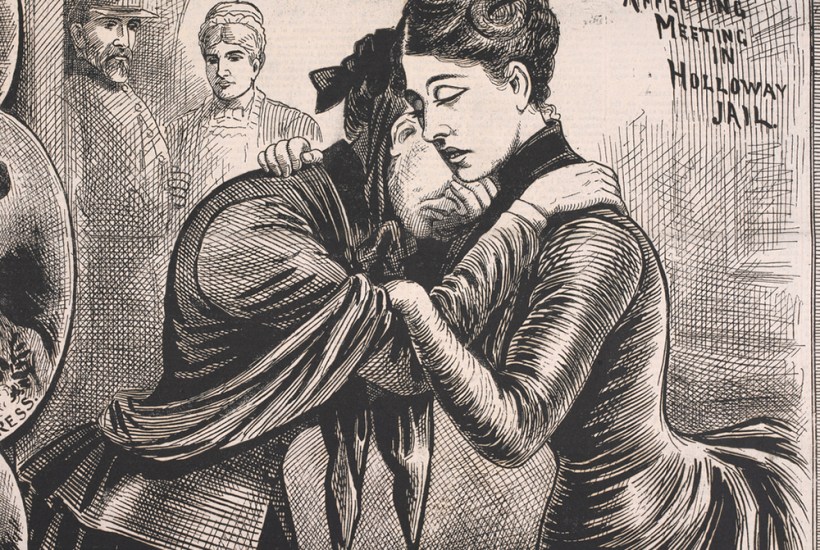
Mrs Pearcey is about two women in 1890s London: sparky young Hannah Teale, engaged to a rising journalist on the Star and living with her widowed mother in Camden Square; and impoverished Mary Pearcey, who lodges in a Hampstead boarding house and is accused of the grotesque murder of a woman and her baby. It was a celebrated case in its day, coming soon after the Ripper murders, and it is now revived in Moggach’s vivid, immersive imagination.
Part of the novel’s attraction lies in its setting in and around Camden Town. Seeing the newly developed area in its infancy, in the midst of the ferment of Victorian residential building and the swarms of labouring poor through which Hannah must fight her way, is fascinating. Hannah is ‘blooming’, but her mother, ‘bony and dry’, is dreary, and her home, with its walls faded ‘to the shade of old liver’, is one Hannah is desperate to escape.
Her fiancé Cosmo lives in Kensington in an altogether brighter and more colourful house, lit by a sumptuous Murano chandelier. Unfortunately, the inheritance he has been expecting to set them up in married life will not be forthcoming, owing to his father being caught taking secret photographs of women. Cosmo decides to raise his profile by getting himself admitted to a lunatic asylum in order to expose its horrors; but Hannah, electrified by the Hampstead murder case and a chance encounter with the accused, manages to get into the real killer’s home and discover details overlooked by the police.
Many fictional Victorian heroines are more enterprising than modern ones, and Moggach’s skill at showing us how a girl educated at North London Collegiate School might resist the attractions of marriage is thoroughly engaging. Hannah, an observant and spirited young woman, learns with admirable ease how to blag her way into a crime scene, an editor’s office and, ultimately, the cell of a condemned prisoner.
Taught how to sensationalise her plain, truthful report, our heroine is soon on her way to becoming one of Fleet Street’s fledgling women journalists, who, like Rachel Beer (the editor of both the Observer and the Sunday Times), were just getting going in the 1890s. It is one thing, however, to make the leap into (anonymous) publication in the Star and another to persuade anyone important that a woman bound for the gallows might conceivably be innocent of a ‘grisly’ crime. Hannah thinks of a number of potential routes whereby the prisoner might escape her death sentence. But once Cosmo gets out of the asylum and plies his own version of the tale, any hope ends.
Sophisticated and suspenseful, Moggach’s novel goes beyond the usual historical fiction. Mrs Pearcey is a poor woman, fatally trapped by her romantic passion for a brutal man and by her lack of options. Hannah, educated, middle-class but so innocent that she is shocked by the ‘animalism’ of a kiss, is equally trapped by the convention that a man patently less intelligent and brave than herself is a desirable husband. Both seem remote from our own age. The gawping crowds at Madame Tussaud’s Chamber of Horrors, viewing the recreation of the murder as entertainment, have scarcely changed from their day to ours.
Got something to add? Join the discussion and comment below.
You might disagree with half of it, but you’ll enjoy reading all of it. Try your first month for free, then just $2 a week for the remainder of your first year.