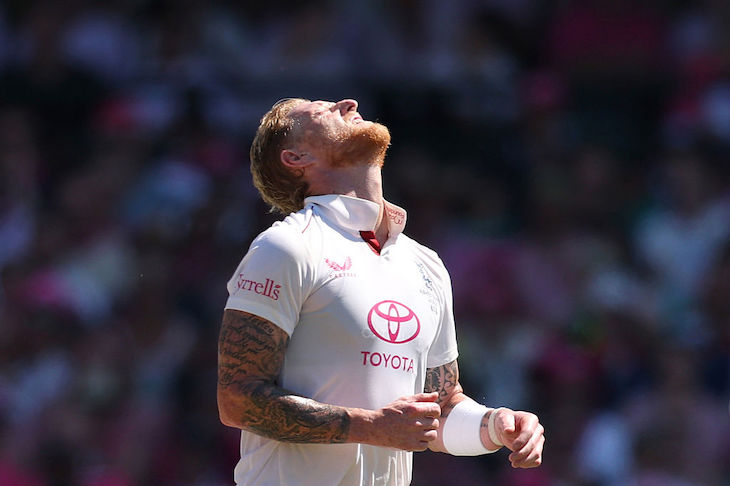
England’s cricketers have just lost the final Test match in Sydney. So the five-match series, a dead rubber ever since the Aussies retained the Ashes over a fortnight ago by winning the first three games, has ended 4-1 in Australia’s favour. This drubbing was entirely predictable: we lost the previous series ‘down under’ 5-0, 4-0 and 4-0 and we never learn.
Our bowlers may be inexperienced but our feckless batsmen have no such excuse
Nevertheless, as Sir Geoffrey Boycott says, ‘There is every chance that the suits at the ECB will… carry on as normal.’ Attempts will be made to explain away and put a positive spin on England’s performance. The heavy defeats in the first two Tests can safely be blamed on a lack of preparation – a ‘one-off’ mistake for which coach Brendan McCullum has already accepted responsibility. Much will be made of our consolation victory in the fourth game – the first time England have won a Test ‘down under’ since 2011. And the sublime batting of 22-year-old Jacob Bethell in the match just finished suggests that we’ve finally found a reliable number 3 so don’t worry: everything will be fine next time.
But the important truth is that we were playing an Australian side in transition which was severely weakened by the absence of several of their best players, and yet we still contrived to lose the series in barely 11 days’ play. Our bowlers may be inexperienced but our feckless batsmen have no such excuse.
Underperforming batsmen have been kept in this team far too long. It’s true that Ollie Pope was, finally, dropped after the third Test in Adelaide, but only after 64 Test matches during which, setting aside mammoth scores against Ireland and Zimbabwe, he averaged under 32. Such indulgence is ridiculous. It was clear a year ago that his replacement Jacob Bethell has a better temperament and technique. But at that time Pope was vice-captain which, very conveniently, meant he couldn’t be dropped.
After Adelaide other batsmen who had performed no better than Pope were retained even though the series was already lost, thereby wasting the opportunity to give more youngsters a first taste of Ashes cricket in Australia. You can’t blame the players selected: obviously if you’re picked, you play. And none of them should be cast into the outer darkness never to play for England again. But equally keeping them in the team however poorly they perform is absurd.
This reluctance to give new players a chance is an endemic problem which long predates the current ‘Bazball’ regime. Over the years, numerous specious excuses have been pressed into service to justify retaining the familiar faces. When England win we’re treated to a version of ‘You can’t change a winning team’ (however badly some of its members may have played), when they lose we’re told that ‘Those selected remain the best available’ (even though others have never been tried). Senior players are picked when injured or unfit and, however poor their form, when they’re closing in on a personal milestone (a certain number of runs, wickets or caps). Sometimes the ‘Catch-22’ argument is rolled out: better not to pick a player until he’s got some experience.
How a team fares is determined by the eleven players on the field so it’s essential to select the right ones. To that end England need to operate with a larger, more permeable and flexible squad so that there is genuine competition for places and a team can be selected according to conditions, fitness, form and the strengths and weaknesses of opponents.
But that’s not how England cricket works. In 2024 when opener Zak Crawley broke a finger, McCullum and captain Ben Stokes chose not to pick a specialist replacement – even though there were several promising candidates who might have done well. Rather than risk discovering a rival, they handed the job to Dan Lawrence. Lawrence is a fine cricketer but he had virtually no experience at the top of the order and so little chance of becoming a credible long-term alternative. Sure enough, he duly failed, allowing Crawley to walk straight back in as soon as he’d recovered. That opportunity to find new talent should never have been passed up: Crawley and his fellow opener Ben Duckett only managed one 50-run partnership in this whole disastrous Ashes series.
We should be grateful to the Australians for showing us what a serious team looks like and for repeatedly giving us these drubbings ‘down under’. It’s a shame we never learn from them.