Climb the Reading Room steps to reach the British Museum’s dazzling Hawaii exhibition, and you perform an obeisance. At the top is a representation of Ku, a larger-than-human god of war and chiefly power, carved in stylish fury from the trunk of a breadfruit tree. He once commanded a flight of stairs at the Museum of Mankind in Burlington Gardens. In Hawaii he would have looked down with royal authority from a stone temple mound. We pass below him into the show, it feels, only with his consent.
This is a landmark event that tells of moving encounters with stunning exhibits
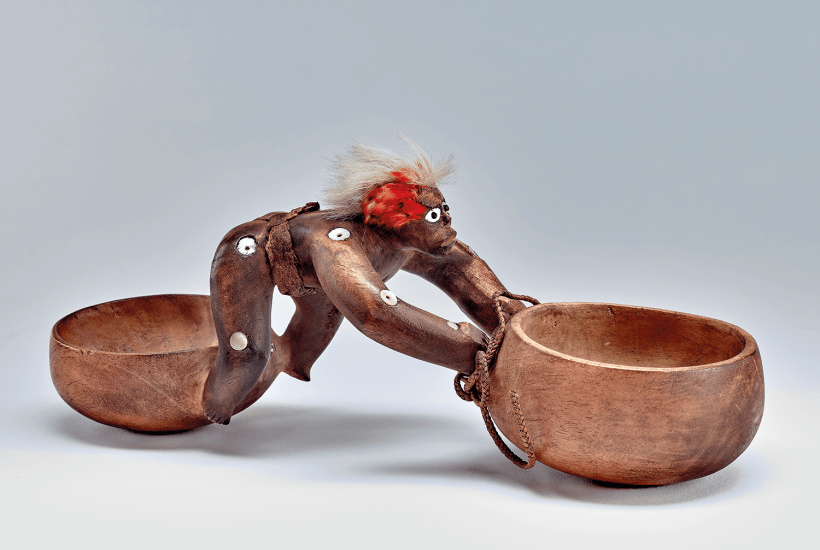
For that we should offer thanks. At an important time for the museum (on which more below), this is a landmark event that tells of moving encounters with stunning exhibits. Rare fabrics, cloaks and headdresses, created with great skill from feathers, bark cloth and wood, explode with colour as if new. Shells, boar tusks and fish teeth decorate wooden bowls, the heads of feathered gods and a terrifying idol. A shiny teapot sports an ivory handle.
Wait, a teapot?
Here, engraved in silver, is the exhibition’s story. On one side the pot bears a British royal crest and a London hallmark. On the other, is the name of a Hawaiian regent and king’s wife: Kaʻahumanu. In 1823 a royal delegation left Hawaii in a British whaler, arriving here after nearly six months and a voyage across two oceans. With King Liholiho were Queen Kamamalu, six high-ranking chiefs, a servant and a French adviser (a priest died en route). Their mission: at a time of challenging cultural and political change across the Hawaiian islands, to gain British protection.
Part toast of London society – visiting the opera and, wonderful to imagine, the British Museum – and part brunt of racist caricature, Liholiho and Kamamalu died in their twenties within a week of each other, struck by measles. But the delegation was successful at first. Britain championed Hawaii’s sovereign independence, maintaining connections for decades (in 1890, two Hawaiian princes became the first surfers at Bridlington). But when the United States overthrew the Kingdom in 1893, Britain failed to intervene.
Liholiho’s request was not the first such from Hawaii. At the exhibition’s centre is a stunning cloak, which reached the future George IV in 1812. Painted with hundreds of thousands of red and yellow feathers, it came with a letter from Kamehameha I (Liholiho’s father) seeking help against foreign powers. Opposite is another cloak, worn by George at his coronation, its red velvet and gold braid a fussy response to the similarly coloured graphic simplicity of Hawaiian artistry.
All three items have been lent by King Charles, the first time the feather cloak and letter have been seen together, and more than a century since the cloak was last displayed. The teapot, a gift to Hawaiian royalty from the British crown, travelled to Honolulu with the returning delegation in 1825. Echoing 19th-century gestures, it has been lent for the exhibition by the Bernice Pauahi Bishop Museum in Hawaii.
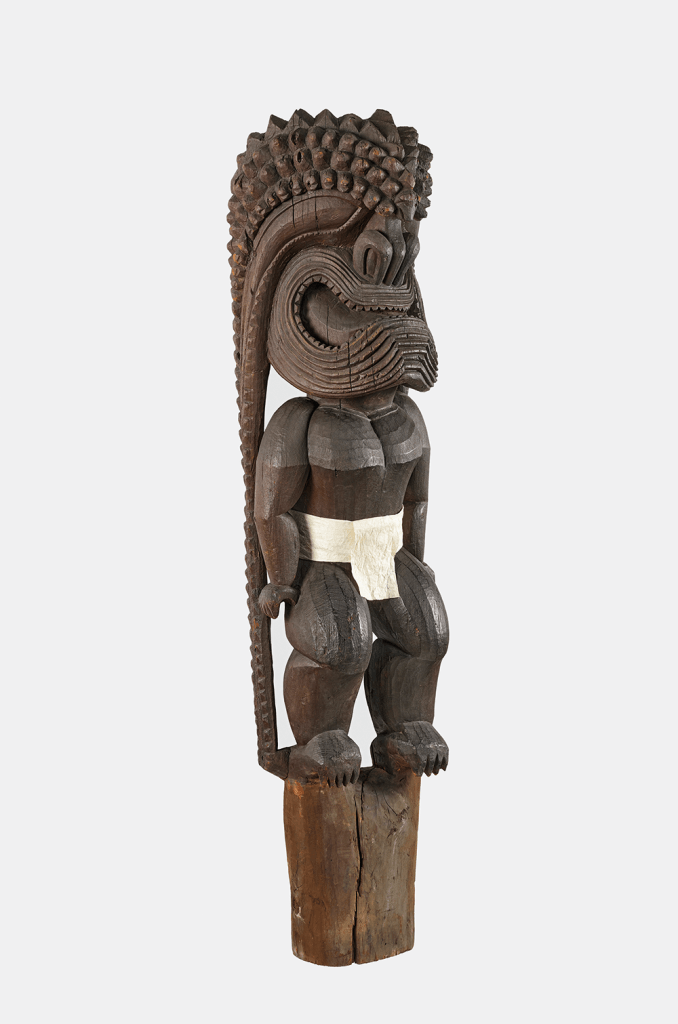 Statue of Ku, Hawaiian god of governance and war. © THE TRUSTEES OF THE BRITISH MUSEUM
Almost all the exhibits, however, come from the British Museum, which has the best such collection outside Hawaii. One feathered cape, or one roll of decorated barkcloth, would be impressive. Here there are 13 and ten of each, evocations of history and inspiration to modern designers. That they appear so pristine is partly accidental – they benefit from being hidden in store, unbothered by curious researchers, unexposed to bright lights and air pollution. As Noelle Kahanu writes in the catalogue, some exhibits, not least the entrance Ku, would not now exist at all but for colonial appropriations.
Some exhibits, not least the entrance Ku, would not now exist at all but for colonial appropriations
Kahanu, a Native Hawaiian curator and cultural champion, is a member of the Exhibition Stewardship Hui (or group); lead curator Alice Christophe, the museum’s head of Oceania, is a co-steward. Across the gallery are occasional texts from fellow co-workers. A wooden bowl, says Leah, is ‘a reconnection with an ancestor that carries our histories’. Addressing a displayed club that he made and gave to the museum, Umi tells us he ‘wanted to add a protective element’ for the feathered gods (looking at the sharks teeth, I think the gods have little to fear).
If this sounds a distraction from art and scholarship, it is the opposite. The compelling displays – captions do not judge – are but the public front of activity and research, transformed by cooperation across oceans and cultures.
The catalogue inventories the British Museum’s entire Hawaiian collection – 950 entries across 69 coloured pages. The institution’s other Pacific collections, barely seen since the Museum of Mankind closed in 1997, are as important. Perhaps the Western Range redevelopment will prompt new Pacific displays. Conversely, the Hawaii approach could bring new wonder to the Western Range, showcasing the sculptures, pots and inscriptions as much more than excavated fossils. Objects are not trapped in a moment of history. They involve us all, viewers and past handlers, makers and ancestors.
Got something to add? Join the discussion and comment below.
You might disagree with half of it, but you’ll enjoy reading all of it. Try your first month for free, then just $2 a week for the remainder of your first year.