In the aftermath of the Bondi massacre, the political response arrived with grim predictability.
Not clarity. Not naming. Not moral authority.
Infrastructure.
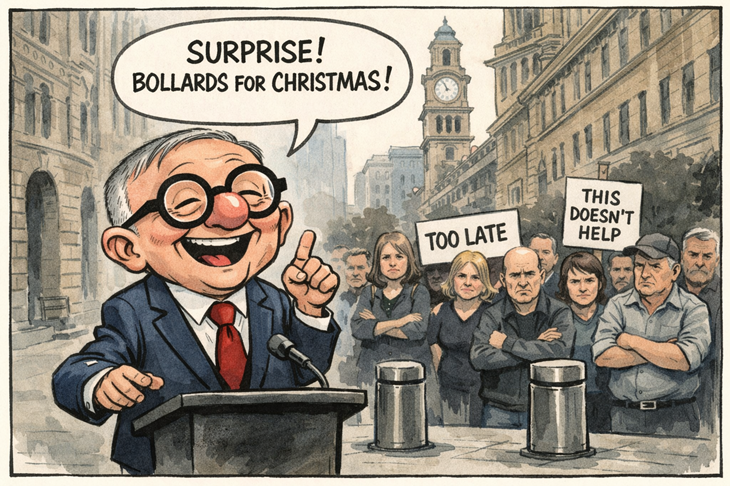
Bollards for Martin Place. Temporary barriers. Reassurance through street furniture.
It was offered as protection, but it functioned as something else entirely. A substitute for saying what had just happened, and why.
For days, Australians were told many things. We were reassured. We were urged to remain calm. We were reminded, repeatedly, that most Muslims are good people. What we were not told was the name of the ideology that had just acted. When it was finally acknowledged, it was wrapped in qualifying language. A ‘grotesque’ version. A distortion. An aberration. This was not clarity. It was evasion.
One of the earliest narrative moves after the attack was the elevation of a Muslim man who acted heroically during the chaos. His courage was real and deserves respect. But the insistence on foregrounding his faith was baffling. He was not a hero because he was Muslim. He was a hero because he acted. His religion is morally irrelevant to that fact. To emphasise it in the media was not an act of unity but of deflection.
It attempted to answer an accusation that had not been made.
No serious person believes Muslims are inherently bad people. Millions live peacefully, work productively, and raise families within Western societies. The repeated insistence on this point avoids the question that does matter. Whether Islam, as a system, contains elements that make it structurally unsuited to free and tolerant societies.
The political response followed a familiar pattern. Instead of confronting ideology, leaders reached for the language of disarmament and physical mitigation. The attacker did possess firearms. That fact is not disputed. But further disarming an already largely defenceless population would not have changed what happened. Weapons do not generate motive. They express one that already exists. If access were the explanation, the United States, with more firearms than people, would experience identical attacks in identical forms at identical frequency. It does not. Europe, with far stricter laws, has endured repeated Islamist attacks. Australia, with stricter laws again, has now joined that list. The variable is not access. It is belief.
Hardware is politically safe to blame because it is inert. Ideology is not. Objects do not accuse their critics of prejudice. Ideas do. When leaders cannot confront belief, they retreat into hardware. Bollards are easier to install than arguments. Steel is safer than speech.
Every civilisation has its failure modes. Christianity had them. Medieval Christianity fused belief and power, conscience and coercion. That fusion was shattered across centuries of war, reformation, and political struggle. Christianity survived modernity by withdrawing from governance. It accepted, however reluctantly, a separation between God and Caesar. Belief became voluntary. Law became secular. Violence was monopolised by the state.
As a result, Christianity today exists primarily as culture, memory, and moral inheritance. Its capacity to organise power has been domesticated by history.
Islam has not undergone that fracture.
Islam was founded as a unitary system in which belief, law, community, and political authority are fused. That fusion produces extraordinary cohesion when restrained, and extraordinary violence when unrestrained. Most of the time it lies dormant. Under conditions of grievance, weak authority, or ideological activation, it does not.
Moreover, Islam has a dark passenger.
Unlike Christianity, where antisemitism arose from historical prejudice and political corruption, man over theology, Islamic antisemitism is doctrinal. Canonical verses, reinforced by hadith and tradition, frame Jews as cursed, deceitful, enemies of God, or legitimate objects of violence under certain conditions. These texts are not marginal curiosities. They are part of the religious corpus. They do not need to be invented. They only need to be activated.
This does not mean Muslims are automatically antisemitic. It means antisemitism does not require theological defiance within Islam. It already exists as a resource.
That distinction matters. When Prime Minister Albanese described the attack as a ‘radical perversion’ of Islam, he was making a theological claim whether he intended to or not. He was asserting that the violence had no lineage within the belief system itself. That claim may be comforting, but it is not accurate.
Islamic governments understand this far better than Western liberals. When I lived in the Middle East, it was clear that Saudi Arabia, the United Arab Emirates, and others rule Islam aggressively. They license clerics. They police sermons. They criminalise extremist interpretation. They do this not out of prejudice, but because they understand what happens when religious authority escapes state control.
Western governments do the opposite. They moralise against their own authority. They outsource responsibility to ‘community leaders’. They punish clarity and reward euphemism. They insist on tolerance while refusing to insist on sovereignty. The result is not harmony but denial, followed by shock when violence breaks through it.
When leaders refuse to name ideology, they are not protecting social cohesion. They are denying the public an honest description of the problem they are being asked to live with. A society that cannot describe a threat cannot contain it.
Liberal societies are not sustained by goodwill alone. They depend on a hard settlement. Belief must be voluntary, law must be sovereign, and violence must belong to the state. Christianity became compatible with that settlement only after its coercive theology was broken by history. Islam has not yet undergone that separation.
Until it does, Western societies face a choice they refuse to acknowledge. Either they develop the authority and confidence to contain Islam as a governing doctrine, or they continue to pretend that tolerance can substitute for sovereignty. Pretence is not a long-term strategy.