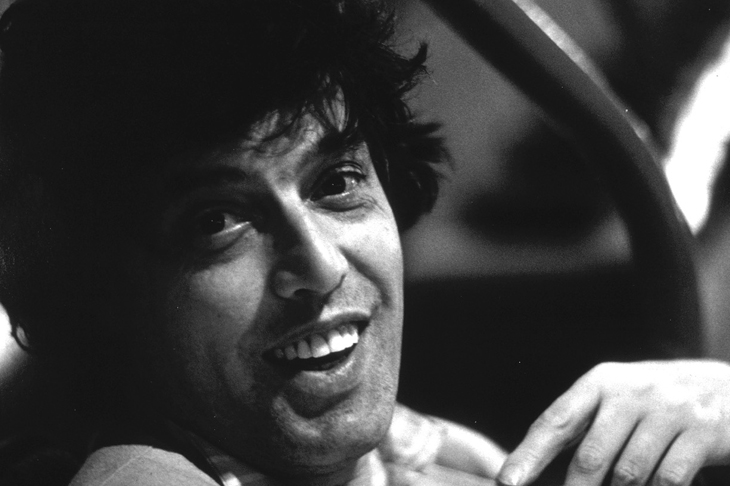
When Tom Stoppard, playwright extraordinaire, was at the early height of his fame, with Glenn Close and Jeremy Irons in The Real Thing directed by the great Mike Nichols, he was asked if he was Jewish. He replied, ‘Well, Jew-ish.’ His Czech-Jewish father had the prescience to get Tom and his mother to Britain via India and died in the process but his mother felt no identification with her Jewish background and married a chap called Stoppard who was British to his bootstraps. Tom was super-smart at school and looked destined for Oxbridge but the Bristol Old Vic in the days of Peter O’Toole’s regnancy beckoned to him and became his true university.
When Charles Wintour interviewed him for a London journalistic job and thought he’d ask him who the foreign secretary was Stoppard declared, ‘I said interested, not obsessed’.
Stoppard became famous with Rosencrantz and Guildenstern Are Dead, the play about the two bit players in Hamlet which is a fervent and strikingly successful attempt to emulate the Beckett of Waiting for Godot. The great Irish playwright said it was refreshing for once to be understood and not just copied.
Stoppard had blinding charm. The Real Thing led to Stoppard writing the script of Empire of the Sun, for Steven Spielberg’s film of the J.G. Ballard novel.
Stoppard effortlessly conquered Hollywood. He wrote Indiana Jones and the Last Crusade for Sean Connery and he won an Oscar for Shakespeare in Love. When he did the script for Philip Pullman’s The Golden Compass that anti-clerical mythmaker said it was uncanny that Stoppard could write dialogue which seemed to come from the novelist’s mind. He would no doubt have said he was a super hack but how he scintillated.
He wrote Arcadia for his sometime-beloved Felicity Kendall, which toys with anticipations of mathematics as well as a quest about the life of Byron and delighted everyone from John le Carré to Harold Pinter.
He was a good man as well as a mesmerising one. He said, ‘I try to act as if there’s a God. I don’t know where that leaves the question of faith.’ He prayed for all the women in his life – from Sinéad Cusack (Jeremy Iron’s wife) to Stoppard’s widow, Sabrina Guinness.
He wrote Night and Day with Diana Rigg at her most dazzling and John Thaw as an Australian journo in an imaginary African country that was proving nightmarish. The play was creepy to his fellow playwright David Hare though Stoppard argued that the fictional shading of the truth could have its sacred accuracy as an ultimate safeguard of liberty. He seems to have brought a passionate coherence to the dialectical play of his own intelligence without any very high opinion of its toing and froing. He said of the myth of his own intellectual powers, ‘The iceberg is all tip.’
He wrote Jumpers about the claims of logical positivism versus moral absolutism with Michael Hordern, that sage and underestimated actor, and early on he tried the patience of Laurence Olivier no less when he got all his name cards mixed up as he was reading a play out loud. Stoppard was some kind of Tory and he had a horror of dogmatic Marxism so that when he came to write Travesties in 1974, the play about James Joyce and the surrealist Tristan Tzara, he left the speeches of Lenin untouched because he wanted to show that the barbarism of Stalin was already there in the figure of Lenin, it was just that we chose to shade him more sympathetically.
Ken Tynan saw the nimbleness of Stoppard’s understatement as a kind of mask. He said it boiled down to ‘see how self-deprecating I can be and still be self-assertive.… Tom’s modesty is a form of egotism’.
It’s certainly the case that Stoppard’s talent can have the deepest kind of appeal to people who might not share his politics. Glyn Davis, the former secretary to the Australian prime minister, is a fan and interviewed Stoppard for the 2023 Adelaide Festival.
With Stoppard you have to allow for the sheer scope of his work. He is the most wide-ranging playwright since Shaw and it’s typical of him that he should have said sometimes his plays were ‘Shavian’ and sometimes they’re ‘Close Shavian’. But Stoppard had an instinctive sense of every kind of drama. He translated Schnitzler – and called one of the plays The Undiscovered Country, referencing Hamlet – and he translated Chekhov, he mastered every kind of theatre, every kind of scriptwriting.
Just think of the plays. There’s The Real Inspector Hound, the one-acter in which two critics get caught up in the action of the play they’re witnessing. There’s the shadowy but luminous The Invention of Love centred round the poet A.E. Housman with roles for Oscar Wilde and Frank Harris and an extraordinary reanimation of the Latin poetry Stoppard would have learned at school.
It was Robert Silvers of the New York Review of Books who put Stoppard in touch with Václav Havel and it was out of this that we got Rock and Roll. Then there are the plays where Stoppard strives to come to grips with his European and Jewish inheritance. Leopoldstadt in 2020 presents an elegiac archaeology of his family and before that there’s the The Coast of Utopia sequence – in which all the Romantic Exiles – Herzen and Belinsky and Turgenev among them – are captured like the patterns on a carpet that has a history. It’s dazzling stuff and so in extreme contrast is the long brilliant television script he wrote of Ford Madox Ford’s Parade’s End with Benedict Cumberbatch’s performance of genius as Tietjens.
Stoppard was wicketkeeper for that old lefty Dame Peggy Ashcroft who gave her last – quite magnificent – performance in his 1991 radio play In the Native State. He declared, ‘The strong argument is to behave decently before you do the arithmetic because the arithmetic is never going to be that bad. There’s a lot of space, money and goodwill in England.’ David Hare – so different in his luggage of opinions – said of this aspect of Stoppard, ‘That’s why I love this man. It so perfectly expresses the way he thinks.’
The earth is a poorer thing without Tom Stoppard. Fortunately he had the great good sense to get Hermione Lee to write his biography in 2020. It is written with brilliance, comprehensively and with great warmth.
Got something to add? Join the discussion and comment below.
You might disagree with half of it, but you’ll enjoy reading all of it. Try your first month for free, then just $2 a week for the remainder of your first year.