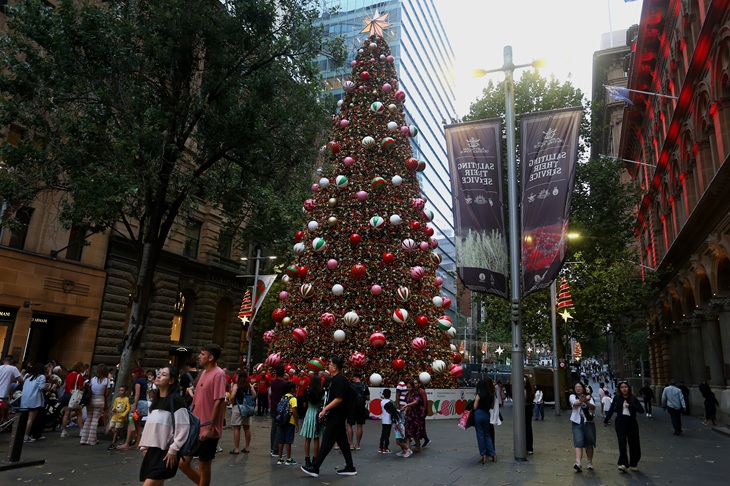
As an Iranian writer who has lived in Australia for nearly 11 years and has been collaborating with The Spectator Australia for about a year, I was invited at the end of the year to the magazine’s Christmas gathering for its writers. The event offered a chance to get to know other contributors more closely a small, warm, and diverse group where, unlike many new spaces I enter, I did not feel like a stranger. It felt as though I had known everyone for years. Many of them, like me, had experienced migration.
What stood out most was a shared spirit among the group. I sensed a common belief that a successful writer is someone who places diplomacy and politics not in opposition to aesthetics and ethics, but alongside them. In that colourful, thoughtful gathering, an unspoken dialogue flowed between cultures, experiences, and worldviews a quiet yet deep and lasting conversation. Even in that short time, I had exchanges that stayed with me long afterwards.
On my way home, my thoughts naturally turned to the Iranian community in Australia. A question took shape: Why has such a rich, diverse, and capable community not been taken seriously enough within the cultural and social dimensions of Iran-Australia relations? What follows is the result of that reflection.
In recent decades, relations between Iran and Australia have mostly been analysed through the lens of the Islamic Republic’s official politics, security concerns, and sanctions. While this reflects part of the reality, it pushes the human, cultural, and social layers of the relationship to the margins. Within this framework, the Iranian-Australian community can, and should, play a role beyond that of a migrant group, as a cultural and diplomatic asset.
Iranians in Australia are among the most educated and professionally accomplished migrant communities. Their strong presence in universities, medicine, engineering, technology, the arts, and entrepreneurship shows that they are not on the sidelines but fully part of Australia’s social and economic life. Yet in foreign policy thinking, this capacity is often ignored or viewed only through political and security lenses.
One of the core challenges in Iran-Australia relations is the lack of a nuanced, human understanding of Iran and its people in Australia’s public sphere. The dominant narrative reduces the complexity of Iranian society to official politics, and many people are unable to distinguish between Iran and its people and the Islamic Republic, which has occupied the country for 47 years. In this context, Iranian-Australians can act as cultural and intellectual intermediaries, people who understand Iran’s history, sensitivities, and social changes, while also knowing Australia’s language, values, and institutions.
This role fits within what is known as ‘informal diplomacy’: diplomacy that operates not through governments, but through universities, think tanks, cultural institutions, and human networks. Especially when official relations are limited or tense, such diplomacy can create space for gradual trust-building and realistic dialogue.
Ignoring this human capital will be costly for Australia in the long run. When a migrant community is seen only as a political or security issue, opportunities for constructive engagement are lost. By contrast, recognising the role of the Iranian-Australian community can lead to more accurate, humane, and informed decision-making.
As a multicultural country and a middle power, Australia has the capacity to adopt a more balanced and realistic approach toward the Iranian people one that clearly separates the nation and its citizens from the ruling structure of the Islamic Republic, and sees the Iranian-Australian community not as a political margin, but as part of the solution. Small but meaningful experiences in Australia’s cultural and intellectual spaces already show that such a path is not only possible, but necessary.
Ultimately, lasting relations between countries are built not only on treaties and statements, but on trust, dialogue, and human connections. If properly recognised and understood, the Iranian-Australian community can become one of the most effective cultural bridges between a free Iran of the future and Australia a bridge grounded in ethics, aesthetics, and mutual understanding, rather than solely in political rules shaped by events after 1979. Such a bridge could even pave the way for new, practical policies: lower-cost, less confrontational, and free from cycles of tension.
By Leila Naseri: Author | Composer | Social Cultural Activist