Krill – the small, shrimp-like crustacean – is a keystone species. It underpins the marine ecosystem of the Southern Ocean, where it is estimated that between 300 and 500 million tonnes of them live. They are consumed by marine animals, including whales, seals and penguins, as well as fish and squid. But is krill now at risk of being overfished? And are the warnings of conservationists being ignored by countries more interested in making a quick profit?
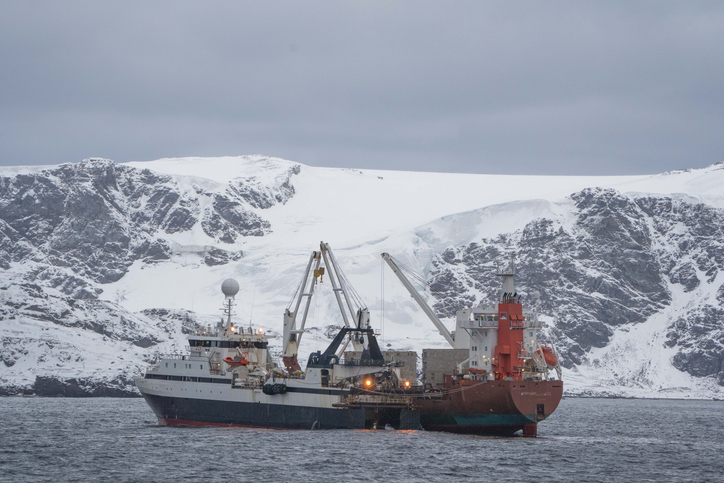
Nowadays, krill features in dietary supplements, livestock food and pet food. It is also processed to produce fish food for use in aquariums and aquacultures. The global krill industry was valued at well over $1 billion (£750 million) last year and is forecast to grow in the next five years to around $2.5 to 3 billion (£1.9 to £2.3 billion). Antarctic krill is also increasingly being used in cosmetics and skincare. Norway’s Aker BioMarine company dominates krill harvesting and was last year responsible for around 70 per cent of the Southern Ocean catch. China came in at a distant second with around 17 per cent and South Korea at 8 per cent.
Krill underpins the marine ecosystem of the Southern Ocean
Several decades ago, the USSR drove krill harvesting in the belief that it might act as a profitable new source of protein at a time when fears were rampant about overpopulation in the global south. In the early 1980s, 500,000 tonnes of krill were harvested annually but a decline set in as it proved unappetising to human consumers. China’s first forays into Antarctica began in the 1980s as well, just as fishing and mining were becoming more prominent points of discussion in the Antarctic Treaty System – the body that regulates and governs the polar continent and surrounding ocean.
Every year, interested parties gather in Hobart, Australia to consider annual catch limits for krill and fish species. The aim of these interested parties is to uphold the principles and rules attached to the Convention for the Conservation of Antarctic Marine Living Resources (CCAMLR), which is part of the Antarctic Treaty System. Negotiated in the late 1970s and active since 1982, it seeks to adjudicate between those who wish to exploit the Southern Ocean and those who wish to ensure that the pursuit of marine conservation is prioritised.
A precautionary and ecosystem approach is enshrined in the convention – including a commitment to expanding marine protection areas (MPA) in the Antarctic. But all of that has been placed under increasing pressure by countries such as China, which has sought to expand its fishing industry around the world. As such, CCAMLR parties always manage to set annual catch allocations every time they gather – despite failing to make much progress on MPA negotiations.
Fishing in Antarctica has often seen geopolitical and economic incentives challenge and at times undermine the work of marine scientists and conservationists dedicated to combating illegal, unregulated and unreported (IUU) fishing. In the 1990s, IUU fishing for toothfish around the Southern Ocean proved particularly challenging, with evidence that criminal gangs and third-party ports were enabling a lucrative trade.
While efforts to dampen down that activity were largely successful, the emergence of China, South Korea, Ukraine and Norway as sizeable fishing stakeholders placed fresh pressures on CCAMLR’s conservation ethos. A tension arose between those who wanted to exploit the waters for commercial profit and those who were inclined to restrict fishing for the sake of protecting marine biodiversity. Where krill is currently fished around the Antarctic Peninsula is the same area that conservationists are convinced needs further protection in the form of an extensive MPA.
In the aftermath of this year’s CCAMLR meeting in October, conservationists and environmental organisations voiced their dismay that there has been no further agreement to expand MPAs in the Southern Ocean. The intention was always to establish a wider network of up to five such areas, where fishing would either be banned or highly restricted. But progress on this is dependent on reaching consensus amongst the parties of the convention – all 26 member states plus the EU. China and Russia have been blamed for some years now for blocking any expansion in MPAs: one sticking point has been their concerns about the imposition of restrictions on krill harvesting around the Antarctic Peninsula.
Until last year, despite being the largest polar operator, the United States was not involved in Southern Ocean commercial fishing. This was considered helpful by conservationists because it meant that the US could show leadership in marine conservation. It was, for example, able to champion the Ross Sea MPA back in 2016 after four years of intense negotiations with other CCAMLR parties.
But in the last twelve months something important has changed. Norway’s Aker BioMarine’s feed ingredients subsidiary – which sells krill meal that is used in commercial aquaculture – was acquired by an American private equity company. The renamed Aker Qrill Company will be run by a Norwegian-US entity, with three purpose-based harvesting and processing ships and a shoreside operating centre in Uruguay. The US now, for the first time, joins the list of Southern Ocean fishing nations and this might move away from historic support for MPAs.
This year, the UK acted as chair of the commission of CCAMLR – and has done so against an awkward backdrop. At last year’s meeting, Britain was blamed by scientists and conservationists for the impasse over krill fishing and the lack of progress on further MPAs. Attempts to harmonise krill fishing with marine protection fractured. In the past, krill harvesting was carried out in four sub-areas of the peninsula, but now there are no longer any spatial restrictions. China and Russia remain suspicious of MPA expansion and sceptical of how historic claimant states, including the UK, are eager to exploit fish around their territories, such as South Georgia (to the north of Antarctica), while restricting the right of others to fish around the Antarctic Peninsula.
The deadlock over these marine protections is now approaching a decade, reaching further back than the current tensions between Europe, Russia and China. Oslo, rather than Beijing, wants to expand the krill catch limit beyond 620,000 tonnes to over 1 million tonnes. Norway might prove critical in brokering a longer-term resolution to how commercial fishing and ocean conservation rub up alongside one another.
Breaking the deadlock will almost certainly require advocates of marine conservation to accept that commercial krill harvesting is a lucrative niche market that is not going to be derailed by emotive appeals to save penguins, whales and seals. The conservationists better hope that President Trump in the meantime does not add krill to his list of objects that he wishes to secure resource and energy dominance in.