‘That is no country for old men,’ wrote W.B. Yeats, turning his gaze toward Byzantium as a symbol of civilisational order, continuity, and meaning.
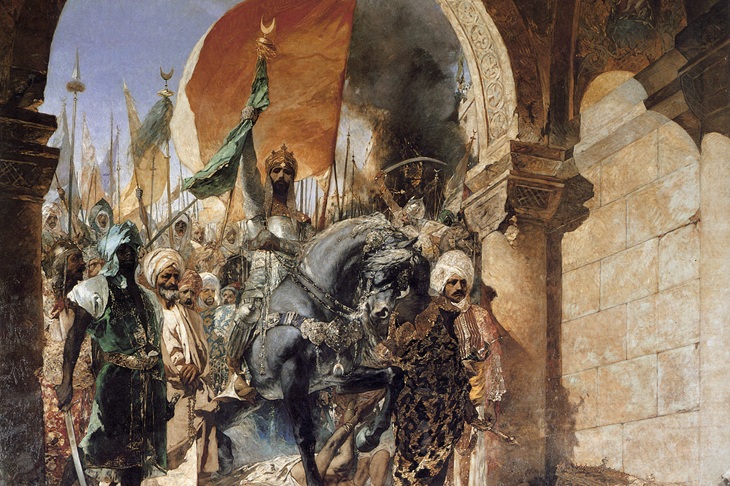
For more than a thousand years, Constantinople stood as the capital of the Eastern Roman Empire and the spiritual centre of Eastern Christendom – a place where sovereignty, law, and faith were fused into a coherent civilisational structure. When the city fell in 1453, it was not merely the conquest of a metropolis. It was the replacement of an entire political and moral order.
The Ottoman capture of Constantinople followed a familiar pre-modern pattern of conquest. Large numbers of civilians were enslaved. Religious institutions were subordinated to the new sovereign law. Hagia Sophia was converted into a mosque within days. Christians and Jews were permitted to remain, but only as legally inferior subjects – protected, taxed, and excluded from political authority. What endured was not extermination but hierarchy; not annihilation but subordination. The city itself survived, but its civilisational role did not.
That outcome was not unique. Where Islamic conquest succeeded politically, it tended to alter the civilisational character of territories in lasting ways. Anatolia, once the heartland of Byzantine Christianity, became permanently Islamic after centuries of Seljuk and Ottoman rule. The Levant and North Africa – once centres of Greco-Roman culture and early Christianity – were transformed through conquest into Islamic societies that remain so today. Persia retained its language and much of its culture, but sovereignty and law were reshaped within an Islamic framework. By contrast, where conquest was later reversed – as in Spain after the Reconquista or parts of Eastern Europe after Ottoman retreat – the earlier civilisational structures reasserted themselves. The pattern is not one of genocide, but of replacement: sovereignty changes, law changes, and over time, identity follows.
Europe grasped this reality too late for Byzantium, but not for Vienna. In 1683, the Ottoman siege of the Habsburg capital forced a moment of recognition. What was at stake was not a border adjustment or a diplomatic compromise, but the future character of a civilisation. The relief of Vienna, led by King John III Sobieski of Poland, succeeded because Europe briefly understood what it was defending. The lesson was not triumphalism; it was clarity. Civilisations endure when they recognise existential challenges in time and act accordingly.
Modern Israel stands apart in this historical record. Reestablished as a sovereign Jewish state in the heart of the Middle East, it has faced sustained efforts – military, political, and ideological – not at coexistence but at reversal. Those efforts have included repeated campaigns of terrorism deliberately targeting civilians: suicide bombings, rocket attacks on population centres, mass-casualty assaults, and hostage-taking aimed not at territorial compromise but at eroding civilian life itself.
This pattern has persisted despite repeated Israeli withdrawals, territorial concessions, and diplomatic initiatives – demonstrating that appeasement has failed to alter underlying objectives or attitudes. Israel’s persistence has not depended on imperial ambition or demographic dominance, but on the insistence that sovereignty, law, and cultural continuity are non-negotiable. Where other societies hesitated or fractured under pressure, Israel treated defence not as aggression but as the precondition for coexistence.
The West today struggles to absorb this lesson, not because history is unknown, but because confidence in inherited norms has waned. In place of shared civic expectations, slogans have taken root – assertions that diversity alone guarantees cohesion, or that coexistence requires no reciprocity. These ideas function as articles of faith rather than tested principles. They ask societies to suspend judgment about the conditions under which pluralism actually works.
This intellectual surrender was diagnosed long ago. Writing in the aftermath of totalitarian conquest, the Polish poet Czesław Miłosz warned of the ‘captive mind’ – the tendency of educated elites to internalise ideas they privately know to be false, mistaking conformity for virtue and denial for wisdom. Once this mental captivity sets in, the defence of inherited institutions is recast as intolerance, while the refusal to draw boundaries is praised as moral progress. Civilisations weakened in this way are rarely conquered outright; they are persuaded to abandon their own criteria for truth first.
History does not suggest that coexistence is impossible. It suggests something more demanding: coexistence requires clarity, reciprocity, and the enforcement of common rules. Where sovereignty is defended and law is supreme, pluralism can endure. Where authority is ambiguous and confidence collapses, pressure fills the vacuum.
Yeats looked to Byzantium as a place where civilisation knew itself well enough to endure. The fall of Constantinople showed what happens when sovereignty is lost. Vienna showed what happens when it is recognised in time. Israel shows that resistance can still break the pattern. The question facing the modern West is not whether history will repeat itself, but whether it will be remembered soon enough to matter.
Aaron J. Shuster is an award-winning cinematist, writer, and analyst whose work explores history, sovereignty, and the civilisational forces shaping modern conflict.