What exactly is the ‘platinum security guarantee’ that Donald Trump is pushing Volodimir Zelensky to accept? While the full details remain confidential, the deal is described as an ‘Article 5 style’ guarantee after the clause in Nato’s charter that states that ‘an armed attack against one Nato member shall be considered an attack against all members’ and triggers ‘an obligation for each member to come to its assistance.’
Sounds reassuring. Except that little weasel word ‘style’ covers an abyss of real-world back-pedalling and caveats. For a start, Nato’s charter does not oblige members to actually take military action if one is attacked but instead leaves that decision to individual states. The ‘assistance’ required by Article Five ‘may or may not involve the use of armed force’ and can include instead ‘any action that Allies deem necessary to restore and maintain the security of the North Atlantic area.’ Whatever Trump’s ‘platinum’ guarantee may be, it will be less binding even than that.
The Europeans are arguing for a world as they would like it to be, while their US counterparts are dealing with the world as it is
At base, a credible security guarantee – formerly known as an alliance – means a promise to go to war to protect an ally. The Anglo-Polish Treaty of March 1939 that committed Great Britain to go to war to defend Poland from Nazi aggression was such a guarantee. So was the 1839 Treaty of London, which obliged us to defend plucky little Belgium when Germany violated its borders in 1914 – a national word of honour redeemed by the deaths of 880,000 Britons. By contrast the 1994 Budapest Memorandum in which the US, Britain, France and Russia guaranteed the borders of Ukraine turned out to be a dead letter when one of its original signatories – Vladimir Putin – blithely ignored it by annexing Crimea in 2014.
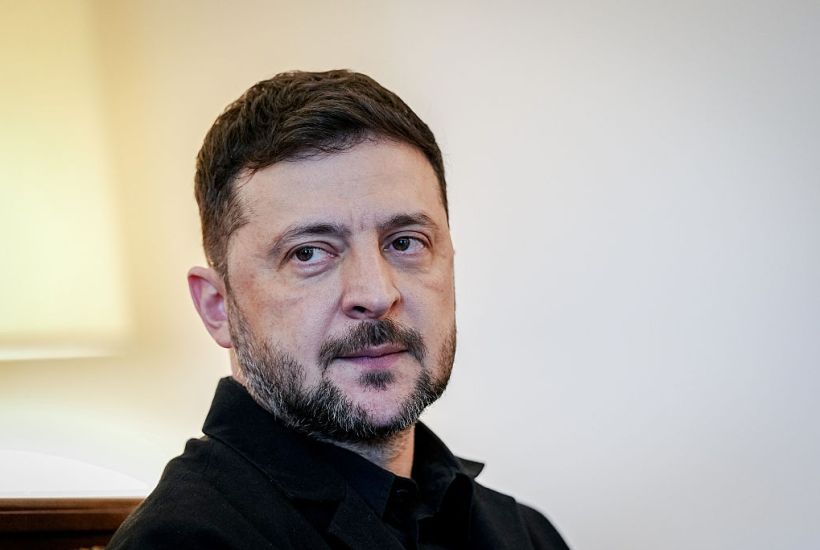
Understandably, Zelensky is wary of trusting his country’s future security to another useless piece of paper. The ‘platinum’ guarantee now under discussion has been hashed out over two days of meetings in Berlin this week between Zelensky, US peace envoy Steve Witkoff, and Jared Kushner, Trump’s son-in-law. ‘We have now heard from the US side that they are ready to give us security guarantees that correspond to Article 5,’ Zelensky announced. But the Ukrainians have also insisted that any US guarantee be passed by Congress, giving it the force of an international treaty.
In recent weeks top European military leaders have taken to warning that Western society must prepare for war. France must prepare to ‘lose its children’ in a potential conflict with Russia, warned Army chief of staff General Fabien Mandon in November, while this week Chief of Britain’s Defence Staff Air Chief Marshal Sir Richard Knighton said that the UK’s ‘sons and daughters’ need to be ready to fight a growing Russian threat. Germany’s Chancellor Friedrich Merz declared this week that Putin was intent on ‘restoring the Soviet Union’ and compared him to Hitler.
But for all that heady rhetoric we can be sure of one thing – the security guarantees offered to Zelensky will not commit the West to go to war over Ukraine. Indeed ‘platinum’, in this case, seems to be a term drawn from the world of the real estate hustle rather than diplomacy and means, in translation, ‘kinda’.
Stlil, there is strong evidence that the US vision of security guarantees is more robust than anything envisioned by Europe. Take, for example, a ten-point document circulated this week by the German government. This German blueprint for a ‘security guarantee’ for Kyiv starts with establishing ‘regular high-level consultations between the defence ministries on armaments policy,’ creating a liaison office in Berlin for the Ukrainian arms industry, and ‘strengthening the staff of the military attache at the German Embassy in Kyiv.’ It also proposes to ‘expand the joint development and production of defence equipment’ and introduce ‘investment guarantees to promote the involvement of German arms companies in Ukraine.’ The one clause in Berlin’s ten point plan that touches on military operations is a proposal to use Ukraine’s ‘digital battlefield data and insights’ to improve German weapons ‘in the defensive battle against Russia.’
Otto von Bismark, founder of modern Germany, remarked that ‘the great questions of the day will not be settled by means of speeches and majority decisions but by iron and blood.’ Add ‘money’ for a modern update of that formula. In practice, though, the Europeans are not willing or able to provide Ukraine with sufficient equipment, cash or manpower to achieve a military victory over Russia.
That hard reality leads to three fundamental weaknesses in Europe’s current position. First, both Zelensky and his European allies seem to believe that they are negotiating final peace terms with Trump – whereas the final word rests with Putin, who will likely reject any Article Five style security guarantee out of hand, let alone the kind of ‘assurance force’ that the Europeans still insist on talking about. Second, Europe seems simultaneously to believe that Russia is on the edge of military and economic collapse if only Ukraine fights on a little longer – but is also somehow also so powerful that Europe should fear a literal invasion in the near future. Both those things cannot be true at the same time. Third, the Europeans seem to have no conception that time may not be on Ukraine’s side. On the ground, Russian missile and drone attacks this week have successfully knocked out power to the cities of Odesa and Sumy for days, while corruption scandals are steadily weakening Zelensky’s credibility and the army faces a serious crisis in recruitment.
At base, the Europeans are arguing for a world as they would like it to be, while their US counterparts are dealing with the world as it is. ‘Now is the time for peace,’ Chancellor Merz said this week. But of Ukraine’s allies it’s the Americans who are actually talking about ending the war by Christmas while Europe continues to look for ways to fund Ukraine’s war effort for at least another two years. As Bismark observed, ‘politics is the art of the possible, the attainable, the art of the next best.’ And when it comes to security guarantees, the best possible is going to be a formula acceptable not just to Ukraine, Europe and the US but ultimately to the Kremlin too. Anyone who disagrees can go to war with Russia, defeat Putin, and impose terms. Any takers?