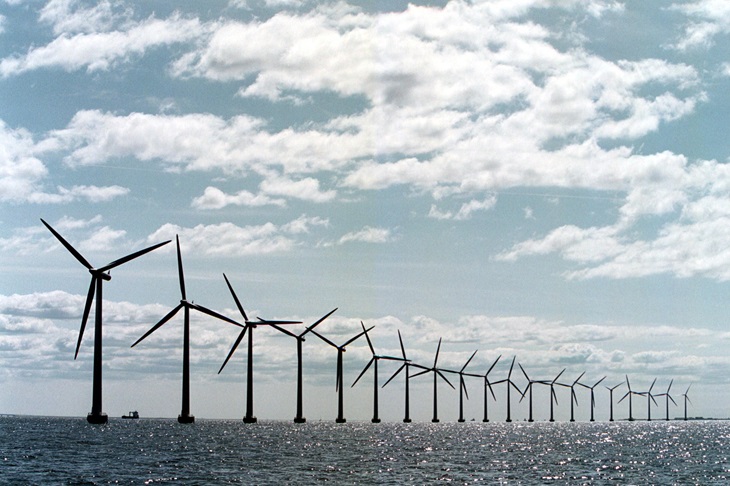
For years, offshore wind has been presented as a narrow climate and energy question – a matter of emissions targets, megawatts and project timelines. That framing is now outdated.
Across the United States and Europe, offshore wind is increasingly being reassessed through a very different lens: national security. Defence agencies, intelligence officials and cybersecurity experts are intervening. Projects are being paused, cancelled, or sent back for review. Financial markets are responding accordingly.
In the United States, a pause on offshore wind construction triggered an immediate market reaction. Shares in Ørsted, the world’s largest offshore wind developer, fell more than 14 per cent in a single session, wiping billions of dollars off its market value. This was not a protest vote against renewable energy. It was a reassessment of strategic risk.
The reasons are becoming clearer.
Military and intelligence agencies in countries such as Sweden and Germany have warned that offshore wind infrastructure can interfere with radar systems, naval operations and maritime surveillance. Sweden went as far as cancelling 13 offshore wind projects after its armed forces concluded the risks were unacceptable. Germany has raised security concerns about Chinese-manufactured turbines operating near Nato waters and critical infrastructure.
Cybersecurity experts are also sounding the alarm. Offshore wind farms are highly digitised, remotely monitored and dependent on complex software systems. Industry bodies and maritime analysts have warned these installations represent cyber-vulnerable critical infrastructure – infrastructure that, if disrupted, could simultaneously affect ports, power grids and maritime operations.
This is the international context Australia now finds itself in.
Despite these developments, the federal government has indicated offshore wind will still proceed in Australia, including in Victoria, Tasmania, Western Australia, the Illawarra, and the Hunter. That places Australia on a divergent path from key allies, many of whom are slowing down to reassess risks before locking in long-dated and largely irreversible infrastructure.
Nowhere is this tension more visible than on the NSW coastline.
Proposed offshore wind zones intersect with Port Kembla and the Port of Newcastle – two of the most critical ports on Australia’s east coast.
Port Kembla is not just another industrial harbour. It is home to Australia’s largest steelworks, underpinning sovereign steelmaking and defence supply chains. It hosts Australia’s second-largest grain export terminal, central to food security. It is also the site of Squadron’s proposed gas import terminal, expected to supply almost all of NSW’s gas needs, with direct implications for electricity generation, industry and households. Longer term, Port Kembla is slated to become NSW’s second container terminal as Port Botany reaches capacity.
Newcastle is equally strategic. It is Australia’s largest coal export port, a cornerstone of export revenue and energy markets. It sits astride major shipping lanes and logistics infrastructure and is surrounded by energy, industrial and defence-adjacent assets across the Hunter region.
These are not peripheral assets. They are critical national infrastructure, where disruption, surveillance exposure or cyber intrusion would have system-wide consequences for NSW and the national economy.
Overlay defence considerations and the picture sharpens further.
Both the Illawarra and Hunter coastlines have featured in defence and strategic planning discussions in recent years, including in the context of Aukus and consideration of potential east-coast submarine basing and support infrastructure for nuclear-powered submarines. Submarine and naval operations require unobstructed maritime access, secure seabed conditions, and tightly controlled electromagnetic and acoustic environments. These are not optional preferences – they are operational requirements.
These concerns are not hypothetical. They have been raised formally in Australia.
In a parliamentary submission, former Shadow Defence Minister Andrew Hastie warned offshore wind proposals raise ‘significant concerns regarding Australia’s sovereignty and national security’. He argued such projects require ‘significant and careful consideration of the broader geopolitical and strategic implications’ and that it would be ‘prudent to consult with Australia’s Aukus partners, the US and UK’.
Hastie also issued a warning Australia would do well to heed: ‘Europe has learned the hard lesson of dependency on Russian gas. We would be foolish not to heed it, and risk the lights going out in a strategic crisis.’
The lesson from overseas is not that offshore wind should never be built. It is that location matters, supply chains matter, cybersecurity matters, and defence considerations matter.
Energy policy cannot be developed in isolation from national security, industrial policy, and strategic infrastructure planning. When offshore wind zones are proposed adjacent to ports that host steelworks, grain terminals, gas import facilities, and potential naval infrastructure, the threshold for scrutiny must be higher – not lower.
Australia’s allies are pausing to ask hard questions before proceeding. Markets are responding to that shift. The question now is whether Australia will do the same – or whether we will charge ahead and assume risks identified elsewhere somehow do not apply here.
Offshore wind may still have a role to play in Australia’s long-term energy mix if it becomes cost-competitive. But pretending it is only an energy issue is no longer credible. It is a national security question, and it deserves to be treated as such.
By Alex O’Brien, President, Responsible Future Illawarra