The Australian centre-right does not really understand the pro-worker national conservatism which has been so electorally successful in the United States and other Western democracies. My friend Louise Clegg’s recent piece criticising the NatCons unfortunately provides further evidence that this is indeed the case.
Clegg claims to have researched the ‘national conservative’ and ‘post liberal’ movement and done a ‘careful consideration of its origins and objectives’. But there are obvious gaps in her understanding and no real evidence she has engaged with the key thinkers. The only modern academic cited is a new and relatively unknown one called Laura Fields (who I note has pronouns in her LinkedIn bio). She is described as ‘genuine conservative’.
Ignored are far more prominent and substantial Anglo-American authors such as Patrick Deneen, Oren Cass, Yoram Hazony, Phillip Blond, R.R. Reno, Michael Lind, Danny Kruger, Nick Timothy, and James Orr to mention but a few. Some call themselves ‘national conservative’ and some do not. But all are united in their criticism of the type of political liberalism which has dominated Western democracies, like Australia, in recent times.
Clegg dismisses this entire movement as ‘a fad’ and a ‘shiny new import from an American subculture’ and says it ‘does not grow out of the Anglo-liberal conservative tradition that shaped Australia’s centre-right’.
But as Yoram Hazony, one of the main leaders of the NatCons, explains in his excellent book Conservatism: A Rediscovery this is the exact opposite of the truth. Indeed, what we are talking about when we refer to ‘national conservativism’ is essentially traditional Anglo-American political conservatism which has roots deep in English history going as far back to people like John Fortescue, Richard Hooker, and John Selden.
The key error that Clegg and much of Howard era right make is to equate conservatism with ‘classical liberalism’. But they are not the same thing at all. Sometimes I wonder what they think Gladstone, leader of the British Liberal Party, and Benjamin Disraeli, leader of the Conservatives, were arguing about in the great British parliamentary debates of the 19th Century.
Clegg recognises the admiration the NatCons have for Disraeli but labels him as ‘tosser’ and ‘not conservative’. This is unserious and belies a lack of familiarity with the man and his thinking. It also directly contradicts her argument that this is all somehow just a recent American phenomenon.
Like many, she also misunderstands that while the party Robert Menzies established used the name ‘liberal’ it looked predominantly to the ‘enlightened nationalism’ of Alfred Deakin as a model, not the liberalism of Gladstone. This is why our leaders at Federation, and Menzies himself, consistently took positions on key issues like trade and immigration which were the opposite of what 19th Century liberals believed. Other great leaders like Alexander Hamilton across the Anglosphere did that same.
Clegg claims she wants to avoid abstract ideology although her article is full of well-worn references to Burke and Mill. Yet she almost completely avoids answering key contemporary policy questions.
She rejects, above all, any reassessment of our open-borders trade policy. But does she really think that continuing to allow 100 per cent of manufactured goods from China and other nations into Australia duty free is a good idea?
Menzies was in favour of tariffs even on British goods to preserve an independent manufacturing base for Australia. He would have thought our current agreements with Beijing and others deeply unwise.
Similarly, does Clegg really think the endless foreign policy liberal interventionism and the ‘forever wars’ of the last 30+ years have yielded positive results? Are there no lessons that can be learned from the age of George W Bush? Or should we continue in the same manner and send ADF troops to patrol the streets of Donetsk, like Tony Abbott argues we should?
Does she really think simply returning to the Howard-era levels of mass immigration is sufficient when centre-right counterparts in the UK and US are talking about net zero or even negative migration? Does not the cultural transformation of our society which has occurred point to some conceptual flaws in the thinking of previous centre-right governments across the West?
We united on the many ills that we face but differ on the key causes and what should be done about them.
What Clegg fails to appreciate – but if she read more Disraeli she would – is that the liberalism she espouses is in a large part responsible for destroying our institutions and the unravelling of our society. ‘The tone and tendency of liberalism,’ Dizzy recognised early on, ‘is to attack the institutions of the country in the name of reform and to make war on the manner and customs of the people under the pretext of progress.’ This is how we ultimately ended up with men in women’s bathrooms.
Liberalism also tends to delegitimise any action taken which might preference our own nation and people. This part explains Clegg’s instinctive objection to the ‘thumping new politics of national identity, cultural identity, masculine identity, religious identity’. But nations are more than a bundle of liberal axioms and taking steps to preserve the character of your country is not the same thing as Marxist identity politics, as she argues.
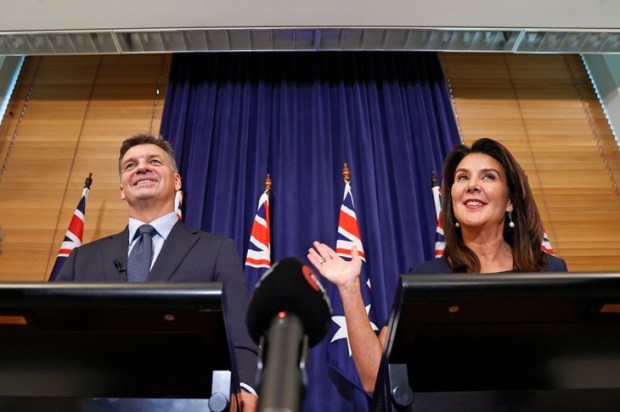
Clegg is, of course, her own person individually and professionally and I respect that. But it is not completely irrelevant that she is also Angus Taylor’s wife. I can’t help but feel her attack on national conservative movement is part of a proxy battle for an upcoming leadership contest between her husband and Andrew Hastie – someone who does seem to better understand the new right.
Rather than dismiss or delegitimise the national conservative movement, the wiser path I would have thought for any leadership aspirant would be to learn from them. As has occurred elsewhere in the world, this new thinking points the way for renewal and future electoral success.
Dan Ryan is Executive Director of the National Conservative Institute of Australia