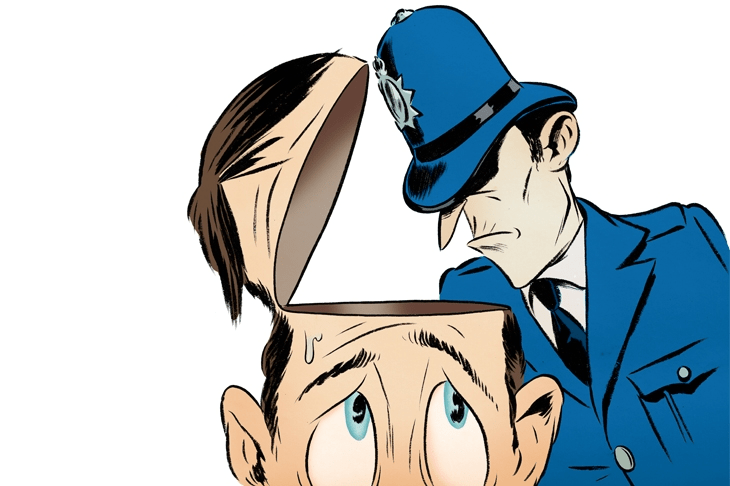
Roll up for a Christmas surprise on the policing front. According to a leak from the College of Policing to the Telegraph, since confirmed by its chairman and in all likelihood condoned by a government desperate for an upbeat Christmas message, non-crime hate incidents are finally to go. Next month the College and the National Police Chiefs’ Council will formally announce a move to a more selective, and less intrusive, practice. Recording will be limited to a much smaller category indicating clear risks of harm or threats to particular communities, such as anti-Semitism.
There is something deeply sinister about the state formally recording that a citizen has said something entirely lawful of which the state disapproves
To remind you, non-crime hate incidents (NCHIs) involve statements or writings by individuals that do not themselves amount to crimes but are seen as signs of animus on the basis of race, sex, religion or a number of other characteristics. Under the present system they are formally added to individuals’ criminal records, may be made the subject of police visits, and appear on the enhanced work checks required by many seeking to work with the vulnerable.
The difficulties they cause are legion. There is no requirement of actual hatred, merely a perception of it by a third party. Despite calls in 2023 to limit them to serious incidents there have been continuous reports since of their use in respect of trivial matters such as playground insults. And, because of their appearance on disclosure checks, they can seriously blight employment prospects. They have also alarmingly compromised free speech when public figures with awkward views have been made subject to them. In any case there is something sinister about the state formally recording that a citizen has said something entirely lawful of which the state disapproves.
There is much genuine good news in the new plan. The police ought long ago to have ceased recording, and still worse acting on, matters that often prove to be either the product of an over-sensitive imagination, or mere low-level writings online. Moving these recordings from criminal records to general intelligence, which is planned, is also overdue. Indeed, there is even the additional prospect of freeing up some valuable police time for more pressing matters.
Furthermore, although the leak has come from the College of Policing, a theoretically independent body, it is a racing certainty that the scheme has government backing. Home Secretary Shabana Mahmood is we are told supportive, which also means that No. 10 must have signed off on it.
This is significant. For one thing, it shows a change of mind at the highest level. As recently as last January a leaked Home Office report indicated that then-Home Secretary Yvette Cooper saw no problem with NCHIs. Cooper felt, if anything, that the system should be not so much scrapped as extended. How things change.
For another, we also seem to be witnessing a deeper change in thinking. The original justification for the NCHI system was the 1999 Stephen Lawrence inquiry report from Lord Macpherson. It insisted that because ‘institutional racism’ permeated our institutions there had to be full formal recording of all indications of possible racism with no distinction drawn between lawful and other speech. For some years this chilling and thoroughly illiberal attitude was regarded as gospel among the left. That it is now in retreat even within a Labour government is a very hopeful sign.
At least two cheers, therefore. Nevertheless, we still need a bit of caution. For one thing, one suspects that the new rules have been largely forced on a less-than-enthusiastic police establishment. The reforms show signs of having been driven by Shabana Mahmood, a clever and sensible Home Secretary with a commendable instinct for liberty, and also by the threat of legislative action in the House of Lords. (Lord Young of the Free Speech Union a couple of months ago promised, with some support, to introduce an amendment to the Crime and Policing Bill to ban NCHIs entirely.) It could well be that police chiefs wanted to retain what wiggle-room they had when it came to recording hate incidents, saw this as the least-worst option, and will now do their best to prevent real change.
And, of course, it’s all very well to promise only to record matters engendering clear risks of harm or threats to particular communities. But the devil is in the detail: where will the line be drawn? We shall have to wait and see how all this works out in practice, and whether we may go back to NCHIs in all but name. The signs are hopeful, but don’t cheer too loudly yet. The proof of this Christmas pudding is, as they say, very much in the eating.