For decades, Australian perceptions have been ‘enriched’ by new ideas brought from the humanities in US elite universities, associated popular campaigns, critiques of Western history, and perspectives that come with migration.
All of it has been good. Except for the parts which are not.
In particular, the concept of equal treatment of all citizens has been systematically undermined. Jewish people have the right to expect equal treatment everywhere they go in Australia and are not receiving it.
First of all, the hatreds of foreign hotspots have been brought to our streets by migration.
To say these antisemitic problems have nothing to do with migration is, unfortunately, an attempt to conceal a truth which is uncomfortable for liberal society.
Secondly, a new belligerent approach has been adopted toward policy arguments. This approach tolerates no deviation from the moral course set by progressive opinion.
The result of these two factors is that antisemitism has been the main neglected human rights problem in Australia since at least October 9, 2023, when demonstrators chanted vile and threatening slogans outside the Sydney Opera House. Jewish people have not been listened to.
Our institutions and national human rights statements have shown none of the strength and leadership needed to stop antisemitism.
Our government has not provided the strength and leadership needed, with NSW an arguable exception.
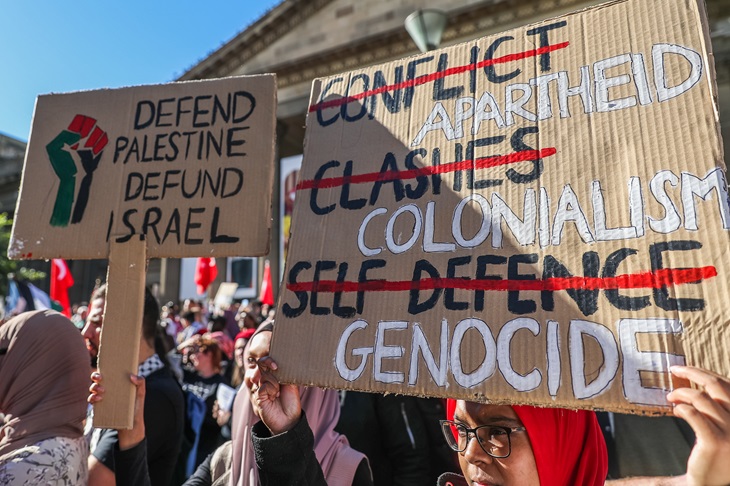
Vile slogans have been tolerated in weekly demonstrations which have made the centre of our cities ‘no-go’ zones for families and Jewish people. I personally know one person who was physically assaulted.
Our universities have become threatening places for Jewish people, not places for reasoned debate and education about the complex issues. Complexity has too often been replaced by belligerent intolerance.
This must surely be a key test for our national government. Now that the problem has become obvious to all, even those who strongly wish to avoid such a conclusion, the government must stand or fall on the national leadership it provides.
If it does not act, then this is a time when Australian fundamentally changes its character, and unequal treatment of citizens becomes the Australian character.
This would be a change for the worse in every way and is utterly intolerable.
The signs have been obvious for some time. Support for unequal treatment of citizens has grown, based on a raft of mistaken ideas and concepts.
While our own civilisational values and historical traditions are subject to what Stuart MacIntyre called ‘merciless’ scrutiny, tribal traditions and non-Western traditions are not. Instead, they are rigorously ‘respected’. One writer said, for example, ‘it is doubtful’ that our 1850s constitution drafters knew that they were giving the vote to all men regardless of race.
In fact, it is not doubtful, because Aboriginal people and other races were discussed.
Nor do voters ignore human rights issues. ‘Western’ values, which Australia inherited with colonisation, are overwhelmingly the source of what is called ‘international human rights law’.
‘There is neither Jew nor Greek, there is neither slave nor free, there is neither male nor female, for you are all one in Christ Jesus…’ (the Apostle Paul)
But what Tom Wolfe called ‘radical chic’ is at least as much of an influence as the Apostles and undermines such ideas. Wolfe made a career making fun of the ‘progressive’ rich elite which embraced ‘black power’ and other radical causes which they knew nothing about.
Ideas of ‘preference’ to designated groups or ‘affirmative action’ became common and influential from the 1960s, as did actions to the detriment of groups not on the list of those considered ‘oppressed’. Introducing new inequalities is now often claimed to be a method of equality. I was personally told in the 1980s to ‘find female employer representatives’.
In the High Court Love Case in 2020 the answer was ‘no’ to the question of whether a person of Aboriginal descent was an ‘alien’ for immigration purposes. ‘Indigenous peoples of Australia are the first peoples of this country’ with a ‘spiritual or metaphysical’ connection to the ‘land and waters’, one majority Judge said. This decision was heavily criticised by the then Attorney-General of Australia for its inequality and many others.
‘Truth’ in history or philosophy has dissolved into a series of different perspectives rather than actual evidence. Or alternatively, expressions of someone’s emotional state, which sway national policy instead of evidence.
‘Defund the police’ was highly influential for a while until reality began to bite, nor is the criminal conduct of people who spark such campaigns ever particularly important.
Whether a riot, violence, or vast amounts of property damage is good or bad depends on the cause, not the violence or the destruction. ‘Protest’ is differentiated by its close association or not with opposing ‘oppression’.
The obvious lack of balance leads to dismissive comments such as ‘they burned down their own city’, which means that such campaigns can be counterproductive.
Some perspectives completely miss the point. Migration is for some an issue of human rights, particularly because those migrating are ‘of colour’ or not Christian.
The ordinary voting public care about human rights but also about their taxes spent on endless rounds of immigration appeals, or abuse of immigration claims. They care about social cohesion, the strain on housing, health and education systems, simple identity of the country as a nation, and shared values. These are problems which were not anticipated in the refugee convention.
Khalid Koser wrote that the refugee convention ‘currently places an unreasonable burden on destination states and has the perverse consequence of promoting people smuggling’. Then people discuss with The Economist how to ‘stop the Populist Right’ and are puzzled and have no real answers.
John Stuart Mill’s exception to liberty was the need ‘to prevent harm to others’.
In this case, it is impossible to completely separate threatening language and horrifying violence based on such language. One ‘swims’ in the other and is justified by it.
We tolerated threatening demonstrations and conduct for too long. We must no longer do so.