At times like these, the worst instinct in Australian public life comes out to play. As fires broke across the country, the usual brigade on Twitter arrived in ambulance-chaser formation, posting triumphalist warnings that this is what happens when a nation refuses to act on climate.
It is a consoling fantasy. It reassures the faithful that natural disaster is really a morality tale, and that catastrophes can be prevented through correct political posture.
But the unvarnished truth is this: there is not a single action Australia can take that will alter the global climate in any measurable way. Not one.
We are 1.1 per cent of global emissions. China is commissioning new coal capacity faster than we could dismantle ours. India, rightly determined to lift hundreds of millions into the middle class, has already declared that development comes before decarbonisation. Africa’s industrial century has barely begun. The United States, locked in existential economic competition with China, will not handicap itself for the sake of Australian moral theatre.
The world is not waiting for Australia’s permission to prosper. Nor should it.
This is the hard physics of the century. Mitigation is global. Adaptation is sovereign. One of these we control. One we do not. Yet 88 per cent of our climate spending goes to the thing we cannot influence in any meaningful way, while only 12 per cent goes toward the thing that would actually save Australian lives this year.
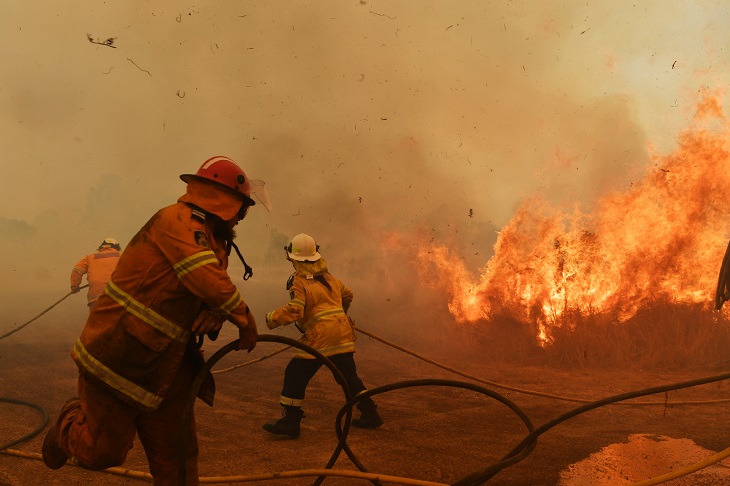
This week showed the cost of that failure with brutal clarity. More than 70 bushfires tore through New South Wales. At least 40 homes were lost. A firefighter died. Thousands were forced to flee with minutes of warning as 41 degree heat and gale-force winds turned entire districts into fire corridors. None of this was theoretical.
Families in Koolewong and Bulahdelah watched their lives burn while the state’s own reports show that governments met barely 30 per cent of fuel reduction targets in recent years. Locals have been pointing this out for years. So have frontline crews.
The clearing was not done. The buffers were not maintained. The systems that protect human life were underbuilt and underfunded.
This is the part of the national conversation that no amount of climate spending will ever fix. No emissions target, no transition timeline, and no symbolic act in Canberra can stop a fire that has already started.
What does stop a fire is the work we did not fund. Wider firebreaks. Cleared corridors. Proper hazard reduction. Hardened infrastructure. Trained personnel in adequate numbers. The tools that save lives were known and available, yet they were deprioritised in favour of climate gestures that do not prevent a single Australian death.
It is not hyperbole to ask how many more.
The Black Summer of 2019-20 claimed 33 lives and scarred the nation. This summer has barely begun and the embers of anger are already glowing.
While we cannot cool the planet, we can prevent Australians from dying in fires, floods and heatwaves. We could fund controlled burns. Maintain fuel loads. Reinstate proper clearing regimes. Build and reinforce fire buffers around vulnerable communities. Harden grid assets and substations. Expand water infrastructure. Equip emergency services with the capacity needed to match the physical risks we now face every summer.
Every one of these measures is cheap beside the cost of symbolic emissions policies.
Every one of them are proven.
Every one would save lives within twelve months, not 30 years.
And every one is chronically underfunded because it does not deliver the emotional glow of climate leadership.
The most astonishing part is that Canberra knows all of this. Quietly, internally, every serious official understands that Australia could triple its emissions overnight without changing the trajectory of the global climate. What we can change is whether the next family trapped on a fire trail survives long enough for rescue. What we can change is whether a regional town has firebreaks wide enough to stop a crown fire. What we can change is whether a power substation melts in a heatwave.
But those changes lack poetry. They do not produce the emotional spectacle that modern climate politics demands. They are practical rather than performative. And so they languish.
Meanwhile, in the real world, a truth that nobody on social media wants to confront is becoming increasingly obvious. People are dying not because Australia refuses to decarbonise, but because governments refuse to adapt.
We are not the moral pivot of the planet. We are a medium-sized nation on a fire-prone continent. Our governments have chosen symbolism over survival.
The geopolitical reality is equally unavoidable. China’s 1.4 billion citizens believe, correctly, that they have a moral right to a prosperous, energy secure, middle class life. India’s 1.4 billion citizens believe the same. Africa’s coming century will demand the same. The United States will never allow a strategic rival to outpace it by voluntarily shrinking its own industrial strength.
When history is written, it will record that the emissions pathway of the 21st Century was determined by the aspirations of billions, not by the virtue signalling of a few.
Australia’s real choice is not whether the climate changes. It is whether Australians die unnecessarily because we refused to harden the systems that protect us.
This leads to the question no politician wants to answer.
How many preventable deaths will the public tolerate before they stop accepting symbolic politics in place of protection?
Every fire, every flood, every lost town brings that question closer to the surface.
People will endure many things from governments. They will accept incompetence, waste and even hypocrisy. They will not accept preventable deaths forever.
There is a threshold after which public patience does not erode gradually but collapses. Nobody knows where that point lies. Yet we are walking toward it with astonishing complacency.
The climate will continue to change no matter what Australia does. The only thing within our control is whether Australians survive the disasters that follow.
Right now, we are choosing not to protect them.