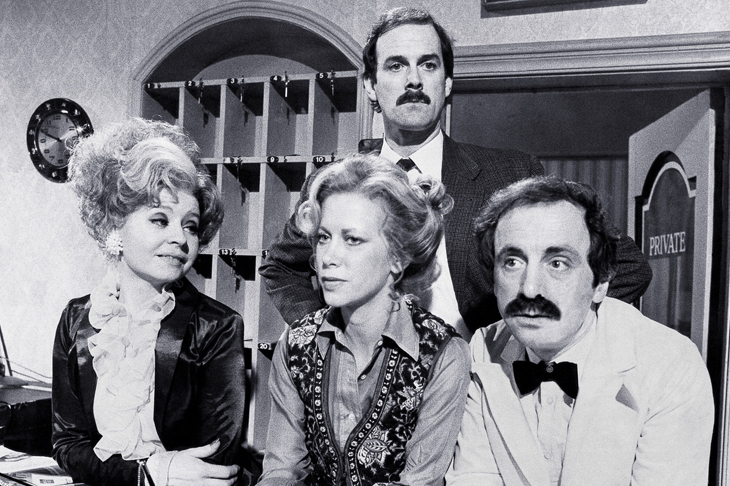
It’s strange the way comedy lives. A legion of the young continue to listen to Pete and Dud or watch Monty Python when the serious television has faded. John Cleese’s cry of ‘Sybil!’ on Fawlty Towers became the most famous exclamation to issue from a human throat with the possible exception of Brando’s cry of ‘Stella!’ in A Streetcar Named Desire. And has comedy ever got better than it was in the 12 episodes of the madcap show about the idiot hotelier played by John Cleese who shouts it hysterically in defiance of the unposh woman with the mad hairdo.
Prunella Scales was an extraordinary actress. You could watch her back in 1991 do Eugene O’Neil’s Long Day’s Journey Into Night at the National almost at the same time that Ingmar Bergman did it at the Brooklyn Academy of Music with the great Bibi Andersson as Mary Tyrone. Prunella Scales was a homelier figure but that didn’t mean it was a lesser performance.
It’s weird of course that she could do such a deadly accurate impersonation of Queen Elizabeth II just as it’s strange that she could turn into Australia’s Coral Browne for the remake of the story of Browne’s meeting with Guy Burgess in Moscow. (This is confusing because Schlesinger made An Englishman Abroad with Browne herself and Alan Bates as Burgess to an Alan Bennett script. Prunella Scales is in the remake with Simon Callow.)
But Prunella Scales’ tour de force pieces of impersonation were just the other side of how much she was steeped in the classical tradition of the theatre: Chekhov and Shakespeare and Shaw. You can listen to the brilliance of her technique in a BBC radio version of Shaw’s You Never Can Tell and she’s also – a bit amazingly – an integral figure in the very great Argo audio version of Milton’s Paradise Lost cut to a dynamic eight hours or so with Michael Redgrave as a silvery but agonised Satan, Tony Church as an absolutely secure, beautifully toned narrator, Sir Michael Hordern as God (sounding a bit like Pope’s description of Him as a ‘school divine’) and Richard Johnson – later to play Antony to Janet Suzman’s Cleopatra and marry Kim Novak – as a forthright, very masculine Adam. But who would have expected Sybil herself, Prunella Scales, as Eve? And yet she does it flawlessly with an absolute clarity of tone.
Gore Vidal said some time in the latter part of his life that Paradise Lost was the last important bit of reading he would do. Well, given the beauty of Prunella Scales’ inhabitation of the role of Eve –– and the majestic realisation of the other major figures by Redgrave and co. – Milton’s great epic – which Doctor Johnson described as not the greatest of all poems simply because it was not the first – becomes the audiobook to die for.
There’s also an absolutely complete recording on Naxos by Anton Lesser which has a masterly command of different registers – he sounds like a convincing Eve too – but is not in the same class.
Where do we class Hair these days? The new production at Melbourne’s Athenaeum conducted by Greg Hocking and directed by Glenn Elston is very pacy and has a band in semi-darkness at the back of the stage. You can see this hippie musical of nearly fifty years ago as a period piece but we have inevitably been formed by the attitudes that shape it. In Hair we get the poignancy of a draft-dodger dressed as a corpse. But there is also a scene where the audience is encouraged to admire the beauty of young nude bodies and that is a perspective way beyond any politics. Of course the production highlights all the psychedelia, the dream world of the acid trips. There’s plenty of druggy stuff that looks a bit antediluvian though it’s a reminder of how much the world of youth culture became a sort of collective enthusiasm and Hair marks the moment when hippie culture became in a fantasyland way the air the young breathed.
As a show, though, Hair is a sort of collective romp, with the humour blending with the idea of protest, sometimes happily, sometimes with intimations of darkness. It may seem as remote as Paradise Lost but it does have a terrific energy. It’s also the moment – in 1969 – when Jim Sharman directed and designed the first Australian production of Hair which transformed the conception of what mainstream Australian theatre could achieve and which led on to his Jesus Christ Superstar and The Rocky Horror Picture Show – he also directed the film. But it’s Hair in Sharman’s hands which juxtaposed the bare skin with the acrobatics of a non-naturalistic theatre with a spectacularly confident Australian accent.
In any case, this new production comes across with all its bespangled, light in darkness moments as good clean fun. And at the end when everyone sings ‘Let the Sunshine In’ we get the rousing chorus of a happy ending.
La Mama has been in recess this last year and it’s good to see the site for drama that Betty Burstall established to the great enrichment of Australian theatre now has a program as well as a coherent plan for bringing in the necessary amount of funding.
Australia is likely to be a middle power when it comes to theatre though it’s interesting to see in cinema and streamer television that Jacob Elordi can jump from Justin Kurzel’s Narrow Road to the Deep North to Guillermo del Toro’s Frankenstein – about which there has been much debate – with the prospect of playing Heathcliff to Margot Robbie’s Cathy in an apparently off-beat Wuthering Heights: well, it’s not as though Emily Bronte’s story is anything other than craggy and black. Is there an affinity between Heathcliff and Milton’s Satan as antiheroes?
But let’s return to comedy. Last week that extraordinary comedian Peter Sellers would have turned 100. He had Michael Parkinson shrieking with laughter when he assumed a Yorkshire accent. He sounded extraordinarily bright and charming and lithe and he left an extraordinary mark on the culture of the world.
The Goons were an early indication of the comic genius, the Pink Panther films another. But think of the work he did with Kubrick. Think of the absolute black comic magic of Sellers in Dr Strangelove – with the bomb as his cherished emblem. And then think of what he did – the undertone of his giggling, the satanic gleam of his cruelty –as Quilty in Kubrick’s version of Lolita.
Got something to add? Join the discussion and comment below.
You might disagree with half of it, but you’ll enjoy reading all of it. Try your first month for free, then just $2 a week for the remainder of your first year.