Once upon a time, the Australian spirit was known for its courage, independence, and irreverent sense of fairness. We didn’t wait for someone else to speak – we spoke up. We didn’t wait for permission – we acted. We were the quiet battlers who built a thriving democracy out of little more than grit, trust and a handshake.
But something has shifted.
In just a few short years, we’ve become a nation lulled into compliance – entertained by the need to fight for bread (and toilet paper) and circus while the very essence of our sovereignty, liberty and civic courage slips quietly away.
A Nation Numbed by Comfort and Control
We’ve been told it’s all for our safety, our health, or our environment. Yet beneath that rhetoric, we are being watched, nudged, and increasingly managed by the very institutions meant to serve us, but now increasingly closer to the panopticon.
Many Australians now feel compelled to measure their words carefully, wary of social or professional repercussions. Increasingly, our financial institutions and major corporations appear more aligned with government priorities than with the communities they serve – a partnership that risks blurring the boundaries between commerce and governance.
We are also witnessing troubling trends in personal freedom and economic participation. The practice of debanking – closing accounts or limiting services based on perceived political or social views – represents a profound challenge to the principles of fairness and equality before the law. Likewise, emerging digital frameworks risk evolving into social credit–style systems, where conformity becomes a condition for access rather than citizenship a foundation for trust.
In some workplaces, individuals have faced disciplinary action or even termination for simply attending lawful protests or expressing views contrary to prevailing orthodoxy. Such developments erode the democratic fabric that depends on open discourse and respect for differing perspectives. With no sympathy from the chapter III entities, formerly a bulwark for rights.
Public debate itself has become increasingly constrained, with genuine differences of opinion too often dismissed under the convenient label of ‘misinformation, disinformation’. In our schools, ideology can sometimes take precedence over open inquiry and critical thinking. At a young age, children are taught about climate alarmism, gender transition, and how the government can be a better parent to them instead of their parents.
Meanwhile, the economy continues to falter. Farmers, tradespeople, and small business owners – the backbone of our national prosperity – find themselves burdened by complex regulation and a growing sense that those in positions of authority have lost touch with the realities of everyday Australians.
Those who wear the crown of leadership crave its prestige but lack the spine to bear its weight. We no longer see an opposition, but a political cartel – insulated, entitled, and united not by vision, but by mutual protection. Their motto remains: ‘It’s good for thee, but not for me.’
The March That Wasn’t Shown
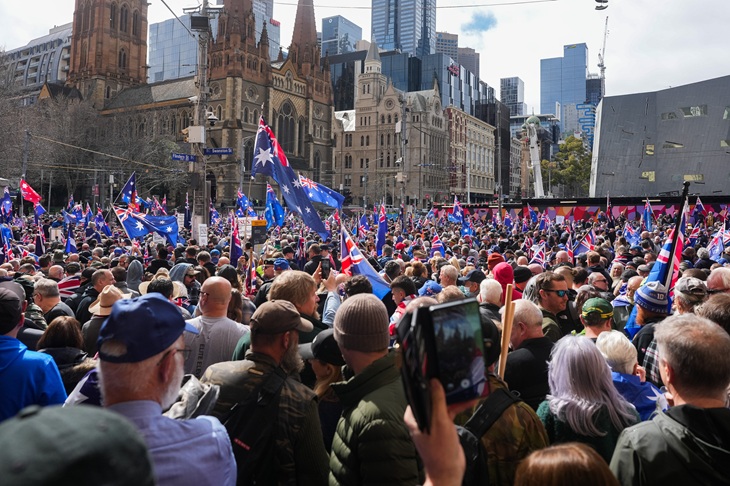
In early 2022, tens of thousands – perhaps the largest peaceful gathering in our nation’s history – marched on Parliament House. Australians from all walks of life stood shoulder to shoulder against Covid mandates and the quiet usurpation of constitutional freedoms.
It was peaceful, principled, and profoundly Australian. Yet it was largely censored – a mass expression of conscience erased from mainstream coverage as if it never happened. The people spoke; the establishment simply refused to listen, but they had no choice, this was potentially bigger than the Vietnam War protests.
Faith, Freedom, and the Moral Test of Our Time
In 2021, I stood alongside members of the Christian and Jewish communities to challenge, through the courts, the Federal, New South Wales, and Victorian governments over the Covid social distancing measures and public health orders. Respect for faith and freedom of worship is not a privilege but a cornerstone of our Judeo-Christian legal and cultural heritage. Defending that principle was not a choice – it was a duty of faith, love and hope for this nation.
Although our case did not succeed, it opened the eyes of many to the moral contradictions of the time. In a moment of quiet solidarity, the Jewish community sounded the Shofar (שׁוֹפָר) – a timeless call to faith, courage, and awakening. (Kudos to the brave who stood up!) Around the same time, Christian leaders across the nation – with the notable exception of some of the major institutions – began to speak from their pulpits, challenging the inconsistency and hypocrisy of policies that silenced worship while allowing commerce and indulgence to continue without restraint.
While many individual churches quietly supported the case, some of their leaders instructed congregations not to speak publicly, fearing political backlash or institutional disapproval. Those who went against their institution were sent away, the very pogrom of faith! Yet faith, by its very nature, calls us to stand for truth – even when doing so is uncomfortable or unfashionable. What did you do?
Not long after these acts of conscience and unity, Premier Gladys Berejiklian announced that places of worship would reopen, first for the vaccinated and then the unvaccinated. This in the backdrop of being told you had a choice and there was no discrimination.
The irony was unmistakable. The same public health orders that prohibited Australians from gathering in prayer permitted visits to large retail outlets, liquor stores, and even brothels. This imbalance revealed a deeper moral dissonance – a government willing to protect consumption, no matter how immoral, yet hesitant to defend the sacred essence of faith, the binding agent of our proud Anglo-Celtic traditions.
Even when our institutions and their leaders should have stood firm, too many chose silence over service to their nation. In the hour when conviction mattered most, they looked away – content to preserve comfort rather than principle. Their hesitation revealed not prudence, but fear.
There is little virtue in rushing bravely across no man’s land once the guns have fallen silent. Courage delayed is conviction denied. If our institutions cannot speak when liberty is tested, then it falls to ordinary Australians to remind them what they were built to protect.
True democracy is not sustained by bureaucracy, but by conscience – and it survives only when its people refuse to surrender truth for convenience.
From Mateship to Dependency
Our strength was always mateship – standing together through hardship, even in disagreement. That spirit built towns, dug mines, won wars, and rebuilt after floods and fires. During Covid, families were told to kick out loved ones if they chose not get the (you know what!), snitch on their neighbours and ridicule dissenters.
Today, too many of us stand divided and distracted, while dependency grows like a vine around our collective will. We’ve traded resilience for reliance, initiative for instruction, and courage for comfort.
This isn’t who we are.
The Net Zero Mirage and Digital Dominion
Under the banner of Net Zero, vast industries are being dismantled and re-engineered without accountability or genuine public debate. Energy security – once a pillar of national strength – has become hostage to ideology, leaving rural and working Australians to bear the cost of policies conceived in boardrooms and bureaucracies far removed from reality.
Alongside this shift, a new lexicon has entered the political vocabulary: misinformation, disinformation, and now what some wryly call ‘Chris-information’ (thanks to IPA for the term) – a nod to the shifting narratives and broken promises surrounding Australia’s energy policy. Words that once described deliberate falsehoods are now too often wielded to silence legitimate criticism, eroding public confidence in government and those cheerleading press alike.
At the same time, the Digital ID Act 2024 (Cth) quietly entrenches state control over who may participate in public discourse. It grants government the power to approve which entities can disseminate media – effectively licensing the narrative itself. Toe the line, or you’re out.
This development comes amid troubling allegations that major broadcasters aired dubiously edited footage on critical stories. Many people are concerned that these are not mere editorial oversights, but rather reflect a deeper pattern of media decline. Such behaviour is not the bedrock of an open, participatory democracy. It is corrosive to both truth and trust.
Meanwhile, proposals to tighten Freedom of Information (FOI) laws threaten to shield departments and agencies from scrutiny rather than strengthen transparency. In effect, these measures consolidate authority under the guise of safety and efficiency, limiting the capacity of citizens to question or hold power to account.
What we are witnessing is not the strengthening of democracy, but its careful management – a shift from open governance to curated mandated – consent (yes you heard right). The result is a system that increasingly resembles a political cartel cloaked in democratic language: a parody of accountability sustained by controlled narratives and selective transparency carefully corralling those sleepwalking.
The Warning from History
Justice Dixon foresaw this danger more than 70 years ago in Australian Communist Party v Commonwealth (1951) 83 CLR 1 at 187:
‘History, and not only ancient history, shows that in countries where democratic institutions have been unconstitutionally superseded, it has been done not seldom by those holding the executive power. Forms of government may need protection from dangers likely to arise from within the institutions to be protected. In point of constitutional theory, the power to legislate for the protection of an existing form of government ought not to be based on a conception that the Constitution intends to protect itself or guard its own continuance by making a place for a particular law.
‘It should rest simply upon the view that the defence of the country is not limited to resistance to external attack but extends to the protection of the body politic from internal subversion, whether instigated from without or not. But in such matters to leave the limits of power to the judgment of the legislature or of the executive is to abandon the Constitution to the supremacy of the political discretion of those whose duty it is to obey and maintain it.’
Those words echo through our time. We are being asked to trust those who have already abused trust – to yield liberty for safety, debate for consensus, and citizenship for compliance – yes! – participatory government is withering.
The Collapse of Common Sense
Equally troubling is the erosion of simple truths that once grounded our laws and our lives. When people in positions of power cannot or will not define what constitutes a male or a female, it exposes more than ideological confusion – it reveals a collapse of moral and linguistic clarity. How can a government claim to protect equality when it refuses to acknowledge the biological realities upon which that equality depends?
Placing biological men in women’s prisons – exposing vulnerable women to potential harm and assault – is not progress. It is a failure of duty, compassion, and common sense. Protecting the vulnerable is one of the oldest moral responsibilities of a civilised society; abandoning that principle in the name of ideology is neither just nor humane.
This is not progress; it is paralysis – the triumph of political expediency over truth. Yet even in this confusion, we must not turn on one another. We cannot afford to be divided. Instead, we must recognise the forces that seek to divide us, and stand united as one people, grounded in shared values, history, and common sense. For only a nation that remembers who it is can find the courage to stand together and chart its own course forward.
An Appeal to Conscience, Not Division
This isn’t about left or right, city or country. It’s about Australia – the land, the people, and the principles that unite us. If we keep thinking left or right, there will be nothing left!
We are better than the fear, division and political cowardice we’ve allowed to take root. It’s time to stop apologising for being proud of who we are: free, fair, and fiercely independent.
It’s time to rise – peacefully, intelligently, and courageously – to reclaim the spirit that built this nation. Because if we don’t, we may wake one morning to find that the Australia we once knew – of opportunity, dignity and freedom – has quietly slipped away.
Wake Up, Australia
The world is watching. Our children are watching. The time for passive despair is over.
It’s time for civic renewal. For courage over comfort. It’s time to wake the Southern Giant and ensure the God continues to bless this great nation.
Tony Nikolic Solicitor and writer. Contributor to The Spectator Australia on freedom, sovereignty, and the rule of law – aflsolicitors.com.au