Richo is dead. The supreme fixer of the Labor party is gone. That wise and moderate man Brian Johns who transformed Penguin Books, SBS and the ABC spoke appreciatively of this man with a supreme knowledge of politics. ‘Whatever it takes’ was Graham Richardson’s password and perhaps his supposed cynicism achieved more than piety. Wasn’t there the election he saved for his party when he realised how crucial the Green vote would turn out to be? When Paul Keating declared that he was the Placido Domingo of Australian politics and Richo, the eternal henchman, was asked who Hawke was, of course he replied the Pavarotti figure.
He was so shrewd that you came to admire the way he saw round corners. Michael Kroger was the parallel figure on the Coalition, the guy who let the mask slip on the embattled night of the election.
It’s a time when political memories are stirred with the 50th anniversary of Whitlam’s dismissal by Sir John Kerr and like a lot of people there’s the memory of where you were when you heard. And what better place than Jimmy Watson’s wine bar on Lygon Street, Carlton?
The Dismissal became the name of the mini-series which dramatised that shocking event. The novelist Amy Witting, the great influence on James McAuley, the co-hoaxer of Ern Malley, refused to believe in the blackguardliness of Sir John Kerr. Amy Witting always referred to ‘silly goose Gough’.Never mind the brilliance, the classicism, the backing of Patrick White and getting him the Nobel Prize for literature.
Certainly the most vivid figure in the TV drama is John Stanton as Malcolm Fraser. He captures the passion and the patrician force. It’s a pity he didn’t do a one-man show about Patrick White. David Marr in his biography says that after White met his partner Manoly Lascaris his face took on the indomitable look of the Australian grazier. You recognise the look from the man who ousted Whitlam but put into effect his multiculturalism but not the freeing up of the market which his lieutenant John Howard wanted.
Howard once campaigned for Tom Hughes, the legendary silk and sometime Liberal attorney-general. At the funeral of John Gorton – the previous prime minister Fraser tipped from office – Hughes spoke vituperatively of Fraser from the pulpit of St Andrew’s Cathedral. He praised Gorton in Chaucer’s words as a ‘verray parfit gentil knyght’.
Afterwards Whitlam went up to his old antagonist and (according to Troy Bramston’s new biography) putting his hand on his shoulder quoted scripture: ‘Let not your heart be troubled.’
We remember that Richo controlled the black magic of the New South Wales Right but we tend to forget that Whitlam purged the Victorian Left in order to gain control. John Stanton did a powerful one-man show of Shakespeare at fortyfivedownstairs and he is one actor with the dynamic range and instinctive feeling for dramatic verse like that of Shakespeare and his contemporaries.
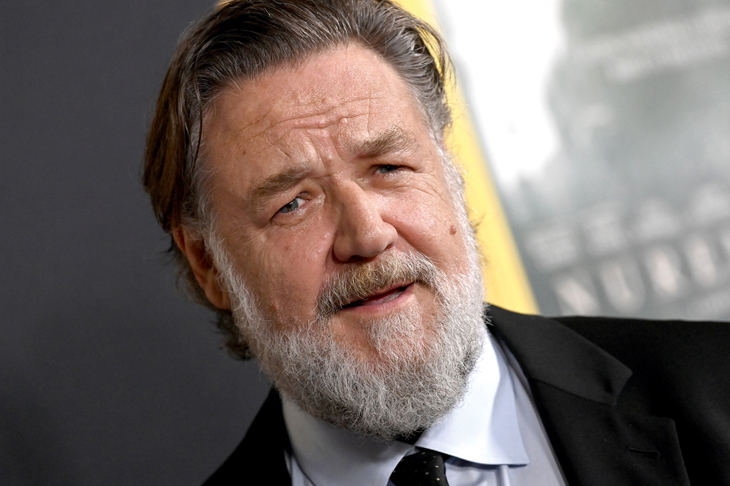
Just recently, Russell Crowe has been talking up the fact that he’s going to be seen in Nuremberg in which he will play that most plausible of Nazi villains, Hermann Goering. When the Red Baron, von Richthofen, died Goering became the greatest air ace in Germany and ultimately the head of the Luftwaffe. Yes, but he also established the Gestapo. He seems to have been a man of baleful charm and as Russell Crowe, looking very handsome at a bearded 61, radiates warmth while he talks to Karl Stefanovic who laughs so hard you wonder if he’s imagining the dark side of this lord of fascism.
Goering was the biggest fish the Allies caught among the Nazis and Nuremberg presents his attempt to escape the hangman’s noose. In prison he lost weight and concentrated his mind. He argued – in a way formidable enough to convince some fraction of ordinary Germans – that everything the Nazis did was done according to law. They were elected, the laws they passed were properly laid out, they observed the conditions of a duly constituted state.
Of course this is disputed by people who think the ultimate consideration is the Holocaust. It’s all very well to see Goering as having the superficial charm that is reflected in Michel Tournier’s The Erl-King. Yes, Goering had a gargantuan grandiosity (and his anti-semitism reflects his mother marrying an ennobled Jew) but he was the opposite of a good guy.
The clips of Nuremberg give us Russell Crowe at his most charismatic. The German accent is at once clipped and resonant, the dialogue is in English and Russell Crowe was never at home with standard Oxford English but he does what some of the biggest-time Australian actors have done which is to keep their own accent.
Dame Judith Anderson did this through every tight sinister phrase of her Mrs Danvers and Errol Flynn did it in everything from Robin Hood, through Santa Fe Trail to They Died with Their Boots On. He also had precisely the right style for light comedy – a bit like Roger Moore years later. Peter Finch to a lesser extent retained traces of his Australian accent.
And when Russell Crowe burst on to screen with Gladiator he may have imagined he was speaking in a Royal Shakespeare accent two pints down – as he intimated to Karl Stefanovic – but he wasn’t. His voice is pure unapologetic Australian. It is in fact – notwithstanding his forebears – a highlighting of his own middle-Australian accent as an accent which is equal to any quirk of nationality that might be required. It is as confidently Australian as Sean Connery’s voice is Scottish. There is, admittedly, Connery’s absolute refusal to deviate from his Edinburgh accent – except in the very early Bond films – but Russell Crowe displayed his linguistic patriotism in Master and Commander where Captain Jack Aubrey talks of ‘the lesser of two weevils’ by taking the accent of the Empire and the Napoleonic Wars as that of Sydney, Australia.
It’s interesting that you can actually make a case for this. Clearly the dominion accents of what was once the British Empire have some affinity as to shared vowels. You can entertain yourself and imagine that the late Robert Hughes (with his beautiful booming leathery Sydney voice) – art critic extraordinaire and brother of the silk – might have had an accent akin to the one Doctor Johnson spoke in to Boswell.
Got something to add? Join the discussion and comment below.
You might disagree with half of it, but you’ll enjoy reading all of it. Try your first month for free, then just $2 a week for the remainder of your first year.