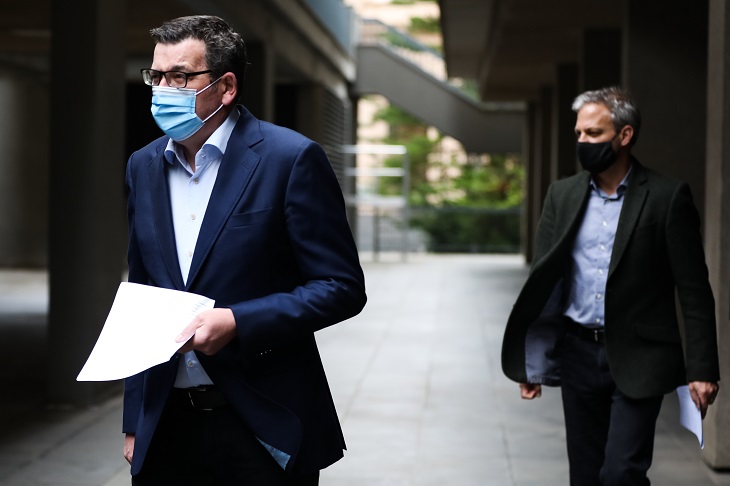
Brett Sutton’s recent comments that some measures implemented during the pandemic were ‘probably never necessary’ is the kind of nuance that would have been most welcome when he was Victoria’s Chief Health Officer and Daniel Andrews imposed a draconian 262-day lockdown.
It is easy for Sutton to make these comments in retrospect, but it must be remembered that Sutton was a key member of the political and public health establishment that not only implemented the restrictive policies but tarred those who questioned the necessity of some of the harsher impingements on civil liberties.
The draconian and censorious approach by government meant Victorians were not given the opportunity to debate the measures implemented as appropriate, no matter how illogical or arbitrary they were.
These latest comments by Sutton, given during an interview with retired radio host Neil Mitchell, follow the revelation in court documents that Melbourne’s Covid curfew was, allegedly, ‘not based on medical advice’. Ditto with the closing of playgrounds, or rules mandating the use of a mask upon entering a café, but upon seating that mask no longer being required; leading some to humorously question whether Covid could not be caught when sitting down.
However, when pressed on specifics such as the necessity of playground closures, Sutton told Mitchell that he was ‘not here to talk about public health orders … [and] I’m not going to talk about political decisions…’
Which leaves us to wonder, how many public policy decisions related to the pandemic were indeed based on medical advice, and how many were political decisions?
Sutton’s subtle acknowledgement of political decisions during the pandemic smashes one of the facades erected by Daniel Andrews, who assured Victorians that the government’s policies were only ever following ‘the science’ and that left them with ‘no choice’. The government did have a choice, and those choices ought to have been subject to scrutiny and open public debate.
Even at the time, other jurisdictions were showing that a less stringent approach was possible and did not end in disaster. Sweden remained open during the pandemic but, according to The Spectator’s economics editor Michael Simmons, experienced less cumulative excess deaths than Australia or New Zealand on multiple models.
A 2023 journal article published in Frontiers in Public Health found that the voluntary, more open policy of the Swedish approach appears to have caused less serious consequences than lockdown policies imposed in most countries.
Accordingly, a proper inquiry – a Royal Commission – is overdue. Failing to investigate how these decisions were made guarantees a further erosion of trust in our institutions and will lead to the same mistakes being repeated. As Sutton himself acknowledges, ‘another pandemic is inevitable’ and it is pivotal that we learn what we can do better.
While some still defend the Victorian government’s hard lockdown approach, few would dispute that Melbourne’s prolonged lockdown has come at a great cost.
The tangible effects are difficult to ignore.
In part due to the economic effects of Victoria’s draconian Covid measures, the Victorian economy faces a massive debt. Institute of Public Affairs’ analysis of the 2025-26 Victoria State Budget established that Victorians will continue to be the most tax burdened people in the country, with tax revenue expected to increase by 22.3 per cent from now to 2029, with the Covid debt levy set to continue to increase over the forward estimates by $300 million to $1.4 billion in 2029. Accordingly, Victoria’s economy has been downgraded from AAA, to AA rating by global credit rating agency S&P Global, the lowest rating of all Australian states.
Interest repayments on non-financial public sector debt now constitute a sizeable part of the state budget and is set to reach $11.7 billion, or approximately 10 per cent of total state government expenditure. This means there will be less money available for essential services such as health, education, transport and justice. The latter of which, the state seems to be losing control over, with crime rates, particularly motor-vehicle theft, skyrocketing.
What is less quantifiable are the intangible effects, but to Victorians the damage is palpable. As Mitchell observed, the lockdowns seem to ‘have had a huge impact on people, particularly kids’ and there is ‘more road rage, more crime…’ In a forthcoming Institute of Public Affairs book on the legacy of former Victorian Premier Daniel Andrews, economist Gigi Foster explains that lockdowns also negatively affected ‘people’s motivation to work and their ability to derive meaning and personal value form that work’ as well the ‘attitudes and soft skills developed by young people when they attend university, TAFE, or apprenticeship programs (not to mention pubs and clubs) with peers’.
Sutton noted the importance of the ‘speed of decision making’. Quick decisions in emergency situations must be made, no doubt. But it is during the times that governments are exercising extraordinary powers that the need for open public debate and scrutiny is all the more necessary – absent the ad hominem attacks.
Melbourne was the world’s most locked-down city – there was ample time over those 262 days to correct course. It is crucial that public policy be grounded in reason, not in emotion or fear. To neglect doing so means the community needlessly suffers.
Victorians, and indeed all Australians, are owed a proper inquiry in the nation’s failed pandemic response, to ensure that there is full transparency regarding the distinction between public health and political decisions.
Mark Burgess is a Research Fellow at the Institute of Public Affairs