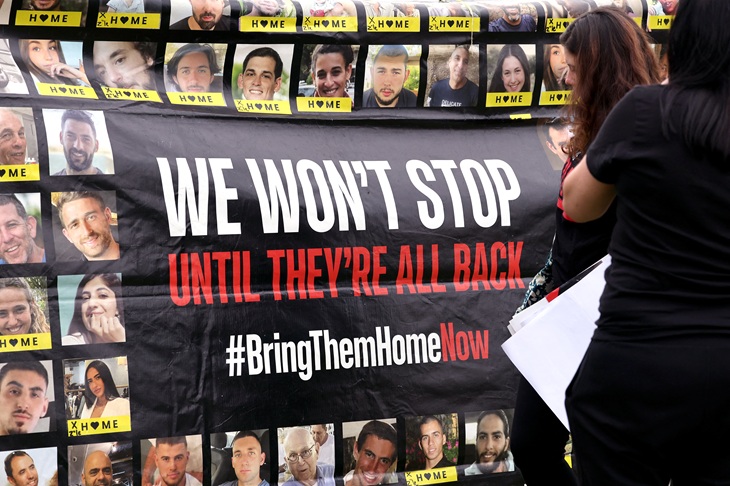
Today is the two-year anniversary of the October 7 Hamas attacks. It is utterly horrific that two years after the worst loss of Jewish life since the Holocaust – and one of the most brutal, depraved massacres in modern history – 48 hostages still remain in terrible conditions in captivity.
It was telling that in the immediate aftermath, many of the reactions were ones of celebration, including here in Australia, on our own Opera House steps.
While the mob let off flares and chanted ‘gas the Jews’ or ‘where’s the Jews’ (both chants equally loaded with genocidal intent), the only arrest made was of a Jewish man waving an Israeli flag.
Less bloodthirsty, but equally concerning, was the rush to provide ‘context’ to the massacre – a phenomenon that would seem horribly insensitive at best, and outright racist at worst, if applied to any other minority group that had suffered a similarly barbaric attack. Interestingly, the context was very specific and very limited. It related only to Israel’s transgressions. It completely missed the horror that violent Islamic extremism has brought – not only to Palestinians, Israelis, and Jews worldwide – but also to many Western nations and entire swathes of the Middle East, such as Iran and Afghanistan.
How soon we have forgotten the Lindt Café attack, the Bali bombings, and 9/11.
The world has been quick to contextualise, compartmentalise, and distinguish the October 7 attack in a way not applied to any other violent, Islamic terrorist attacks. The context of the October 7 massacre most certainly did not extend so far as to include a very well-established three millennia of Jewish persecution.
The endless marches – not even our very own ‘March for Humanity’ across the Harbour Bridge – seemed to include mention of the hostages, let alone demand their release. It would seem they are not worthy of humanity. It has been two years of watching vast groups of people, apparently desperate for the conflict to end, yet not able to bring themselves to call for the release of the hostages – the very thing that could have ended the war. How stupid, and how deeply shameful.
Since that day, Jews around the world have experienced a rise in antisemitism and race-hate crimes not seen since pre-second world war Germany. Except this time – it has been made global.
While the world largely ignored wars with far higher civilian casualties (Syria) and far worse humanitarian situations (the current situation in Sudan affects tens of millions), Jewish people were meant to believe that the world’s obsession with this conflict was justified because what was happening in Gaza was truly worse, or uniquely evil, or something?
In Australia, as in much of the rest of the world, we have small Jewish and Palestinian populations and no soldiers directly involved. So why is Australia’s gaze (and the world’s) so relentlessly focused on Gaza, in a way that has never been the case for any other conflict or humanitarian situation?
Jewish people know why.
Our elderly parents, our grandparents, our great-grandparents, and our many ancestors before them – they knew too. The global rise of the pro-Palestine movement has happened in parallel with a steep global rise in antisemitism, significantly fuelled by social media.
The aftermath of October 7 has seen one of the most severe surges in antisemitism ever known, including here in Australia, which has experienced one of the most notable degradations of Jewish safety anywhere in the world. Jews in Australia are now the largest targets of race-hate crimes per capita. I have seen many people I know post about Gaza, apparently in the pursuit of social justice – yet I have not seen any of those people post about Australia’s antisemitism crisis, despite it happening in our own backyard.
Do Australian Jews not deserve the social justice sought for Palestinians? The sense of betrayal and isolation felt by many Australian Jews is hard to convey.
Only five days ago, on Yom Kippur, the holiest day of the year for Jews, Jihad al-Shamie allegedly drove a car into pedestrians outside a Manchester, UK, synagogue and then started stabbing people. Two Jewish congregation members were killed and three more were seriously injured. In response, baying crowds protested – not against the killings – but to globalise the intifada.
It was yet another in a long line of violent attacks against Jews. We can no longer pretend these incidents are anomalies of a movement that has relentlessly targeted Jews around the world for two years. Now more than ever, every time Jews celebrate Chanukah together, see a Jewish comedian, send their children to Jewish schools, support a Jewish artist, or go to synagogue, we wonder – will it be me next? Will it be my children?
Will it?
I would end this by saying ‘Bring Them Home’ but the saying should have always been ‘Let Them Go!’ And every person advocating for an end to the conflict should have been saying it.
Let Them Go.
7 October, the movie, is now available to hire on Apple TV. I will be watching it tonight.