The 145th edition of the United States Tennis Open has now been concluded with Spain’s Carlos Alcaraz winning his sixth Grand Slam victory at age 22. He competed against Italy’s Jannik Sinner, who at age 24, has already won four Grand Slam titles.
A new tennis dawn has arrived which promises an epic rivalry between these two super talents. It is, however, doubtful that they will ever better Novak Djokovic’s astonishing record of 24 Grand Slam victories.
At age 38, Djokovic is still competing at the highest level, having reached the semi-final in all four grand slams in 2025, only succumbing to much younger opponents at that stage of the competition.
There is no doubt that Djokovic is one of the most accomplished athletes in modern sporting history. Unlike his iconic contemporaries, Roger Federer and Rafael Nadal, Djokovic has often been the target of disrespectful commentary and, at times, has endured outright hostility from significant segments of the Western media and the tennis establishment. This paradox has led to spirited debates about the legitimacy of attempts to belittle his achievements and tarnish his legacy.
As Djokovic’s legacy only grows with every major record he shatters, the question becomes ever more pressing: why does the Western media persist in denying him the fullness of recognition he so evidently deserves?
Novak Djokovic’s career, spanning two decades and continuing strongly, is a chronicle of record-breaking consistency and versatility. Djokovic has won a record 24 Grand Slam singles titles, outstripping both Rafael Nadal (22) and Roger Federer (20), who themselves were once hailed as the tennis sport’s ultimate champions. His longevity at the pinnacle of the sport is truly remarkable: Djokovic has spent a record 428 weeks as the ATP world No. 1, the most for any man (or woman) in tennis history, finishing as year-end number one a record eight times over 13 different years. This is not merely a testament to durability but also to an almost unrivalled dominance of the game’s top tier.
Adding to these achievements, Djokovic is the only man to complete a ‘triple career Grand Slam,’ winning each of the four majors at least three times. Djokovic also owns the enviable distinction of winning all nine ATP Masters 1000 events at least twice (‘Golden Masters’), underlining his unmatched versatility across surfaces and tournament formats.
The ‘Big Three’, Federer, Nadal, and Djokovic, have defined men’s tennis for over 20 years, with Djokovic prevailing in their direct matchups. Djokovic leads Nadal 31-29 in career encounters and has a winning record (27-23) over Federer as well. He is the only player to beat both rivals at all four Grand Slam events, reflecting his unique ability to perform on every surface and occasion. As the era of the Big Three draws to a close, statistical and qualitative arguments increasingly place Djokovic above his legendary peers.
Djokovic’s 2011 and 2015 seasons are now iconic in tennis lore. In 2011, he beat Federer and Nadal 10 times, finished 25-1 in Grand Slam matches, and won 5 Masters titles — arguably the greatest single season ever. In 2015, he reached all four Grand Slam finals, winning three, dominated the Masters, and finished with a record 16,950 ranking points.
Djokovic’s off-court journey is shaped by his deep awareness of his own roots, growing up in war-torn Serbia, where dreams are often thwarted by adversity. To break this cycle, he and his wife Jelena founded the Novak Djokovic Foundation, dedicated to giving every Serbian child access to world-class pre-school education. The foundation’s mission is both ambitious and practical: to ensure every child in Serbia can attend pre-school and to foster inclusive, creative, and rewarding learning environments.
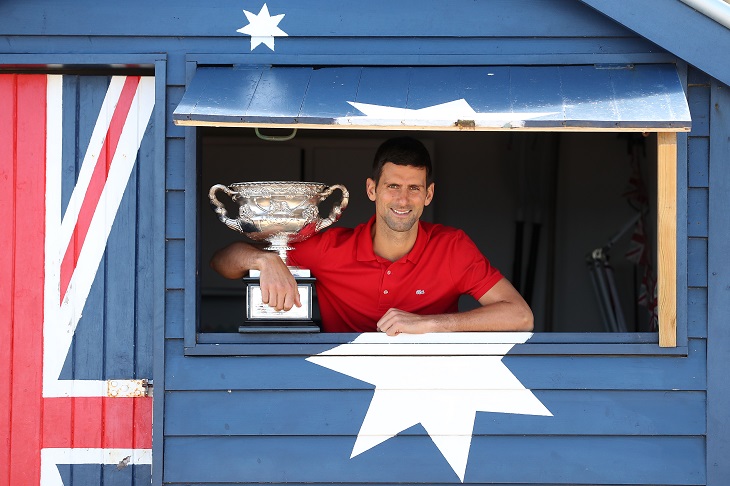
Djokovic’s philanthropy regularly transcends national borders. His leadership, as ATP Player Council president, was pivotal during the catastrophic Australian bushfires of 2019-20. Djokovic announced on-court that the ATP would donate USD$725,000 towards wildlife and nature recovery, and individual players matched efforts through campaigns like ‘Aces for Bushfire Relief’. Djokovic’s public remarks reflected his empathy for Australia as a ‘home at the start of each season’ and his shock at the devastation, rallying the tennis community to global action.
Djokovic’s Covid-related saga at the 2022 Australian Open is a stark example of how health politics, national anxieties, and media biases colluded to deprive Djokovic of his chance to participate in the Australian Open. Djokovic, unvaccinated but with a documented recent Covid recovery, arrived in Melbourne with a medical exemption cleared by both Tennis Australia and the Victorian state government. However, the federal government and Australian Border Force denied his entry, held him in a hotel used for asylum-seekers, and embarked on a week-long legal odyssey. While Djokovic initially won in court on procedural, not medical, grounds, his visa was soon revoked by the immigration minister, who cited his presence in Melbourne as an encouragement of anti-vaccination sentiment. As Djokovic was subsequently deported, he was unable to defend his 2021 title, and his treatment spawned a global news frenzy.
Western media, especially Australian, British, and American media, painted Djokovic as a selfish, ‘anti-vax’ activist, or even as a public health threat. Opinion columns endlessly repeated the ‘rules are rules’ mantra, and rarely considered his medical, legal, or personal circumstances. Social media, meanwhile, became a battleground, with tennis fans and casual observers lining up against Djokovic. Public reception within Australia reflected intense division, initially showing that less than a third of Australians supported Djokovic’s right to play at the Open, though that figure began to shift over time as pandemic measures softened and debates over freedom of choice gained recognition. Serbia, Djokovic’s home country, stood united behind its champion. Following the Australian Open debacle in 2022, even the Serbian government and president mobilised to protest his treatment, decrying it as ‘harassment’ and a disgrace.
The saga did not end with his deportation; Djokovic has since revealed the personal toll of his Melbourne detention. In a 2025 GQ Sports interview, he shockingly claimed that food consumed ‘poisoned’ him – the Australian Department of Home Affairs declined to publicly comment on this claim.
Djokovic has repeatedly stated he is not ‘anti-vax’ but a committed proponent of bodily autonomy. In interviews, he expressed disappointment, noting, ‘95 per cent of what has been written and said on TV about me in the last three years is totally false. I’m not no vax … I defend freedom of choice.’ Djokovic also described how Western media selectively quoted his statements, omitting crucial context and distorting the public’s understanding of his actual position.
Despite his undeniable achievements, Djokovic remains the subject of a disproportionate level of media scrutiny. Former coaches, players, and observers, including Nikola Pilic, Djokovic’s childhood mentor, have bluntly described Western media’s reluctance to crown Djokovic as the undisputed GOAT as stemming from ‘belittling’ his achievements and refusing to admit what is now a ‘finished story’. Even after Djokovic’s record-breaking ATP Finals win in Turin in 2024, a German magazine put Federer on its cover in a tuxedo, rather than celebrating Djokovic’s triumph. Such symbolic acts are not isolated but emblematic of a wider pattern that downplays the Serbian’s dominance of tennis.
Social media both vigorously defend and attack Djokovic and increasingly shape public perception. The polarisation is intense, and waves of ‘NoleFam’ (Djokovic’s fan base) supporters point to anti-Serbian or anti-Eastern European bias. The knee brace debate is offered as proof of this anti-Serbian bias: peer Frances Tiafoe’s black knee brace which was said to contradict Wimbledon’s all-white rule did not attract negative commentary, whereas Djokovic’s grey brace (to protect his knee after an operation) was relentlessly criticised.
Although Djokovic has never visited Africa as of 2025, he frequently expresses a deep interest in tennis development on the continent, recognising its potential and the need for more investment and strategic support from the sport’s ecosystem. His comments at the 2024 Laureus World Sports Awards underscored his intent to be a catalyst for growth, not for glory but out of genuine conviction that tennis should be global and inclusive. African players and fans overwhelmingly admire Djokovic for his humility, excellence, and philanthropic values. His popularity is partly a response to his outsider status, resonating with regions that often feel overlooked by the Western-centric sporting establishment.
While some now begrudgingly acknowledge Djokovic as the GOAT tennis player, even joyous milestones are often accompanied by qualifiers and comparisons. Large swathes of the Western press focus instead on controversies, personality quirks, or moments of frustration rather than the sustained, historic greatness that defines his career. The comparison with Federer and Nadal, whose narratives are sometimes constructed as nobler or more appealing, is instructive. Social media sentiment polls and fan surveys consistently show a ‘respect gap’, especially during times of controversy, like the Covid saga. Though approval rates for Djokovic have risen over time, significant numbers continue to see him, at worst, as a polarising figure, and at best, as an ‘outsider’ hero. But for younger fans in Asia, the Balkans, Africa, and increasingly elsewhere, Djokovic is admired as the accessible, self-made champion. The full extent of his legacy may yet take time, but the tide, propelled by both data and undeniable record, is slowly shifting. Undoubtedly, the World’s media will eventually catch up. And when the dust of debates settles, the tennis achievements, the records, the rebuilt schools, the rescued wildlife, and the inspired children will remain as tangible evidence of Djokovic’s greatness.
As a new cohort of tennis stars emerges, so vividly seen in the thrilling US Open final between Jannik Sinner and Carlos Alcaraz, Djokovic’s place in tennis history looks ever more secure. Djokovic, after all, has always played for history. Even as the competitive field evolves and new challenges emerge, Djokovic remains at the centre of tennis, often as the standard by which greatness is measured. He is truly the greatest tennis player ever.