While Germany’s defeat in the second world war was not formally declared until VE Day on May 8, 1945, it is widely recognised that the war’s outcome became inevitable almost a year earlier after the liberation that followed the D-Day landings. German forces may have limped on afterwards, in ever-increasing retreat, but D-Day guaranteed Allied victory.
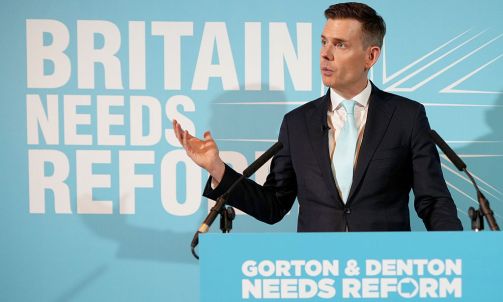
Last week, British conservatism had its own ‘D-Day’, ‘Danny-Day’, after the unexpected defection to Nigel Farage’s Reform UK of Conservative MP Danny Kruger, formerly the standard bearer of genuine conservatism in a Vichy party that has too often collaborated with the enemy. While his former party may continue to have some honourable soldiers within it, themselves victims of the cowardice or even treachery of successive leaders, its demise is now seemingly inevitable and, sadly, not undeserved.
Of course, the Conservative Party will limp on, in ever more pitiable retreat, but any lingering thoughts that its fortunes could be revived in the foreseeable future can now be put to bed. In a strange twist, the party will have its own VE day on May 8 next year, the day after local and devolved elections, when the counting of ballots will likely see it wiped from the electoral map in Scotland, Wales, and London, liberating two corners of the UK and its capital city from the malady of fake or compromised conservatism.
In many ways, Danny Kruger is an unlikely man to seal the Conservatives’ fate. A traditionalist Tory with a shire constituency, a gentlemanly soldier who has never held senior office and whose name will, regrettably, have been unknown to many outside of the Westminster bubble. And yet, in securing its first defection of a sitting MP (Lee Anderson was an independent when he joined Reform in the last Parliament), Reform UK has, in its first swoop, plucked perhaps the finest prize remaining on the green benches of the House of Commons.
For those unfamiliar with Kruger, I wrote about him here recently, describing him as the standout star of this Parliament. Until now, Kruger has been the patron saint of taking lost causes and almost turning them into victories. Having attempted to steer the Tory sinking ship away from the rocks in the last Parliament by establishing the ‘New Conservatives’ group that sought to persuade Party leadership to change course and adopt true conservative policies, Kruger then oversaw Robert Jenrick’s leadership campaign. Against all odds, Jenrick, the candidate of the right, almost defeated the establishment candidate in a party whose MPs would rather go down with the ship than elect a leader who represents their titular name.
Having narrowly failed to prevent the ongoing suicidal trajectory of his party, almost immediately Kruger set to work to oppose the Keir Starmer-backed Assisted Suicide Bill that had been tabled in Parliament. Last year’s election thumping for the Conservatives has handed the UK the most ‘progressive’ Parliament in its history, and yet under Kruger’s leadership, an expected landslide victory for this sinister legislation was thwarted and it sneaked through with a majority of only 23 MPs. It may yet fall in the House of Lords.
But now Kruger has the chance to take on a winning cause for once, with Reform UK riding high in the polls, securing a vote share more than Labour and the Conservatives combined in one recent opinion poll.
Kruger’s defection is significant for both the Conservatives and Reform. For the Tories, it suggests the game is up. As Kruger wrote in the Daily Telegraph at the weekend, in many ways his decision was one of simple calculated logic in light of the incalculable damage being wrought on the country by the Labour government. Britain needs a small ‘c’ conservative government and the Conservatives, languishing in the polls, sadly despised by many of its natural voters as well as its enemies, cannot be the vehicle for national restoration. There is only room for one party on the right, and so the Conservative Party has now unwittingly become the great obstacle to a conservative victory.
Last week’s defection is also totemic because if even Danny Kruger does not believe Tory revival is possible, perhaps under a Jenrick leadership, true conservatives everywhere will get the message that it is time to man the lifeboats and the Conservative ship is now holed so far beneath the waterline, its sinking is unavoidable.
However, Kruger’s defection is significant for Reform also. Kruger is one of the leading – and few – political thinkers of his generation. He actually understands conservatism and has an intellectual vision for it. His acceptance by Reform shows that Nigel Farage is serious about policy and has nailed his colours to the mast of classical conservatism, social and economic. The party’s slogan, ‘Family, Community, Country’ will come alive under Kruger, who met with JD Vance in the summer and shares his combination of national conservatism and social conservatism, driven by a Christian faith that gives life and philosophical coherence to it.
Those genuine conservatives who have doubted whether Reform would be the real deal on social and cultural issues and have teetered on the brink of jumping ship will now have the confidence to do so; indeed, they must do so, for a whole army will be required for the battles that lie ahead. Kruger has been given the strategic role of leading Reform’s efforts to prepare for government, a monumental task as it seeks to take on the axis of obstructive wokery which is the civil service, the BBC and the schools and universities with their eco zealotry, national self-loathing, denial of biological reality and DEI dogma.
I have written previously about the possibility of an alliance between those genuine conservatives left in the Tory Party and Reform, perhaps the ‘Reformed Conservatives’. At the press conference following his defection, while not ruling out the merit of some kind of alliance in the future, Kruger acknowledged that it currently makes little sense for Reform to pursue such a strategy. For now, there is a war for the soul of the nation. Historic tribalism must not prevent remaining conservatives in the Tory Party from following in Kruger’s footsteps, nor lead those who have perhaps lacked Kruger’s courage in following his principles, conservative principles, to attack him for his decision. Unlike most defections, Kruger’s was born of courage not careerism, and will have come at personal cost. More significantly, it is not Kruger who has moved but his former party, which defected from its voters and historic principles.
Challenges still face Reform – though Farage is choosing his generals wisely – and the party may yet implode or fail from internal or external pressures. There has been much talk about ‘uniting the right’, but for now, Reform is Britain’s only hope and uniting the right means uniting together under its banner. It is all the stronger for the presence of Danny Kruger.
The author is an anonymous conservative withholding their name for professional reasons that require neutrality on party political matters.