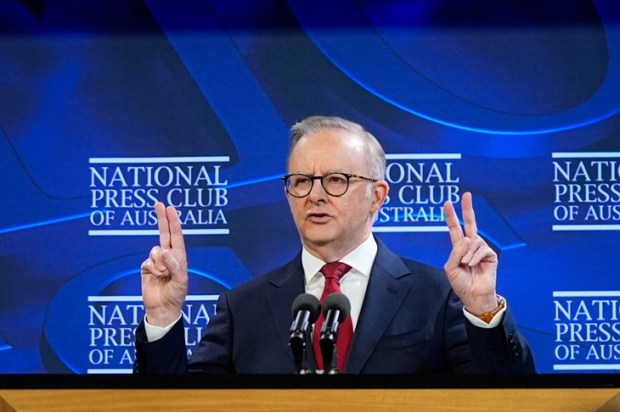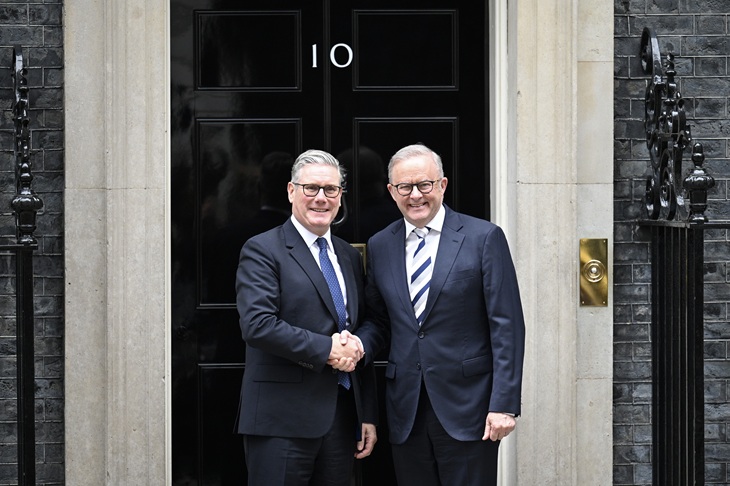
Australia’s Prime Minister, Anthony Albanese, galivanting all over the world, spent last weekend in the United Kingdom where he had meetings with his Majesty, King Charles III, and the UK Prime Minister, Keir Starmer,
He also spoke indulgently at the Labour Conference in Liverpool to promote Australian interests.
Undoubtedly, as a fellow socialist-lite traveller, he would have found a receptive and appreciative audience when addressing the Conference’s delegates. After all, the Australian Labor Party and the UK Labour Party have a lot in common: a zealous belief in renewable energy and the perceived, yet unrealistic, need to achieve Net Zero by 2050; an almost unrestrained and divisive immigration policy; a two-tier justice system which demonstrably favours some groups at the expense of others; a politicised police force; and an indifferent, servile embrace of Woke policies.
Of course, Albanese would not have experienced the ugly face of a decaying country.
However, former UK Prime Minister, Liz Truss, vividly described the reality in an interview with Sharri Markson on Sky News Australia a few days ago. Truss stated that the UK has become ‘ungovernable’, and she intimated that the unpopularity of the two main parties – Labour and Conservative – has propelled Nigel Farage’s Reform Party into a winnable position.
This dire situation prods us to reflect on how such a spectacular collapse of the civil order could ever have occurred in the UK, so quickly and so devastatingly. Surely, the collapse of the rule of law is a contributing factor in the UK’s decline.
As the rule of law is instrumental in protecting individual rights and freedoms, it is the backbone of a mature, stable, and prosperous society.
What became of the individual rights and freedoms once closely safeguarded by the UK legal system? In 1999, Peter Hitchens, describing better times, stated in a prescient book entitled The Abolition of Britain: From Lady Chatterley to Tony Blair:
The British system did not only enshrine habeas corpus, trial by jury, common law and parliamentary democracy. It demanded freedom of speech and thought, protected inheritance and secured property. It gave every citizen a private life, every family its own small kingdom. It made each police officer the embodiment of the citizens’ will, rather than a gendarme sent from above … it decreed that everything was permitted, unless specifically prohibited. It honoured dissent, loved eccentricity and despised conformity … above all, it relied upon its laws being written in the hearts of the British people, who both respected, authored and guarded liberty.
A quarter of a century later, this uplifting message has become an embarrassing remnant of a previously free society, now supplanted by the spectacular evisceration of free speech.
As widely reported in the media, people in the UK have been jailed for posting ‘politically incorrect’ messages to social media platforms, for standing in squares, away from traffic, with a sign proclaiming that there are only two sexes, male and female, or bemoaning the gender transitioning of impressionable children. The current UK’s immigration practices, developed or condoned by both Labour and Conservatives, have seen illegal arrivals housed in plush accommodation with meals, phones, medicines, and more, provided by the government and paid for by the taxpayer, at a time when suitable accommodation is scarce, even for British citizens and their families. And the government’s planned introduction of an identification card, known as the Brit Card, will require the population to participate in a system geared towards increasing surveillance of a person’s activities; it will also prohibit people from working if they do not possess the Card.
George Orwell’s 1984 is no longer a work of fiction!
Surely, the Australian Prime Minister and his UK interlocutors have not discussed these issues…
Geopolitical discussion would have prevailed, like the need for the United States to honour the Aukus Treaty, the recognition of Palestine, and Russia’s armed conflict with Ukraine and its undeclared war against Nato. Although these issues are appropriate items for discussion, they should not obviate the need to also confront the enemy within. In this context, the American Vice President, J D Vance, in his speech at the Munich Security Conference on February 14, 2025, said that he worried about ‘the threat from within’ and Europe’s retreat from ‘some of its most fundamental values’.
Is there any remedy? Or is any corrective action, even if taken, too late? Is the UK beyond redemption? Could the massive electoral lead for Reform over the two main parties arrest the demonstrable decline of the UK and revive the fortunes of that once great power?
A feasible remedy surely requires a rejuvenation of the rule of law and he restoration of free speech. Specifically, any attempt to rekindle free speech needs to harness the capacity and willingness of people to create a culture of legality which nourishes and supports the rule of law. To that purpose, of course, it is necessary for ‘freedom’ to inhabit the souls of people, a point powerfully made by Judge Learned Hand in 1944 in his The Spirit of Liberty speech. He said, ‘Liberty lies in the hearts of men and women; when it dies there, no constitution, no law, no court can save it.’ Similarly, Friedrich Hayek, the Nobel Prize co-winning economist, characterised the rule of law as ‘the legal embodiment of freedom’.
And yet, if present conditions prevail, there is no guarantee that the rule of law will resurface in the UK soon. At least, Reform seems to understand that the rule of law is not merely a convenient slogan, but a guidebook on how to restore the rights of people – a bulwark against government overreach, and a mechanism to minimise government arbitrariness. As such, it behoves on politicians to break free from officially sanctioned or spontaneously developed left-wing narratives to facilitate an examination of the contribution that a mature legal system could make to the revival of the rule of law.
In the early 1900s, William Graham Sumner, discussing the importance of education in the making of good citizens, implored people to become ‘slow believers’, implying that they should not uncritically accept all that is communicated to them by the government because the government, at best, is merely a purveyor of contestable propositions that may not serve society well. In any event, there is a need to effectively counter the politics of superficiality, mediocrity and hypocrisy that are currently practised in many Western countries, including in Australia.
Hence, the message of this opinion piece is clear: Australians must confront the enemy within Australia’s borders. If not, Australia will become a carbon copy of the United Kingdom.