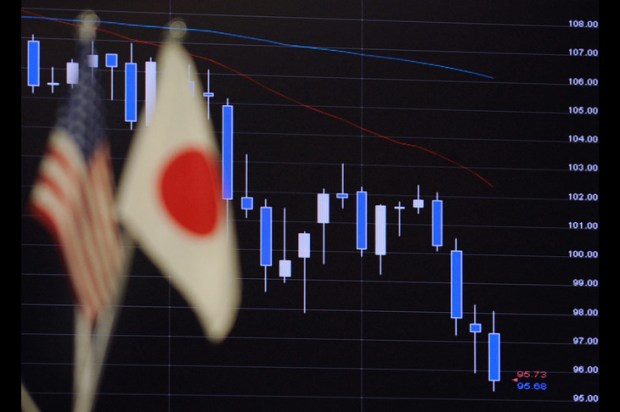
Japan’s opposition parties, eyeing Upper House elections in July, demanded the government cut taxes. Prime Minister Shigeru Ishiba refused, saying he wouldn’t sell more bonds to fund a bigger budget deficit when borrowing costs are surging.
‘It is important to recognise the dangers of a … a world with (rising) interest rates,’ Ishiba told the Diet on May 19. ‘Our country’s fiscal situation is … worse than Greece’s.’
It sure is. Tokyo’s debt reaches a world record 235 per cent of GDP (IMF figures) compared with 142 per cent now for the country that triggered the eurozone debt crisis. Tokyo this year will spend about 25 per cent of its budget on interest repayments, while running a budget deficit of 2.9 of GDP.
The day after Ishiba spoke, Tokyo’s 30- and 40-year bond yields hit record highs due to feeble demand at a debt auction. Concerns about inflation and Tokyo’s fiscal risks have since boosted yields to fresh highs – 30-year yields hit a record 3.22 per cent in August.
Higher yields are a curse across other indebted and spendthrift advanced countries, especially since central banks have ended, or slowed, 15 years of mass-buying government bonds under quantitative-easing programs. That removes the distortion that suppressed yields to record lows.
Investors are now assessing government bonds on their merits. Bonds are a series of payments and investors evaluate them like so. Short-term yields are governed by monetary policy – the appeal of bond versus cash returns. Longer-terms yields reflect the inflation outlook and a government’s creditworthiness.
Echoing their ‘bond vigilante’ nickname, investors are punishing countries with poor finances, especially France, Japan, the UK, and the US, and are wary of others – government debt across advanced countries averages 110 per cent of GDP.
Investors are demanding higher yields on longer-dated bonds because their supply is rising and government indebtedness is less sustainable now interest rates exceed economic growth – investors worry governments can’t borrow much more at affordable rates. They foresee debt spirals, when a vicious cycle of sluggish growth, rising indebtedness, and higher debt-servicing costs worsens debt ratios. These spirals can lead to defaults and high inflation.
France is closest to calamity because 30-year bond yields have soared to 14-year highs of around 4.40 per cent on concerns a financial-come-political crisis will lead to the second government collapse in nine months. Prime Minister François Bayrou has called a confidence vote on September 8, and he is likely to lose due to a budget that seeks to reduce Paris’s deficit from 5.5 per cent of output to contain debt at 116 per cent of GDP.
Finance Minister Eric Lombard warns an IMF rescue will be needed if opposition parties torpedo the government because none have remedies for Paris’s finances. Neither has President Emmanuel Macron a credible backup plan.
France’s sluggish economy intensifies the risk that self-destructive debt dynamics will detonate another eurozone political and financial crisis. The European Central Bank will struggle to contain any French eruption because the country fails to meet criteria for intervention.
Across the Channel, the parliamentary tears of UK Chancellor Rachel Reeves in July symbolise the warnings that ‘financial Armageddon’ is coming for London’s finances that could lead to an IMF bailout too.
Prime Minister Keir Starmer, on taking power in 2024, declared the country ‘broke’ yet he is further indebting the government because the needed spending cuts and tax increases are too hard politically when about 53 per cent of people live in households that are ‘net recipients’ of government largesse.
London’s budget deficit is 4.4 per cent of GDP, while its debt stands at 104 per cent of output – interest repayments now exceed spending on education or the military. Heightening the anxiety is the UK economy is struggling, inflation is accelerating, the current-account deficit is widening, and much of the debt is inflation-linked bonds that cost the government more when inflation rises.
Yields on London’s debt are the highest among advanced countries due to the ‘moron premium’ placed on the hapless government. Thirty-year yields at close to 28-year highs around 5.64 per cent top the 5.2 per cent they reached during the bond crisis of 2022 triggered by Liz Truss’ unfunded stimulus plan.
On the US Treasury market, 30-year yields are nearing the 18-year high of 5.08 per cent they reached in May on worries President Donald Trump’s tariffs herald stagflation, a mix of high inflation and low or negative economic growth.
They worry too that Washington’s deficit is 6.5 per cent of GDP and Trump’s domestic agenda could add US$6 trillion to its debt load of US$37 trillion, which reaches 123 per cent of GDP. Under the US political system, budget-inflicted damage is hard for Congress to quickly undo.
A third concern is Trump’s policies and governing style are eroding trust in US policymaking such that investors no longer price US Treasuries as haven assets. A fourth is Trump’s advisers have recommended defaulting. A fifth is investors think Trump will capture the Federal Reserve and effect rate cuts that will unmoor inflation and long-term yields.
Japan’s outlook for higher rates threatens the spending spree policymakers have pursued since asset prices collapsed in 1992 that assumed the Bank of Japan would keep rates low. But this stimulus eventually rekindled inflation. The problem is a lack of will to fix the budget – the ruling coalition’s loss of the Senate in July is likely to unleash more spending.
The inevitable end of low interest rates was always going to torment the indebted.
As government finances are worse than they were in 2008, any bond crisis could be more monumental. The optimistic take, however, might be that any upheaval will force advanced countries to live within their means rather than impoverish future generations.
Rising stock markets, to be sure, show stock investors place scant probability on a bond crisis. Share markets, however, are buoyed by record buybacks and are notorious for overlooking dangers because they feature retail investors who are less informed and prone to manipulation, hype and emotional decisions. The fact US courts are ruling against Trump’s tariffs and investors think ‘Trump always chickens out’ lower US risks – for now. AAA-rated countries such as Australia, Germany, and Switzerland are not under pressure. But their government debts and yields are mostly rising.
The danger is the governments sinking into Greece-like indebtedness or worse have few remedies if bond investors trigger another crisis. As debt and interest rates keep rising, it’s inevitable they will.