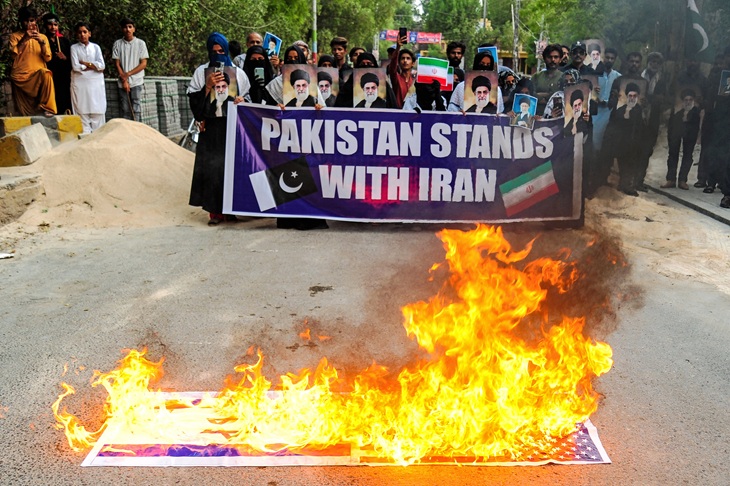
According to a report published by the official news agency of the Islamic Republic (IRNA), the purpose of the recent visit by the regime’s President, Mr Pezeshkian, to Islamabad, Pakistan, was not merely to expand bilateral relations, but to pursue the formation of a military alliance under the title of an ‘Islamic Nato’ with Pakistan. This alliance is explicitly defined as a coalition aimed at confronting the United States and Israel. According to official accounts, the Islamic Republic is to serve as a ‘missile and drone superpower’ while Pakistan is presented as ‘the only nuclear-armed Muslim nation’ both envisioned as leading forces in this bloc.
However, such a dangerous initiative could have catastrophic consequences for international security, regional stability, and even the future of the Islamic world. The reasons for concern can be analysed through several key points:
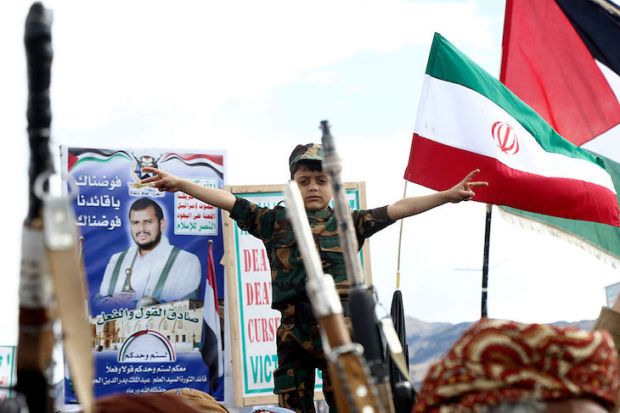
The Islamic Republic of Iran, according to numerous official reports from the United Nations, the European Union, and the US State Department, is one of the world’s largest financial, logistical, and ideological sponsors of terrorist organisations such as Hezbollah in Lebanon, Hamas in Palestinian, the Houthis in Yemen, and Hezbollah in Iraq. The leader of the Islamic Republic, Ayatollah Khamenei, has openly referred to these groups as the ‘strategic depth of the Islamic Iran’.
The US State Department’s 2023 Global Terrorism Report identified the Islamic Republic as ‘the world’s leading state sponsor of terrorism’. The United Nations Security Council Report of July 2022 condemned Iran’s arms support for the Houthis as a violation of Resolution 2216. A 2021 statement by the European Union designated the military wings of Hamas and Hezbollah as terrorist organisations.
Although the Islamic Republic has repeatedly claimed that its nuclear program is peaceful, evidence from covert activities exposed by the International Atomic Energy Agency (IAEA) and intelligence revealed by Israel suggest that parts of the program are geared toward military purposes.
If a regime that systematically violates human rights, directly supports transnational terrorist operations, and ideologically promotes the annihilation of Israel were to acquire nuclear weapons, the result could be far more devastating than the tragedies of Hiroshima and Nagasaki.
The key question is this: Would those who support Palestinian militant groups and routinely condemn Israel for defending itself be held accountable in the face of a potential Iranian nuclear strike on Tel Aviv, the Western world, or any region opposed to its ideological vision of Islam?
In April 2024, a massive drone and missile attack was launched from Iranian territory toward Israel, involving more than 300 projectiles. In response, Israel conducted a limited and targeted operation against several military possibly nuclear sites in Iran. Many observers described this as legitimate self-defence under Article 51 of the United Nations Charter.
Yet, many who hastily condemned Israel alone and remained silent about the terrorist nature of the Iranian regime are part of the broader problem. The double standards visible in global public opinion will ultimately lead to the repetition of historic catastrophes.
A military alliance between Pakistan and Islamic regime in Iran, one possessing nuclear weapons and the other deeply involved in proxy wars is not in the interest of Muslims, nor of global peace. Pakistan, a nation with a troubled history of internal conflict and Taliban influence along its borders, risks becoming a key player in a project directed by the Islamic Republic, thereby placing global security in unprecedented jeopardy. An ‘Islamic Nato’ is the beginning of a deadly game for the world.
History has shown that dangerous weapons in the hands of extremist ideologies never lead to stability. The world has already witnessed this with the rise of ISIS, the Taliban, al-Qaeda, and now the regionally influential Islamic Republic. These should serve as alarms for the global community.
Supporting the Palestinian people should not mean turning a blind eye to organised terrorism and militarism in the name of religion. It is reasonable to believe that peace in the Middle East and indeed the world depends on dismantling all forms of ideological extremism and militant fundamentalist groups.
By Leila Naseri: Author | Composer | Social Monarchy Activist