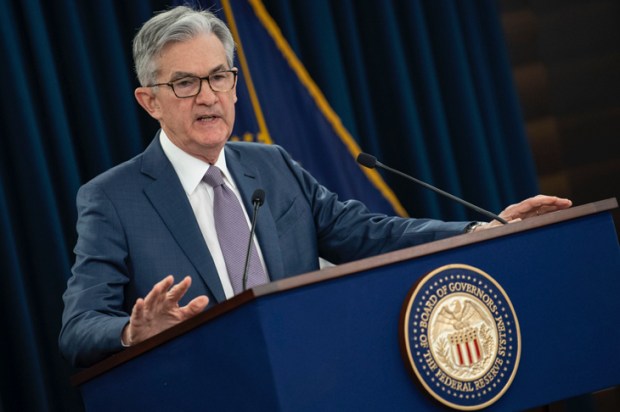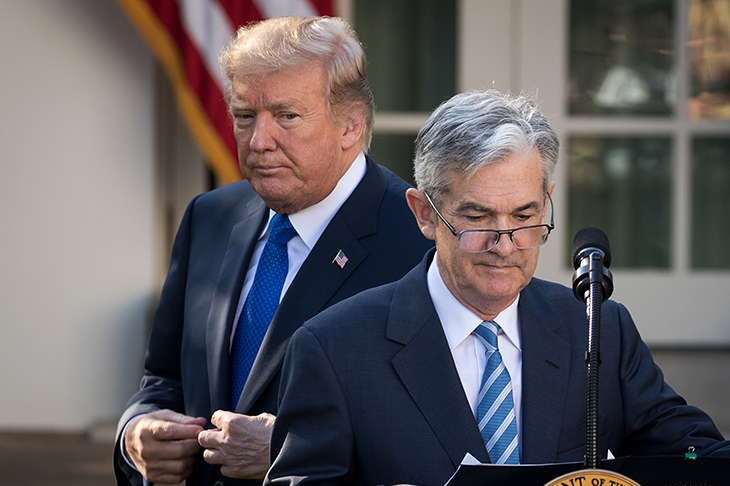
US President Donald Trump in January demanded the Federal Reserve lower the cash rate, and that he’d talk to Fed Chair Jerome Powell about this because he understands monetary policy ‘much better’ than his appointee to lead the central bank.
Trump in February bestowed the nickname ‘too late’ on Powell after the Fed chief said he was reluctant to cut rates. Revelations that month Trump was investigating whether he could fire Powell before his second four-year term expires next May spooked investors.
Trump in April slammed Powell as ‘not good at his job’ when the Fed kept the key rate steady. The president rattled investors again when he said Powell’s ‘termination cannot come fast enough!’.
In May, Trump posted that ‘Powell is a FOOL’ after the Fed chief justified leaving the US cash rate unchanged because tariffs are clouding the outlook for economic growth and inflation.
In June, Trump said a ‘great’ inflation result meant the Fed should slash the cash rate from its target range of 4.25-4.50 per cent. If not, he ‘may have to force’ ‘numbskull’ Powell to act.
Same month, Trump called Powell a ‘total and complete moron’ who has ‘Trump derangement syndrome’ for not cutting the cash rate to 1 per cent to save ‘hundreds of billions of dollars’ in government interest repayments. The White House aired sidelining Powell by naming his replacement early.
This is just some of the scheming and abuse that extends Trump’s bullying of Powell during his first term as president. Powell has withstood the barrage in that the cash rate has been left unchanged since three cuts late last year.
Apart from the threats to sack Powell, investors have brushed off the unmatched public presidential venom towards any leader of the Fed, which has set monetary policy without overt political interference since the late 1970s after this foundation was laid in 1951. If anything, investors assessed Trump’s hostility made Powell and the other 11 policy-setting board member more reluctant to cut rates.
Market pricing rarely showed a greater probability of a rate cut after any Trump insult. Even the Bank of International Settlements, which is owned by major central banks, in June said Trump’s attacks did not threaten the Fed’s independence.
But on 27 June, Trump overstepped. The watershed comment was Trump said he intends to pick replace Powell with someone who will reduce interest rates. ‘If I think someone is going to keep rates where they are I’m not going to put them in,’ Trump said.
With those words, Trump told investors the next Fed chair will be a Trump loyalist who will cut rates, and thus lower short-term Treasury yields to reduce Washington’s interest bill.
A consensus is forming Trump will end the Fed’s independence, a political gift that can be reclaimed – only Germany’s constitution enshrines an independent central bank. Trump’s comments on 8 July that ‘baby’ Powell should ‘resign immediately’ for apparently misleading Congress about renovations at the Fed headquarters reinforced these concerns.
The likely Trump takeover of the Fed is altering market pricing in expected ways. Investors are expecting sooner and bigger rate cuts. The US dollar extended its drop to 11 per cent over the first six months of this year, the largest half-year slump since 1991, because investors are avoiding US assets, especially Treasuries, amid concerns inflation will accelerate. Ten-year US Treasury yields, which react to inflation expectations, have jumped as much as 21 basis points from 4.24 per cent on 26 June.
Investors perceive the Fed’s inability to set monetary policy without political interference will snap the tenant of neoliberalism they think ushered in decades of prosperity. They fret, with reason, that politicians – especially Trump – back setting monetary policy will make decisions that rekindle consumer inflation. To reinforce such concerns, the two Trump appointees on the Fed’s policy-setting board favour an immediate rate cut whereas the others don’t.
Many argue, however, independent central banking doesn’t deserve its seemingly infallible reputation. They say central banks under political direction ran responsible monetary policies and the era of central banking under technocratic control happened to coincide with events that suppressed inflation. These developments included cheap goods from China’s industrialisation. Another was capital’s dominance over labour that suppressed wages growth. A third was the globalisation of supply lines, which allowed companies to operate in countries with low wages. A fourth was how the IT revolution reduced costs.
Whatever led to tame consumer inflation, it allowed central banks to pursue ultra-loose monetary policies whenever threats arose. Many say this had four consequences that diminish the benefits of independent central banking.
One is that promiscuous monetary policies sparked the asset inflation that has widened inequality and made housing unaffordable. A second is record low rates allowed governments, companies and consumers to embark on borrowing frenzies that have boosted global debt to a risky 330 per cent of world output. A third is low rates allowed zombie firms to survive, thus productivity slid. The other drawback is that, by avoiding smaller recessions that correct mild imbalances, central banks have likely set up bigger busts.
But it’s the investor faith in independent central banking that matters in terms of what happens on asset markets if it ends. A Fed submissive to Trump will prompt investors to further flee US assets, which could boost worldwide interest rates and even burst the asset bubbles central banks fanned.
Upsetting the framework under which the world’s most important financial institution operates threatens economic stability. The diminishing of the Fed’s credibility could rank among Trump’s most consequential and reckless decisions.
A Trump stooge as Fed chair, to be clear, does not give Trump control of monetary policy. Only a majority vote of the Fed’s policy-setting board (the Federal Open Market Committee) does that, and a president only appoints seven of those 12 positions. The other five are rotating presidents of the 12 Federal Reserve district banks who are chosen by commercial banks in their regions. But the chair has outsized influence, as, of course, does Trump. Any imminent US recession might justify Trump’s calls for Fed rate cuts. Even so, Trump’s assaults on the Fed independence could prove more damaging longer term.
Trump is hoping to become Fed puppeteer when tariff-induced stagflation and Washington’s large deficits and rising debt are unnerving investors. Let’s see if he’s much better at running monetary policy than Powell.
Got something to add? Join the discussion and comment below.
You might disagree with half of it, but you’ll enjoy reading all of it. Try your first month for free, then just $2 a week for the remainder of your first year.