The Peace of Westphalia in 1648 had attempted to resolve a previous era of religious wars and there began the development of the nascent nation states of Europe. The new fledgling states, it was thought, would herald a period of relative peace. The Jus Publicum Europaeum (European Public Law) had acted as a kind of Katechon (restrainer) between belligerent powers. Previously, wars were fought under the aegis of Christian ideology. Now it was believed that relations would be more ‘transactional’. There was a type of chivalrous respect between states. Violence was something to be exported and fought out in the colonies. This system worked for as long as there were no hegemonic powers. Industrialisation and statecraft meant that the modern era became geopolitical; the link between geoeconomics and state wellbeing ushered in the 20th Century of economic war.
Globalisation and geoeconomics has blurred the boundaries between states. Since economic power began to be seen as the end in itself, the era of European Public Law collapsed. The 19th Century liberal view of a non-zero-sum quid pro quo was the Adam Smith idea that the benefits of trade led to economic and political advantages for all concerned. Now it was a zero-sum concept of winners and losers. This was the understanding which drove US foreign policy since the second world war. The trend was one of Mercantilism. This was the idea that increases in wealth means greater power, to the detriment of the other. Therefore, geopolitics and geoeconomics became intertwined. This has heaped pressures on the system of International Law.
The problem is that modern developments of International Law and its institutions, hoping to encourage cooperation among states, is run in opposition to the unremitting dominance of Geoeconomics. Globalisation was merely a Janus-faced attempt to legitimise the concept of hegemony. A way to colonise without the need for state administration in the jurisdictions of the Orient. This has had serious repercussions for International Law. There are a few areas of conflict that illustrate the historical and growing tensions and problems within International Law.
Firstly, there is a tension between State Sovereignty and International Law. This is omnipresent as civilisational states (the US, China, Russia, India) see their diaspora beyond the traditional confines of the nation state. These states use sovereignty as a buffer to accusations of human rights abuses. Russia with its idea of ‘Great Rus’ or ‘Chinese Tianxia’ (all under heaven philosophy). The US seeks aggrandisement in the Americas. Their ambitions are geoeconomic, revanchist, and sovereign. There are disparate conceptions of what constitutes International Law; a growing tension as Mercantilism reaches its apogee. This is reflected in the conflict between sovereign national law and International Law. In Europe, for example, national judicial decisions in the UK, Hungary, for example, have opposed those of EU and international law. Within the realm of Climate, the Paris Agreement has come under pressure due to the chauvinistic assertion of sovereign rights.
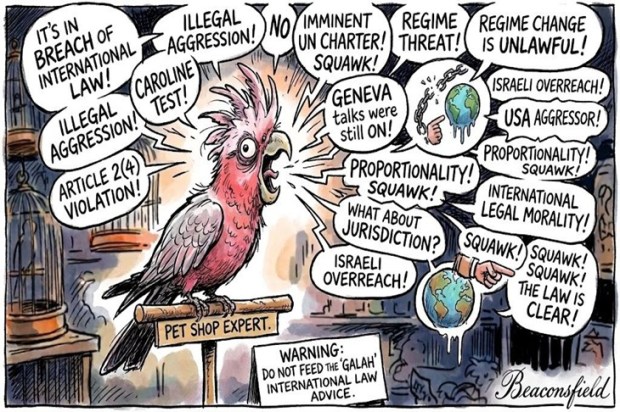
The second area of concern is compliance. There is limited enforcement capability in a system of vetoes. China’s unilateral actions in the South China Sea have continued despite the 2016 UNCLOS arbitral tribunal ruling under, which Beijing rejects. International Law requires a culture of compliance. In a world of geoeconomic enlargement this is difficult. The Russian incursion into Ukraine continues irrespective of ICJ measures and many UN General Assembly resolutions. In Gaza, despite UNHRC assertions, there has been no jurisdictional authority.
The third disparate area is multilateralism. Multilateralism is in abeyance worldwide. Multilateral institutions such as the United Nations, World Trade Organisation (WTO), and the International Criminal Court (ICC) are becoming irrelevant, routinely bypassed as aggrandising states pursue realpolitik. This is, however, partly due to the tunnel vision of liberal multilateral policy, enforcing world views on nations despite culture. The WTO’s Appellate Body has been blocked since 2019 due to the US stopping new appointments. The disarray is visible in the ICC with non-cooperation from African and Asian states. Also, new independent schemes such as the African Continental Free Trade Area and China’s Belt and Road Initiative, are run outside of universal norms. This disintegration undermines the universality of international legal law.
Yet on another level, the discord works both ways. There is a conception that Selective Application of the law exists whilst its legitimacy depends on a fair application. However, there is growing concern about fairness in enforcement. For example, despite well-documented abuses by Special Forces in Iraq and Afghanistan the ICC has concentrated on African cases. Sanctions, equally, appear from the perspective of the Orient as lob-sided. The Targeted Sanctions Consortium, a global research network that systematically analysed over 60 UN sanctions regimes established since the end of the Cold War, saw political bias and also neutrality unevenly employed.
The neoconservative policing of the world, up until the Trump administration, failed to account for the disparate cultures and interests at work in the world. Ideas such as human rights and multilateralism were always written in a liberal occidental script. Now, emerging nationalisms and dominant civilisational states question the idea of multilateralism and result in the present push back.
In foreign policy, particularly that of the US, diplomacy is on the ropes. It reflects these cultural seismic shifts. The US, in particular, adopts maximalist demands. The purpose is always quick solutions to difficult problems. Modern culture and technology likewise delimit personal interaction. Modernity, although blessed with infinite information, has lost the intimacy of dialogue. International Law is only as efficient as its diplomats. Kissinger noted this in his World Order:
‘The discussion and exchange of ideas has for millennia provided an emotional and psychological dimension in addition to the factual content of the information exchanged. It supplies intangibles of conviction and personality. Now the culture of texting produces a curious reluctance to engage in face-to-face interaction, especially on a one-to-one basis.’
This cultural tendency, an oblique one-dimensional communication, adds to the problems between Occident and Orient and the need of International Law to take account of growing grievances in other realms.
Anne Peters at the Max Planck Institute notes a general dissatisfaction towards the inefficacy of global legal institutions:
‘The power shift towards the East, the groundswell of dissatisfaction with the excesses of economic globalisation, and the unfolding ecologic crisis generate a deep critique against international institutions, procedures, and principles as they stand … a new International Law is needed which pays attention to corporate human rights, responsibility to digital constitutionalism, cyber due diligence, or animal rights.’
Yet it may be that, in an era of increasing nationalisms, International Law becomes increasingly irrelevant despite the well-meaning of its practitioners. Universality is the hopeful idealist, born of the Enlightenment, now in its final death throes. Leaders jostle for the role of the next Charlemagne. To bring order from the chaos.
Brian Patrick Bolger LSE, University of Liverpool. He has taught International Law and Political Philosophy. His new book: ‘Nowhere Fast: Democracy and Identity in the Twenty First Century’ is published now by Ethics International Press. He is an adviser to several Think Tanks and Corporates on Geopolitical Issues.