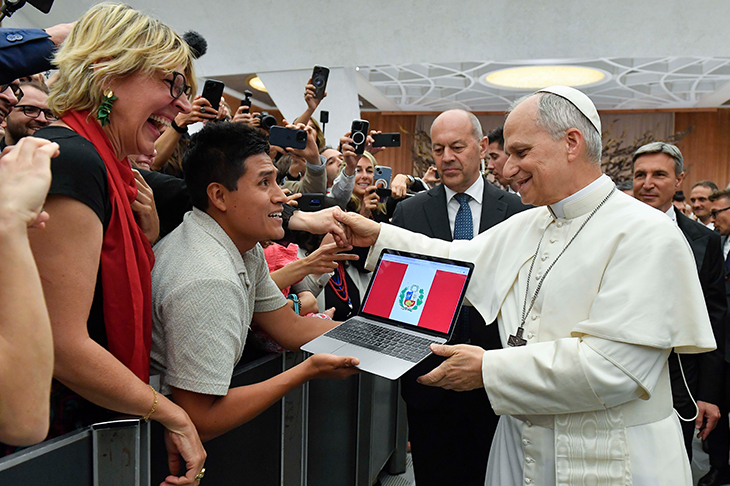
If a pleasant and cordial personality is a reliable indication, the Roman Catholic Church can look forward to calmer days under its new pope, Robert Prevost, now Leo XIV, than it was accustomed to under the unpredictable papacy of his predecessor Pope Francis.
More productive days too, in its mission to spread the Gospel with greater doctrinal and moral clarity after the confusing and at times deliberate ambivalence generated by many of Francis’s utterances, particularly his off-the-cuff ones.
Beyond this, there’s nothing much that can be predicted with certainty about the new Leonine papacy. But several things are suggested by the character of the man and the little he has so far shown of his modus operandi.
He has a capacity for administration, demonstrated when he was a bishop in Peru (American-born but a Peruvian citizen, Prevost had gone to South America as a missionary with the Augustinian order) and in his later appointment as head of the Vatican’s department for appointing bishops. A small clue to the direction he will take as pope was visible in his first public appearance on the balcony of St Peter’s directly after his election. He was wearing the traditional papal attire of mozzetta (a little cape) and stole in which popes have been depicted since the Middle Ages. Pope Francis, on his election, appeared without it. Since nothing in papal protocol is accidental, this was a signal that Francis was breaking with the past. And so he went on to do with his exaggerated belief that the 1960s Second Vatican Council was effectively a new beginning for the Church after its two millennia of existence, and his cumbersome project for reforming ecclesiastical government, handed down from apostolic times, through his own ‘democratic’ invention of ‘synodality’ (basically a vast talking shop for pushy laity). This, while simultaneously consolidating in himself supreme authority in the Church, which in theory is ‘collegially’ shared with the world’s bishops. Francis’s centralising tendencies saw the authority of the bishops well on the way to being reduced to the authority the local bank manager has in relation to head office.
Leo has already committed himself to ‘the path that the universal Church has now followed for decades’ since the Council but gives no sign of being obsessed by that event. His decision to dress as a pope stated clearly that he sees himself in continuity with the Church first, Francis perhaps afterwards. Not that there are lacking liberal commentators insisting that the Francis papacy will live on in Leo. No doubt the best parts of it will, especially the concern for the ‘peripheries’ of humanity, but not slavishly.
Leo’s choice of name also declares continuity: fourteen Leos is a lot of history. The first one, Leo the Great, faced down the conquering Attila the Hun in 452 and saved Rome.
It is unlikely that this Leo will be, as Francis tended to be, a disruptor – a disruptor of the Church, that is, not so much of what the world around it approves of. The confrontation has already begun, with the LGBTQ etc high command expressing itself ‘worried’ by some of his past remarks, eagerly dug up by activists. His somewhat pejorative references to ‘homosexual lifestyle’, and to same-sex ‘families’ being neither the real thing nor compatible with Christian morality, have been interpreted as evidence of ‘social conservatism’, in contrast to Francis, who was super gay-friendly to the extent of giving several spectacular abusers sanctuary in the Vatican.
Francis’s intention that the post-Vatican II Church be seen in discontinuity with the past except in essentials was manifest in his restrictions on the celebration of the Tridentine, or traditional, Latin Mass and his frequent and tiresome habit of sniping at ‘traditionalists’, who would previously have been considered just ordinary orthodox Catholics, for being ‘backwardists’ and ‘rigid’ and even hinting none too delicately that they needed psychiatric attention.
That will stop. For a missionary pope, the collapse of faith in the West, and the need for imaginative evangelisation, will be a huge priority, to which the last papacy’s dislike of the old Mass is irrelevant. But the evangelistic potential of that rite is clear. Its return to widespread use over the last twenty years has been driven by largely youthful congregations who have shown that they prefer its spiritual clarity and depth to the reductive version of the Mass put together by a committee in the wake of Vatican II. This success alone earned the old Mass the enmity of those elderly clerics such as Pope Francis still able to persuade themselves, in the face of all the evidence of post-conciliar decline, that Vatican II was ‘a new springtime’ for Catholicism. The new pope would seem to be free of this divisive prejudice against the old rite and able to value its growing appeal.
An eloquent indication of Pope Leo’s priorities is the name he has chosen. The Guardian sees (wishfully) in this evidence that he will be a ‘reforming’, i.e. progressive pope, because his predecessor namesake Leo XIII supposedly was, being much concerned with the rights of workers and unions. It should be remembered though, that in the field of ecumenism, which liberal Catholics love, Leo XIII was anything but progressive. He was the pope who declared Anglican orders ‘null and void’, that is, that Anglican priests were not priests in the (Roman) Catholic sense, which High Church Anglicans believe they are.
The media called Francis a ‘people’s pope’. He was, but only for some people. Pope Leo’s first speech suggests that he will want to reconcile ‘the entire Christian community’, which obviously includes factions in the Church manipulated by Pope Francis in his whimsical Peronist way of playing them off against each other.
Got something to add? Join the discussion and comment below.
You might disagree with half of it, but you’ll enjoy reading all of it. Try your first month for free, then just $2 a week for the remainder of your first year.