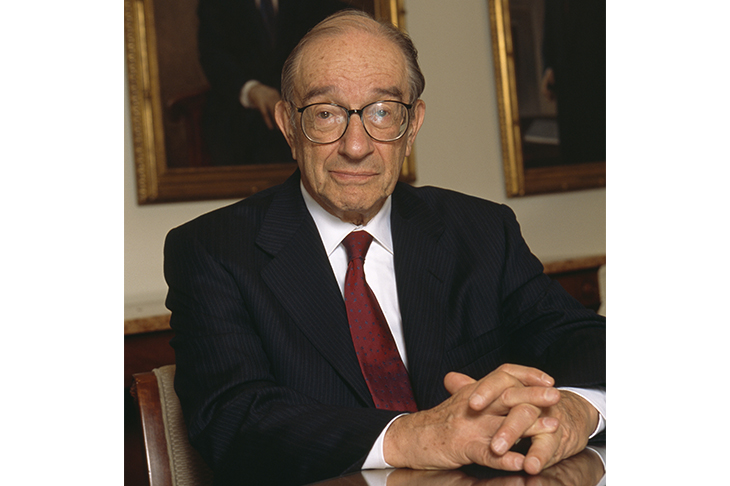
On Monday, 19 October 1987, the US share market dropped on opening by about 10 per cent, double the slump of the previous Friday. Federal Reserve chief Alan Greenspan called a meeting of the Fed’s policy-setting board. No action was proposed though one board member urged Greenspan not to fly from Washington to Dallas that day to give a speech.
But Greenspan did travel. On arrival, he asked a Dallas Fed official how the stock market had fared. ‘It was down five zero eight,’ came the answer. Greenspan felt vindicated in travelling, given the stock market had lost only 5.08 points. ‘What a terrific rally,’ Greenspan said.
But the Dallas Fed official looked pained. Greenspan realised the man meant the Dow Jones Industrial Average had plunged 508 points, nearly 23 per cent for the largest single-day percentage loss in history.
Amid concerns the Chicago Mercantile Exchange could collapse due to ‘Black Monday’, the Fed early the next day issued a one-line statement that affirmed ‘its readiness to serve as a source of liquidity to support the economic and financial system’. In the first hour of trading that Tuesday, the Dow recouped 40 per cent of the previous day’s losses.
Such is Greenspan biographer Sebastian Mallaby’s account of the birth of the ‘Greenspan put’, a nickname that references how ‘put’ options limit stock losses.
The Greenspan/Ben Bernanke/Janet Yellen/Jerome Powell puts in place since have consisted of rate cuts, reassuring statements and asset buying (quantitative easing). Other helpful steps for stocks were emergency liquidity facilities installed to prevent the collapse of financial (bond) markets and the financial system (banks). Other central banks have adopted the put strategy.
The flaw inbuilt into this approach, however, is central banks need to be able to muster some credible and effective actions during a crisis. That’s not guaranteed. Yet investors today believe the Fed will provide its undeclared safety net because the central bank has so often rescued stocks – as of mid-April, investors were pricing at least three Fed rate cuts this year.
History since 1987 explains why investors expect a Fed rescue. In 1998, the Fed cut rates when Russia defaulted on debt. Ditto in 2001 when dotcom stocks crashed. When the global financial crisis unleashed in 2008, the Fed slashed the cash rate to zero, conducted quantitative easing for the first time and launched fourteen emergency lending facilities.
Much the same happened during the pandemic in 2020. The Fed lopped rates to zero, conducted unprecedented asset buying and launched special facilities. The banking crisis of 2023 showed the Fed has honed the art of supporting trouble spots even when restricting the economy with higher interest rates. The Fed reinforces investor faith in its put by rarely, or only slowly, reversing emergency actions when markets stabilise.
Over all these episodes, one factor gave investors faith in the Fed put; that inflation was not viewed a threat.
While no law forces central banks to protect stock markets, they justify their rescue missions as preventing slumps that could hurt economies – they are haunted by a belief their inactions deepened the Great Depression. Plunging asset prices can make consumers feel poorer and jittery. That restricts the consumer spending that drives economies.
Harmful side-effects of this government intervention in markets include that it encourages, even rewards, excessive risk-taking and cultivates the asset bubbles the Fed then comes under pressure to protect.
Mallaby wrote that Greenspan employed the Fed put even though he knew it was wrong to ensure bubbles never fully burst. He encapsulated this doublethink in the title of the biography of 2016: The Man who Knew. Mallaby argued Greenspan knowingly acted carelessly when Fed chair – usually under the cover of preserving jobs – because ‘he calculated that acting forcefully against bubbles would lead only to frustration and hostile political scrutiny’.
The political pressures are magnified under President Donald Trump. The Fed has no wish to let asset markets crash. But a central-bank put can become ineffective, even counterproductive. And that’s the case today when Trump’s policies and the uncertainty he generates are sabotaging the US and global economies while stoking US inflation.
The Fed put only works when inflation is around its target of 2 per cent and it has scope to help. But US core inflation is 2.8 per cent and could head beyond 5 per cent. Rate cuts would prove to be insignificant when the US cash rate is at a lowish 4.25-4.50 per cent. Zealous quantitative easing might only support asset prices to a point where it doesn’t and the damage would be even larger. Trump’s tariffs might even boost inflation and inflation expectations (already at a 44-year high) so much the Fed might want to raise rates.
Like all contracts, central-bank puts expire – defined here as its absence or losing its effectiveness – unless the Fed is willing to tolerate higher inflation. That expiry arrives sooner when investors have hyped the latest technology (artificial intelligence) to create a stock bubble, world (government, corporate and personal) debt is at record levels, and a US president is testing the Fed’s credibility by pressuring the central bank to cut rates when his policies fan inflation, wreck economies, create a China-US trade war, overturn the global economic order, shake Western politics and make US government bonds trade like risky assets.
On 4 April, Powell seemed to rule out any Fed put when he warned Trump’s tariffs could boost inflation in a way that ‘could be more persistent’. The end of the Fed put would mean the decline in US stocks and the wider turbulence on asset markets is just starting.
Circumstances, to be sure, could arise that force the Fed to intervene on bond markets. Such actions might prevent a financial collapse. But Trump’s upending of everything means they would be unlikely to revive the US economy and stock market. Other central banks have more scope to place puts.
Since Trump announced global tariffs on 2 April, the S&P 500 Index has slumped as much as 19 per cent from its record high of 19 February. How much could the index fall when investors grasp the Fed put is kaput? During the Great Depression – when no Fed put was imagined – the Dow Jones plummeted 89 per cent over four years. Stocks are unlikely to dive like that. But they are likely to tumble much more than the two-day decline of 27 per cent in October 1987 that inspired the Greenspan put.
Got something to add? Join the discussion and comment below.
You might disagree with half of it, but you’ll enjoy reading all of it. Try your first month for free, then just $2 a week for the remainder of your first year.