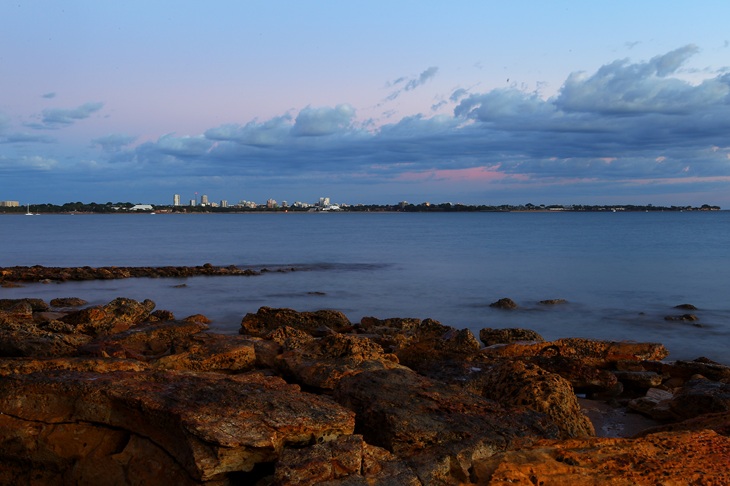
In 2015, the Northern Territory Country Liberal government, controversially, leased the run-down port of Darwin to Chinese company Landbridge, to encourage its commercial development. At the time, relations with China were promising, ASIO and the Turnbull government had no objection.
It is now realised that the current ownership structure may limit the port’s military expansion; our priority for development is security. In 2021, the Australian Strategic Policy Institute flagged the difficulty in potentially unloading sensitive military equipment at the port as its ownership stands.
The original occupants of the area, now known (at least for now) as Darwin, were the Larrakia people, who knew the area as Garramilla. Always a trading port, the locals visited outer islands on both sides of what is now the sea border with Indonesia. As Labor and the Prime Minister seem reluctant to confront the issue, perhaps we could get the local Indigenous group to negotiate the port’s return?
With Europeans surveying the area for habitation in 1869, the community was yet another settlement originally named after Lord Palmerston, the British Prime Minister at that time. With the discovery of gold in the early 1870s, the port, always known as Port Darwin, became an important connection. With the goldrush came a massive influx of Chinese. By the late 1800s, over 6,000 were in the area. They worked their own claims, established market gardens, cooked, made clothes, and became involved in commerce. To this day their descendants, in the Chung Wah Society, maintain the Northern Territory Chinese Museum.
The name of the town was officially changed to Darwin in 1911. The connection with evolutionary biologist Charles Darwin related to a visit by the ship, The Beagle, in 1839. The previous voyage of the Beagle took five years, from 1831-36, but Darwin was onboard for only 18 months, frequently stopping off for his research. Although he was not present on the next voyage, the ship’s Captain Commodore Wickham, named the port after his past companion.
The importance of the port was recognised, by Japan, if not Australia, with Japanese involvement in the second world war. In February 1942, after the fall of Singapore, over 200 planes bombed Darwin and its military airfields; this was the first of 100 raids on the city over the next two years. Navy, Army and RAAF bases, had been constructed in the 1930s, the US military also had had a presence since 1941. These were their primary targets, but widespread damage occurred to transport ships and the town, with around 250 killed.
A subsequent enquiry concluded the town had been under-prepared both with anti-aircraft guns and planes, the ships in harbour were also under-prepared for the attack. The end result was the abandonment of the port to shipping, but a steady build-up of airfields and planes.
Lying in the Tropics, Darwin has also been exposed to nature’s climate assaults, with damage from cyclones in 1897 and 1937. Following recovery from military assault in the war, Darwin settled back into tropical lethargy, in 1974 rudely awakened by Tropical Cyclone Tracy, the worst in Australia’s history. This Category 4 cyclone caused massive damage for the 47,000 inhabitants, destroying 80 per cent of the buildings, 66 were killed and 30,000 were evacuated. A massive recovery project resulted in the city’s rebuilding over three years.
Today, Darwin is a city of 140,000, 50 per cent of the Northern Territory population, with an Aboriginal population of around 10 per cent while around 5 per cent claim Chinese ancestry. The city has an unenviable history of alcohol abuse and violent crime, it has held the per capita world record for assault! Alcohol restrictions in 2019 produced a dramatic fall in assaults, only to be reversed when the State Labor government relaxed the bans.
Apart from its international airport, which witnessed many ‘first flights’ in the early days of aviation, there are many airstrips, used during military exercises. The RAAF has upgraded its Northern base at Tindal, outside Katherine, and there is, since 2012, a permanent detachment of US marines and planes, including a rotation of USAF B52 bombers; these modifications are intended to reduce the risk of Chinese attack in Taiwan, Japan, and Australia.
There are also regular international exercises, involving many ASEAN countries.
As Chinese interference increases, both in the air and at sea, the importance of a base at the ‘top end’ is being remembered; this is Australia’s gateway to Asia. The latest provocative incident, with a small Chinese fleet circumnavigating the country, has demonstrated both the increased threat and our inability to respond to it. Our military is under-powered, under-equipped and under-manned.
With Trump now in charge, the Western World has had a wake-up call, we must increase our capability to match the world’s largest navy and army; it is time to develop Port Darwin to deal with that risk. A government review in 2021 and again in 2023, surprisingly found there were no strategic implications from the current lease, but the Chinese Belt and Road activity, has been ignored for too long. China would not allow foreign control of a vital asset, nor should we.
The question is whether the Prime Minister will cope with the inevitable trade consequences of a lease cancellation; talks have now commenced, with the Landbridge director already announcing the port is not for sale. Compulsory acquisition may be required.
In 1848, Lord Palmerston, still the name of a small Darwin suburb, quoted, ‘We have no eternal allies and no perpetual friends. Our interests are eternal and perpetual, and those interests are our duty to follow.’