Colombian President Gustavo Petro on 26 January ‘deauthorised’ the repatriation of handcuffed compatriots on US military aircraft after footage emerged of shackled Brazilian deportees being treated ‘like criminals’ on their arrival in Brazil.
US President Donald Trump responded with threats of tariffs, tougher customs inspections and other sanctions against the US ally. Within hours, the White House said Petro had agreed to ‘all’ Trump’s terms and deportations would recommence.
Hail another triumph for the weaponisation of US financial might, where this practice is defined here as using US economic dominance to achieve political goals.
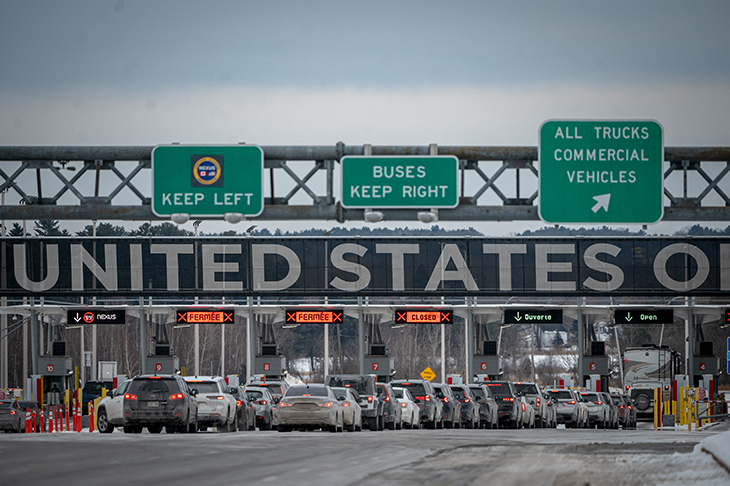
It’s a common US tactic. Trump ostensibly imposed, then delayed, tariffs on Canada and Mexico over the illegal flow of people and drugs to the US. He has enforced tariffs on China for challenging US power. He threatens financial coercion on Denmark for not surrendering Greenland, on Russia if it continues the Ukraine war, and on the ten Brics countries if they ‘dedollarise’ to escape US financial sanctions. (Trump’s policy to impose tariffs on all US imports has an economic aim – to stop the US being ripped off trade-wise, his view of trade deficits.)
Amid the Petro and Trump posturing, came a pointed comment from Zhu Jingyang, China’s ambassador to Colombia. Zhu boasted ties between Beijing and Bogotá were ‘at the best’ since relations were established in 1980.
China’s ambassador isn’t exaggerating. China has so won over Latin America with investment and trade Joe Biden’s motorcade passed through Lima streets full of people waving Chinese flags at the Apec summit in Peru in November. Peruvians preferred to honour Chinese President Xi Jinping, who was centre stage in the official photo while Biden was in the back row.
Here’s why. China’s bilateral trade with Latin America has rocketed from US$14 billion in 2000 to US$500 billion in 2022. China is now Latin America’s second-biggest trading partner and South America’s largest.
China’s opportunity to exploit Trump’s deportations to further court Latin America shows how the US weaponisation of its economic might via tariffs, blockades and sanctions risks backfiring – focusing here on the unintended, hidden and longer-term setbacks for the US (rather than the more-immediate ‘pain’, as Trump described it, from faster inflation, slower growth, fewer jobs and retaliation).
Start with tariffs. Those imposed from 2017 by Trump and Biden have prompted countries to reduce their export dependence on the US.
Ruchir Sharma, author of 2024’s What went wrong with capitalism, says that since 2017 world trade has stayed around 60 per cent of global GDP, yet the US share has dropped from 18 per cent to 15 per cent – a slump of 17 per cent in terms of market share. Same result for trade as a percentage of national GDP – US share down, others up.
The world is overlooking the US in trade pacts too. Since 2017, the US has inked zero deals, while the EU has signed eight and China nine, including a 15-nation one in Asia. ‘Trump 2.0 seems likely to bring more of the same: trade without America,’ Sharma says.
Another way Trump tariffs can backfire is if they hurt spluttering trading partners such as Germany so much demand falls for US exports.
Then there’s the cost of breaking treaties. Doubts about the durability of trade deals such as the one between Canada, Mexico and the US reduce the incentive and ability of US companies to ‘near-shore’ production. Even threatened or temporary breaches jeopardise plans.
Another risk is countries weaponise their financial clout. Governments could lower currencies to impede US exports. They could restrict capital flows to the US, by, say, boosting taxes on such investments.
Turning to Washington tech sanctions against China, US stocks tied to artificial intelligence dived on 27 January after Chinese start-up DeepSeek unveiled a cheap chatbox that rivals Western ones. US tech icon Marc Andreessen called DeepSeek’s feat ‘the most amazing and impressive breakthrough I’ve ever seen’.
Such Chinese success, even if questionable and achieved in nefarious ways, is happening despite Washington’s ban on the sale of high-power AI chips to China since 2022. But that’s capitalism. Driven people overcome hurdles to invent better products, while the protected get complacent.
As well as exposing the failure of Biden’s industry policy on microchip domination and defusing the buzz around the US$500 billion AI infrastructure project Trump just announced, China’s chatbot feat highlights how the seven US tech giants that form 30 per cent of the S&P 500 Index are vulnerable to ‘creative destruction’. Yet these stocks are priced like they are as safe as government debt.
Any stock ructions, however, would be minor compared with the blow to global living standards that would be wrought if US financial sanctions were to backfire.
While the US has resorted to financial coercion since the Embargo Act of 1807 targeted France and the UK for harassing US ships, their use has ballooned in recent times. Foreign Affairs magazine counts that Trump in his first term imposed an average 1,000 sanctions a year, double the tally of Barack Obama.
Washington can inflict such torment because the US dollar is the world’s dominant reserve currency. US-dollar transactions by foreign banks fall under US jurisdiction as these banks must hold accounts at the Federal Reserve.
The foreseeable consequence of, say, stealing Russia forex reserves in 2022 for invading Ukraine is that Western rivals will create a competing currency. That won’t be easy. But if US foes dedollarise – and it’s almost inevitable they will, the financial world will split in two. A World Economic Forum study in January suggested a bifurcated world would reduce annual global GDP by up to 5 per cent, or US$5.7 trillion.
The weakness of the US weaponising its financial muscle is this: while the US can pressure one or a few countries, the world’s biggest and wealthiest economy can’t outcompete all, or even much, of the rest of the world if opponents cooperate. Today’s era, where politics eclipses economics, is a lose-lose one.
The US, to be sure, has achieved political goals with financial threats. To appease Trump, Canada deployed drones and helicopters to police the border, while Mexico filled in smuggler tunnels. But there are ways to achieve political aims without pushing allies towards foes and losing global trade share. Other countries employ financial sanctions too.
But Washington overuses the tactic. Trump’s victory over Petri will likely encourage more financial bullying that undermines US economic security.
Got something to add? Join the discussion and comment below.
You might disagree with half of it, but you’ll enjoy reading all of it. Try your first month for free, then just $2 a week for the remainder of your first year.