So impressed with the Samoans’ numerous canoes and their great skills in handling them, French Admiral Louis de Bougainville named their homeland in 1768 the Navigator Islands.
256 years later, on a Saturday afternoon earlier this month, my Samoan friends were on the south coast beach having a dress rehearsal barbecue for the imminent visit by King Charles, Queen Camilla, and all the heads of the Commonwealth for the CHOGM meeting.
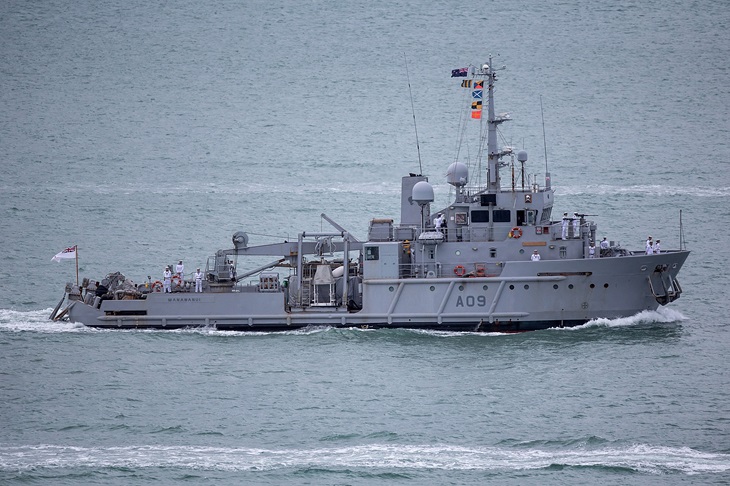
Like most Samoans, my friends have more than a passing knowledge of things maritime and they observed this high-sided ship, very close to the ‘lee’ shore with a strong breeze, slowly moving as is required for hydrographic duties. A ‘lee’ shore is where the wind is blowing the ship towards the shore. Experienced sailors, from small yachts to big ships, know that you stay well clear of a lee shore. Boating 1.0.1!
In my four years training at sea, navigation and seamanship were two key elements of ship safety and the particular ship that I was on, a passenger-cargo ship trading between Australia and the South Pacific, we had to keep two miles off the land, rocks, or small outcrops. If it was a ‘lee shore’, the captain would make it three miles. In case there was a power failure, this would give the engineers time to restart the engine as we had backup fuel pumps, air starts, cooling systems etc.
Avalanched with calls from friends and media to give commentary on this New Zealand ship grounding, I kept my opinion to myself until I found out the facts. Brace yourselves readers.
Did it run aground because of a female skipper? My answer is no, and being from a merchant navy background I can tell you that as far back as the 60s, the Russians had the first female officers and female captains on many of their cargo and passenger ships. Mind you, they were more Georgian than gorgeous, but they were highly competent and were, appointed on merit, as are all merchant navy captains, male or female. My friend Inger Thorhauge, who is Captain of Cunard’s latest liner Queen Anne, started her seagoing career at 16, as I did, and she achieved this prestigious position purely on merit, experience, and current Certificates of Competence.
In just over seven years at sea, off watch, I could sleep well knowing that other watchkeepers were experienced and capable of navigating in busy waterways, reduced visibility or close quarters. The Master would mostly be on the bridge during these times.
My experience with Naval ships was winning the National Service lottery where I could get shot at in Vietnam or go on board Royal Australian Navy (RAN) ships as I was already a qualified navigator with five years of sea experience. I chose the RAN because it would get me the sea time necessary to sit my Masters foreign going certificate. The RAN was an eye opener and due to budget constraints and crew shortages, subsequently the ships actually seldom went to sea and crew experience and competence at that time was, in my opinion, very limited. Junior officers were not allowed any decision-making even on watch and I didn’t sleep well in the broom cupboard cabin I was sharing with three other guys down in the bowels of the HMAS Melbourne and the HMAS Supply when we were at sea. I recorded my experiences in Baird Maritime columns at the time, mostly to the disbelief of my merchant navy colleagues.
All of this leads me to ask, why was the New Zealand vessel skirting so close to an island with a lee shore under the watch of Captain Yvonne Grey? Boating 1.0.1, remember?
Was the ship suitable for the task? Having been involved in the design of hydrographic ships, to choose a second-hand ship with a 26m air draft (height of windage above the waterline) for slow steaming operations in windy conditions was not an optimal choice for the task, but typical of the defence procurement bungling bureaucratic process as highlighted frequently by Greg Sheridan of The Australian.
Would the combination of, in my opinion, an inexperienced Captain and a sub-optimal vessel be a recipe for a disaster? Yes! Now you have a clearer picture.
Another New Zealand commander crashed another Navy vessel earlier this year in Auckland to the tune of $220,000 in repairs.
Setting aside the cause of these accidents, which remain under investigation, the discussion of DEI within the Navy is a proud feature of their website which is why it is being discussed. It is a legacy possibly left over from former Prime Minister Jacinta Ardern who not only stuffed the New Zealand economy but was foisting such DEI policies into unsuspecting government bureaucracies such as the Navy. DEI policies for onshore establishments may be unpleasant but are workable, however, bosses there won’t put your life at risk. At sea, it is an entirely different matter, and such policies should be unacceptable and certainly not boasted about.
DEI policies, proudly printed on recruitment sites, would be a deterrent to any potential navy applicant, even female ones, who know full well this imbalanced system could see an individual treated differently due to their gender, sexuality, or race.
Was the evacuation and sinking of a very expensive ship a ‘triumph’ as described by New Zealand’s Defence Minister and Navy Chief Judith Collins? What puerile nonsense from Collins in her weak response to a shameful incident!
On a happier note, a previous CEO of a South Pacific Island Ferry informed me several years ago he had been instructed by his government to take at least 50 per cent female trainees, in-line with DEI suggestions from matriarchal New Zealand.
‘Was it a success?’ I asked him.
‘It was a 100 per cent success,’ he responded.
‘How do you mean?’
‘All of them were pregnant within six months,’ he happily replied, ‘so we are back to normal, taking applicants on merit, male or female.’