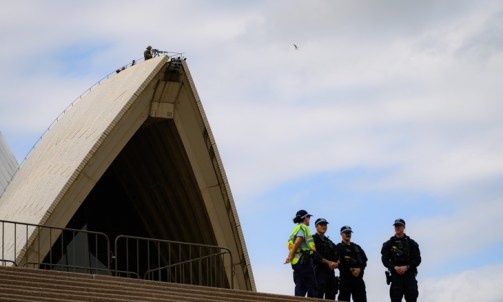
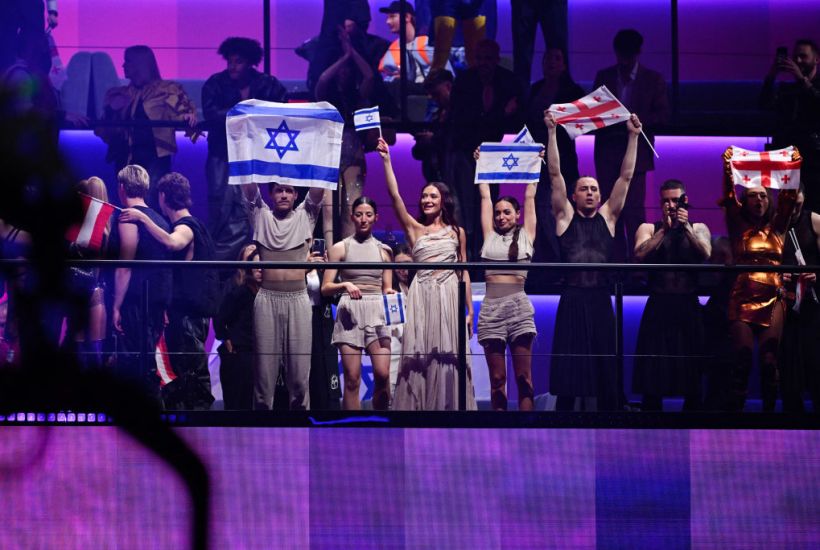
Eden Golan has qualified for the final of tonight’s Eurovision Song Contest and will represent Israel in the world’s most-watched cultural event. How she’ll get there is another issue: the pro-Palestinian crowds outside the venue (including Greta Thunberg) are so formidable that at one point yesterday Golan’s security team said it was not safe for her to leave the hotel. Yet again, the Eurovision final will become a massive collision of politics, music and culture: the world’s most-watched non-sporting event.
To many Brits, Eurovision is a concert of bad musical taste and a festival of camp trash. The BBC, which chooses the UK entry, certainly seems to see it that way which is why our competitors tend to be so bad as to be a passive-aggressive insult to an entire continent. I’ve long seen Eurovision a different way: a forum of low-culture, but no less important for that. It unites a global audience through the medium of schlager: a kind of carabet where humour, choreography and music come together to pitch for the votes of a mostly-drunken electorate across dozens of national and language barriers.
Yet again, the Eurovision final will become a massive collision of politics, music and culture: the world’s most-watched non-sporting event.
To most, it’s just a laugh (or a tacky horror show). But for those who want to understand European politics, more can be learned from Eurovision voting than in watching a year of European Parliament debates. It’s a scene of diplomatic drama, where hatchets are buried or battlelines drawn. Israel giving 12 points to Germany in 1984 for Nicole’s A Little Piece was a landmark in reconciliation between the two countries. Turkey’s 2003 victory was the high water mark of its Europhilic ambition; Ukraine’s 2006 victory presaged its Orange revolution.
In Israel, the only democracy in the Middle East, the Eurovision cultural bat signal is seen very clearly. It’s a chance for Israel to be seen by the world not for conflict but for what it is: a liberal, democratic country. The avant-garde culture of Tel Aviv comes across: the way it nurtures a diversity of identities that could get you imprisoned or killed in pretty much any of Israel’s neighbours.
Eurovision matters a great deal to small countries. They get to parade their European credentials on the world stage. The elation of the Georgian team when they made tonight’s final was moving and reflects what’s happening back home: protesters battling police every night, fighting the threat of a new law that could end Georgia’s EU entry hopes and put it on track for Russian. But when does anyone in the West pay any attention to Georgia? Tonight, briefly, millions will. So these small countries try to think carefully: what message to send? How to articulate the historical moment?
Israel won in 1979 with Hallelujah: a Hebrew word understood everywhere, cleverly emphasising cultural commonality at a time when entrants had to sing in their own language. In 1998 Israel won with Dana International, a trans woman whose professionalism showcased an aspect of Tel Aviv’s culture that might never have been given a global airing otherwise. Then came the 2018 victory of Netta, an orthodox Jewish singer whose look and style challenged the female performer archetype. ‘Thank you so much for choosing different,’ she said in her victory speech. ‘Thank you for accepting differences between us.’
Netta proved that you can win while defying the aesthetic of pop beauty. Everyone is now following her playbook. If you watch the final tonight you’ll see all kinds of weird stage acts (Finland and Ireland especially) as artists beg voters to ‘choose different’. Netta’s anti-supermodel vibe anticipated a trend — just as Dana International, an act named in homage to Ireland’s 1970 Bogside winner, presaged Austria’s now-famous Conchita. But it was Israel, a country on the periphery of Europe, that was the cultural trailblazer.
Israel dared to be different, which is the story of its existence. This is what has inspired Jewrovision in Germany, a celebration of Jewish music again through schlager — and the largest Jewish youth event in Europe.
Israel dared to be different, which is the story of its existence.
Israel gets the chance to be seen not as a country perpetually at war. Instead, it can be understood as a place where all types of people can not just survive, but innovate and thrive. It’s a reminder of what the Jewish people have created: a democracy that’s world-leading in tech, academia and culture. They turned desert into farms, built Tel Aviv from nothing and created an oasis of tolerance, in a part of the world where being gay can get you imprisoned or worse. It’s not just a county and economy but a double-identity culture: of West and East, mixing ultras with secular.
It’s not as if everyone on Israel is pro-Netta: there are is no shortage of people in Jerusalem who see the festival as an assault on taste, music and basic morality. Ultra-orthodox Jews were protesting last time Israel hosted Eurovision, annoyed at work done in defiance of the Sabbath.
But Israel is a place where the views and the rights of the minorities have cast-iron protection: the only place in the Middle East where it’s genuinely okay for a Muslim (or anyone) to be openly trans or gay. This is what baffles me about those criticising Israel’s inclusion now. BBC Newsnight had a long interview with a drag performer saying she had cancelled her Eurovision party in protest at Israel’s inclusion. Good luck hosting that party in any other country in the region.
Israel is a beacon of democratic diversity and tolerance in a Middle East that is at war with those values. The 7 October massacres forced Israel into yet another war for its survival. How it fights that war is, to put it mildly, a matter for debate. But this evening is about music where Israel takes its hard-earned place in a Western cultural forum celebrating values of tolerance — in whose defence Israel is fighting a war. The theme of this evening’s Eurovision is United Through Music. Now more than ever, that unity means nothing if not extended to Israel.