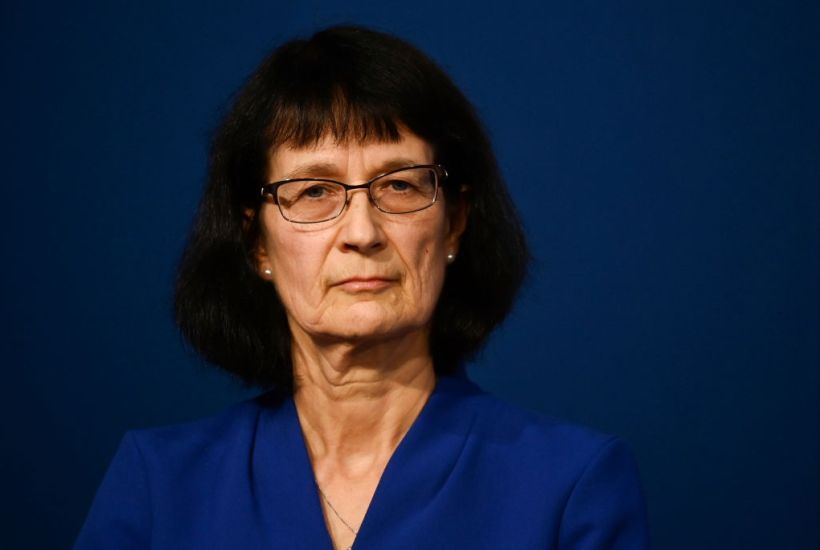
Next time there’s a pandemic, the advice of Dr Jenny Harries will be crucial. She runs the UK Health Security Agency, set up during Covid to replace the much-maligned Public Health England. In her interview with the Telegraph there seemed to be a penny-dropping moment where she suggested that Britain may be more like Sweden next time:
What we saw with Omicron and later waves of the pandemic, and even now, is that people are good at watching the data and they will take action themselves. You can see it in footfall going down. People actually start to manage their own socialisation, and the [viral] waves flatten off and come down.
She missed a crucial point here: it wasn’t just after Omicron. Brits locked themselves down from the offset, in wave one, long before lockdown was needlessly imposed – a common-sense solution. And something that the modellers failed to take into account. This crucial, demonstrable fact disproves lockdown theory, hastily assembled by Professor Neil Ferguson and exported – to disastrous effect – worldwide. The work of Ferguson’s group at Imperial took as its assumption the idea that the virus will spread at a constant exponential rate (or R-number) that can only be reduced by state mandates: non-pharmaceutical interventions, or NPIs.
The below graph summarises this fiction, so often presented as fact. It assumes that lockdown shoots Covid out of the sky, overnight.
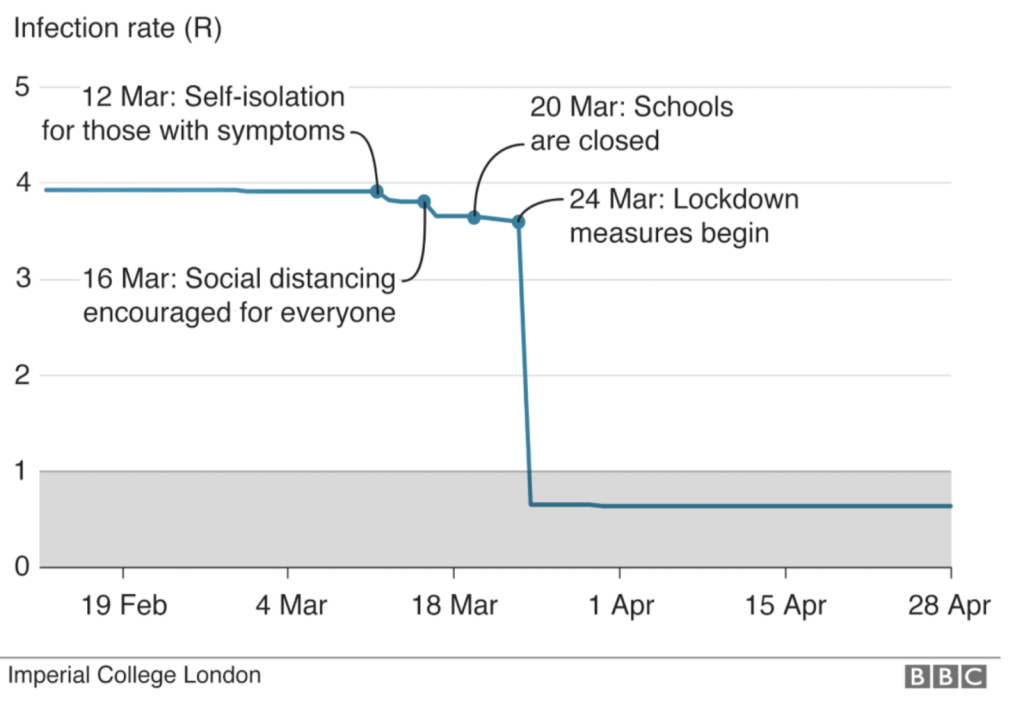
Ferguson’s doom graphs were all based on this false premise but his report purported to tell every country how many dead there would be if they didn’t lock down. Figures of 85,000 for wave one were produced by Sweden, which never locked down and ended up with just under 25,000 deaths over two years of Covid. Why did Ferguson get it so wrong? Why did the Sage graphs end up being such nonsense?
Because they didn’t factor in the behavioural response: that, in a high-information democracy, people would keep track of the news and take their own evasive action. It has been argued that the obedient and sensible Swedes did so, but Brits are more unruly. This can easily be disproved by mobile phone data, via Google Mobility data, which gives unprecedented detail on who goes where. It shows the UK response was sharper than Sweden’s before the first lockdown.
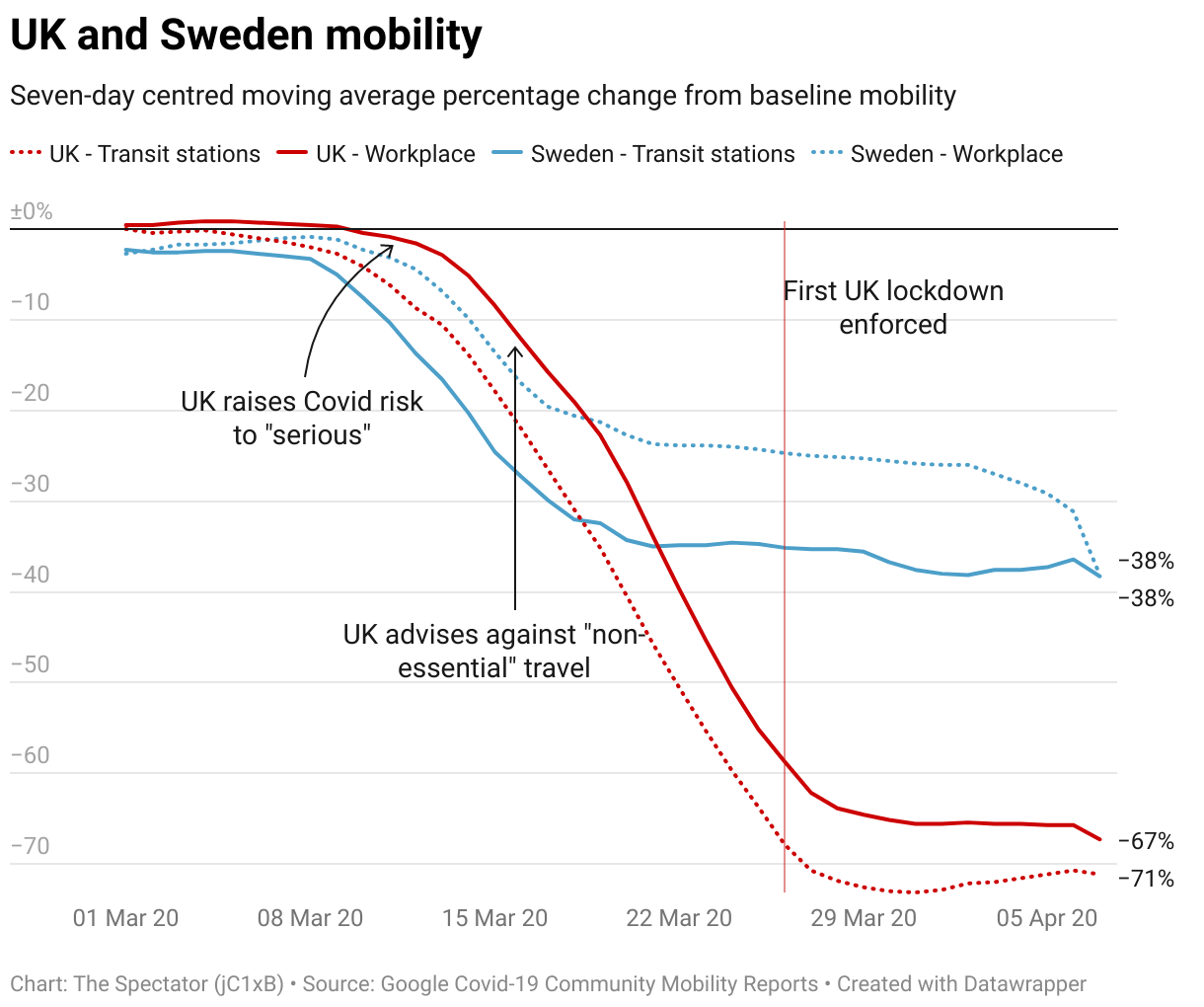
First time around, you could forgive people for not noticing. But lockdown very quickly went from being a draconian and unproven theory implements on a test-and-learn basis to being an orthodoxy that should not be challenged. When data did emerge exposing the Ferguson cliff-edge theory as nonsense, it was ignored. In fact, academic studies drawing on actual (rather than Imperial’s imagined) figures suggest Covid had actually been forced into reverse before the first lockdown was imposed. How could Ferguson’s lockdown theory explain the below?
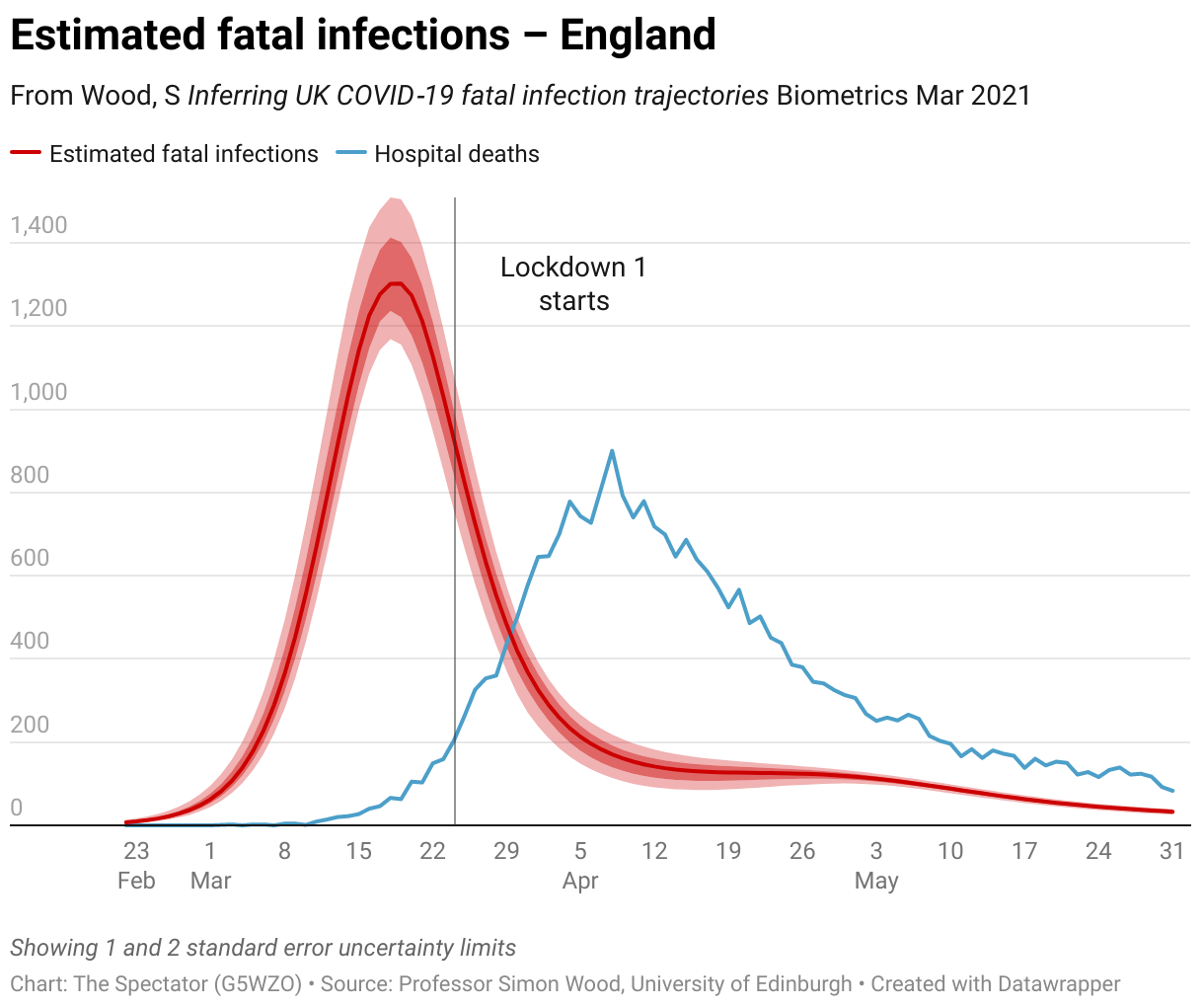
All this really is quite important and Dr Harries cannot in all good faith suggest that the British only started responding quickly after Omicron. It’s possible – even likely – that her colleagues were not tracking Google mobility data during the first wave and simply not know how quickly Brits had locked down. But the data is now there for all to see.
This should be the single most important fact in any pandemic response. We now know, from observed data, that people lock themselves down and can do so in such numbers as to force a virus into reverse. But Dr Harries is a serious woman: why would she speak of an organic behavioural response after Omicron and not before other waves? Perhaps because doing so would admit that the Sage graphs that kept Britain locked down for so much of 2021 were based on a false premise. The minister responsible for the UKHSA is Neil O’Brien, who devoted much of his time to hounding academics and others who questioned lockdown theory.
Perhaps Dr Harries waiting for the inquiry to point this out. If so, this delay is actively dangerous: a new pathogen could emerge any moment and now is the time to be asking questions. We are living in the quiet between the viral storms, and need to use this period well. Speaking honestly about what happened in March 2020 is vital: there really is no time to lose.