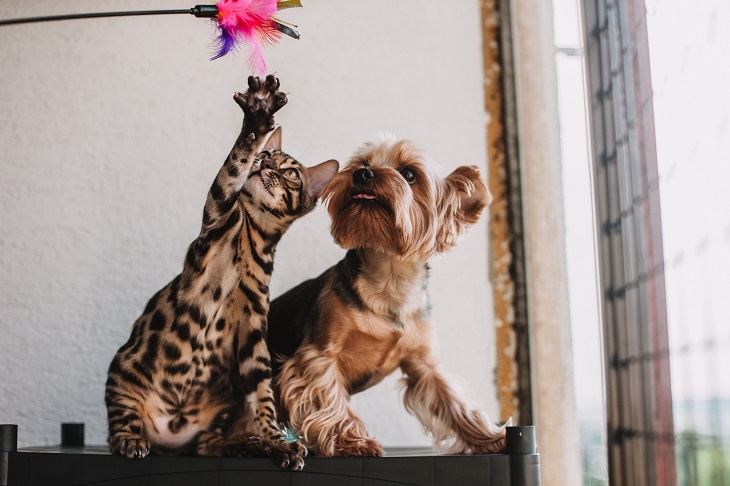
Our four dogs really really wanted to kill our cat. From their perspective, one day they were the supreme pack doted upon by the various humans that inhabited the farm – the next, they had to accommodate this higher-order creature that was allowed to sleep inside the laundry.
We didn’t buy the cat. She showed up, curled on a hay bale in the front paddock as a grey smear of skin and bone. There was a rare cat breeder down the road that used to abandon animals that weren’t of ‘show quality’. This cat was an expensive breed of Chartreux – or would have been if she didn’t have a little white spot on her stomach. They were bred from Syrian mountain cats and were installed in ancient French monasteries to hunt mice.
Rescuing her required precisely no skill after the cat invited itself into the car and meowed at us saying, ‘The heck you been?’ as if we were some kind of Cat-Uber service. We named her ‘Leeloo’ after a sci-fi female protagonist that similarly conned their way into a car.
In any case, the dogs were smart enough to know they couldn’t outright pounce on the cat and tear it to bits. The humans would suss that situation and enforce some sort of punishment. Dogs understand this concept. You can tell they employ a rudimentary concept of ‘right and wrong’ when they look guilty after ‘marking’ all the cars in the driveway or digging up the Azaleas.
Aside from a few advantageous air-bites when the dogs thought we weren’t looking, the canine pack hatched a new plan. Every morning and every evening they’d push their way into the laundry and eat the cat’s food. The logic, as far as we could tell, was to starve the cat to death. Victory and snacks. Top plan.
It’s pretty clever when you think about it – and a tad alarming when you realise that your animals are playing ‘the long game’ against one of the other family pets. Turnabout is fair play. I suspect Leeloo was playing a similar game with the nesting swallows that idiotically built their nest above her bed inside the laundry. Picking fur directly out of the back of a high-end predator to line the nest isn’t the best option for continued survival.
Meanwhile our dogs failed to factor two important variables into their ‘kill the cat’ plan: the first is the virtually unlimited supply of food available to the cat and the second is the lifespan of the cat. Actually, there was a third… All that extra cat food made them heavier, rounder, and slower.
The cat outlived its furry adversaries and as far as we know, Leeloo only knocked off one swallow in 18 years after the bird flew straight into the cat’s face at high speed. We tried to get Leeloo to hunt useful things, given the breed was famous for its mice-catching skills, but Leeloo only caught mice to annoy us – leaving bits of tail, ear, and severed feet outside the front door if we committed a crime, such as running out of her favourite food. We were the ones that had to hunt the mice and river rats.
I share this story because starving out the opposition is a tactic that transcends the animal kingdom. Politicians, for instance, are quite fond of this approach because it allows them to avoid direct confrontation for which they might be punished – even if they succeed.
ESG (Environmental, Social, and Governance) is a corporate version of ‘starving the cat’ where politicians collude with big business to decide the most lucrative direction for the economy. Politicians agree to kill off corporate competition, almost always by culling small and independent business, and in return the few remaining mega corporates spend advertising dollars propping up political campaigns – such as the never-ending Pride Month.
This might not be Mussolini’s union-dominated fascism with delusions of a workers’ revolution, but it is a breed of fascism.
The purpose is not to create socially and environmentally responsible businesses – how could it? By design, ESG leads to ‘affirmative action’ better known as racial and sexual discrimination where companies are enticed to sack staff based upon their appearance and replace them with ‘diversity’ as if human beings were Pokemon cards. Nor can it be for the sake of the environment where small family businesses with tiny carbon footprints are destroyed in favour of global corporates whose CEOs cause more environmental damage flying to conventions than a mum-and-dad business creates in its lifetime.
No, ESG is a corruption of capitalism to ‘starve’ parts of the economy without the need for politicians to stand up and declare that they are punishing citizens who refuse to vote for them by making those citizens poor – taking their businesses – and making sure they’re pushed to the bottom of the job list.
This cannot happen in a functioning economy where there is an endless pool of consumer wealth to go around, undermining nefarious ESG intentions. Like Leeloo, those businesses would continue to out-compete their plump rivals.
However, politicians have cut off the pet food supply. By making ESG a requirement of trade, and with the implementation of Digital ID transactions to ensure the anonymity of cash is stripped from the world, there will be nowhere to hide from the rise of this new fascism. No one voted for this, but somewhere in a backroom with a few anonymous handshakes, the decision was made for us.
ESG means the wolves win and the pets eat each other. It will be done in silence, without a single press conference, and without a single election speech.
Alexandra Marshall is an independent writer. If you would like to support her work, shout her a coffee over at donor-box.