In 2003, Iceland, a country with fewer people than the Sunshine Coast, strove to become a global banking hub. Within five years, Icelandic banks had expanded their assets (loans) 10-fold to 900 per cent of GDP, as fishermen and smelter workers who had turned into investment bankers gave compatriots foreign-currency loans to invest in property and stocks. Come the global financial crisis, alas, Iceland’s banking sector collapsed as foreign money fled. Capital controls were imposed to stabilise the country.
That was the first time an advanced country acted against the free movement of capital across Western borders since global capital flows started swelling from 2 per cent of global GDP in 1980. They peaked at 21 per cent of world output in 2007, before receding to 15 per cent of global GDP last year.
Global capital flows offer many benefits but come with two flaws. They can cause problems, often political, if they pour in rather than trickle. But the bigger menace is that foreign capital can bolt and create turmoil as it scrams.
That is the risk worrying the European Central Bank, the International Monetary Fund, the Reserve Bank of Australia, and others about a tightening in Japanese monetary policy.
They fear that higher Japanese interest rates will threaten global financial stability if they prompt the Japanese to repatriate enough of the US $3.8 trillion they hold in foreign investments.
The Japanese are the biggest foreign holders of US Treasuries (at 4 per cent). They hold 11 per cent of Australian debt, 10 per cent of Dutch bonds, and 8 per cent of New Zealand’s debt, between 1 and 2 per cent of major stock markets, and 6 per cent of eurozone debt.
The background to the threat is this. Since the Japanese asset bubble burst in the early 1990s, the Bank of Japan (BoJ) has undertaken the world’s boldest monetary experiment to revive Japan’s economy and combat deflation.
In 1999, the BoJ pioneered zero benchmark interest rates. In 2001, it invented quantitative easing. In 2016, it adopted negative interest rates, a policy devised by Denmark four years earlier. It also conceived the policy of ‘yield-curve control’.
Central banks usually control just one short-term interest rate (in Australia, it’s the cash rate) and allow other rates to be set by the market. But for the past seven years, the BoJ has controlled another rate as well. It anchored Japan’s yield curve by fixing the 10-year government bond yield at 0 per cent. (This is something the RBA attempted to do to three-year Australian government bond yields but failed.)
The BoJ’s yield-curve policy was only intended to be a short-term fix because it was confident lax monetary policy, one of the ‘three arrows’ of Abenomics, would stir inflation to its 2 per cent target. (The other arrows of Shinzo Abe’s radical economic policy were fiscal super-stimulus and micro reforms.)
But Japan’s economy remained plagued with sporadic deflation and stop-start growth. So, Japanese investors ventured overseas for decent returns, and monetary policy stayed aggressive.
Unfortunately, in persisting with its yield-curve policy, the BoJ paralysed bond trading, which made bond pricing dysfunctional.
To stimulate the economy in 2018, the BoJ allowed the 10-year yield to move 10 basis points either side of 0 per cent. But not enough transactions ensued. So in 2021, the BoJ widened the band to 25 basis points either side of 0 per cent.
Let’s congratulate the BoJ because, guess what? Inflation is back in Japan. It reached a 41-year high of 4 per cent in 2022 and now sits at around 3.5 per cent.
Investors know the BoJ must soon de-radicalise monetary policy. Anticipating higher yields, they are selling bonds to limit imminent losses.
This has forced the BoJ to increase its bond purchases beyond what is sustainable. The IMF in May estimated the BoJ now owns 70 per cent of outstanding five-year Japanese government bonds and more than 80 per cent of outstanding 10-year Japanese government bonds.
Since the BoJ cannot credibly go on buying bonds forever, the central bank must widen the band again or abandon the peg. Either way, Japanese bond yields will jump.
The world knows higher Japanese interest rates could be traumatic because of what happened on December 20 last year.
On that day, the BoJ doubled the 10-year bond target to 50 basis points either side of 0 per cent, in what was meant to be a tightening of monetary policy, not a spur for bond trading.
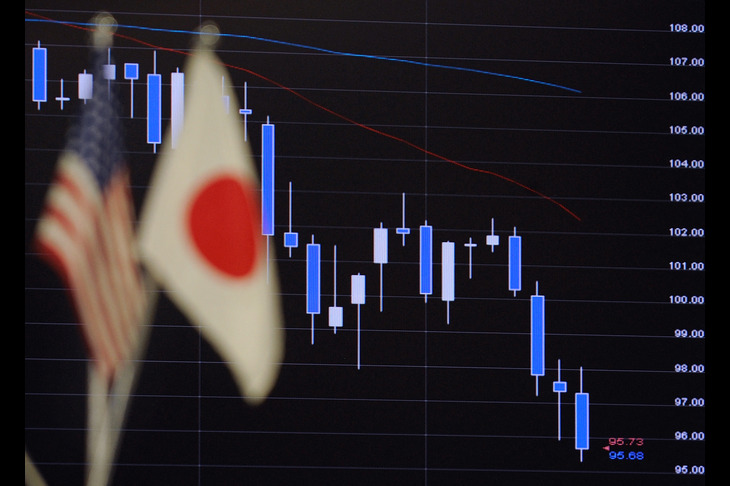
But with just that tweak, magnified by its surprise, bonds plunged, the yen soared, and global markets trembled.
The IMF warns further monetary tightenings will gyrate exchange rates, boost bond yields, and prompt global investors to demand more return for risk, undermining asset values worldwide.
The eurozone, which is just one shock away from another financial crisis, is the most vulnerable.
In Japan, higher yields could hamper indebted local ‘zombie’ companies and bloat interest payments on Tokyo’s gross debt, which stands at 260 per cent of output.
That an inevitable tweak to Japanese monetary policy can cause so much turmoil vindicates those who fretted that radical monetary policy would create havoc when it was unwound.
To be sure, the ECB, IMF, and RBA warn of other threats to financial stability besides Japan.
And any BoJ move on the 10-year yield wouldn’t be the surprise it was in December. Even if the 10-year bond peg vanishes, Japan will still have a lax monetary policy. That might limit how much money gushes back to Japan.
Money already returning has boosted Japanese stocks to their highest levels since the early 1990s, so it’s not all financially damaging. The Icelandic experience is probably an overblown warning.
True. But the money flowing to Japan could become a torrent and expose how reckless policies come with blowback. Just ask Icelanders.