Conservatives in Victoria are well accustomed to disappointment and defeat. Not only did the state’s Liberals lose their third election straight, their ALP opponents have held office for 20 of the last 24 years, while the cultural Left has completely reshaped the state: think near-permanent Pride parades, left-leaning literary festivals, and an education system bordering on indoctrination. So dire is the state of conservatism, Victoria is effectively a one-party left-liberal state.
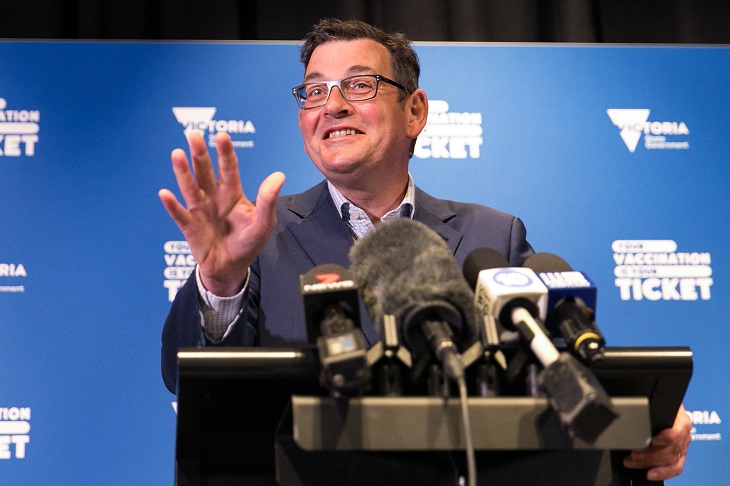
What worsens this malaise is the endurance of the state’s left-socialist leader, Dan Andrews. He is a man who’s despised by the Right, and is not without his own controversy and ill repute. Yet the Premier is in the midst of a series of milestones. Recently, Andrews marked 3,000 days in office and is thus eligible for bronze immortalisation. In April he’ll pass John Cain as Victoria’s longest-serving ALP leader. And if Andrews stays full term, as planned, he’ll become the second-longest-serving Premier in the history of the state.
Such occasions are taken as a vindication of Andrews’ efforts and thus the usual hagiography. As such, one example is that of Monash professor Paul Strangio. ‘Andrews is a titan,’ he says. A colossus whose accomplishments include a ‘suite of gargantuan transport projects’ and ‘adventurism in social policy’. The latter is a euphemism for a range of uber-liberal endeavours including moves to decriminalise sex work, establishing Victoria’s first drug-injecting room, and further supporting the state’s LGBTQ+-aligned Safe Schools program.
Strangio adds that Andrews is a ‘premier of national consequence’. A figure who ‘became a pioneer of voluntary assisted dying laws’ and who’s been in the nation’s ‘vanguard by embarking on … a treaty with the state’s Indigenous communities’. Less popular and unmentioned in the article, are the state’s gender–fungible birth certificates and legalisation of medical cannabis.
All of which boosts Andrews’ liberal bona fides and his ‘effectiveness as a progressive reformer’. For as is frequently observed, including by Andrews himself, the Premier leads Australia’s ‘most progressive state’. The implication of this is obvious. As with most of the Western world, ‘progressivism’ is a byword for improvement. The more left-liberal we become, the better we ostensibly are. An interminable left-liberalism is thus the telos of our time.
Yet the problems with all this are the obvious ones. By what criteria is this progress? What, if any, of these reforms will endure? Like Zhou Enlai’s apocryphal remarks on the French Revolution, it’s far too early to tell how history will judge the Andrews era.
On any number of measures, however, the Andrews-led ALP is already a failure of note. Victoria had the worst Covid figures of any state as well as the most onerous restrictions. A stance worsened by Labor’s disastrous and diversity-inspired hotel quarantine program and Andrews’ own obfuscation and amnesia. Victoria also experienced a mass exodus and now has the largest debt of state in the land. The state has also witnessed once-unheard of crimes like carjacking and gang riots, and Melbourne’s loss of its much-vaunted ‘world’s most liveable city’ crown.
As like elsewhere around the world, the feel-good expansion of progressivism is usually accompanied by a regression in matters of real import. Take California, for example. Commonly known as the most progressive place in America, the Golden State is now the site of its own exodus and some of America’s worst social metrics. A scene we see repeated across the West where our cheerily promoted ‘progressivism’ is belied by the decline observed upon the ground.
And so it is with Victoria. To take another key metric, as Victoria has become more progressive not only have people fled the state, the ones who’ve remained have given up on the future entirely: with Victoria having the lowest fertility rate of any state in the country. An irony that is evidently lost on Andrews et al. As the more vociferously they promote Pride marches and the other aspects of their uber-liberal agenda, the older we get and the more atrophied we become.
A disaster that’s not addressed by any changes to our settings, nor by Andrews acknowledging the failures of his liberalism, but in unsustainable mass migration. As Victoria, like the rest of the country, has come to rely on mass immigration – now 75 per cent of the nation’s population growth – to inflate its economy and mask the entropic effects of its left-liberalism.
Why, then, has Andrews prevailed? Simply, he’s been the fortunate beneficiary of a series of broader trends. For one, he’s merely the latest Labor leader in a thoroughly leftist state: the third ALP Premier this century and further proof that the proverbial ‘drover’s dog’ could lead the party to victory in Victoria.
Something we see replicated across the country – with the ALP in control in Canberra and in six of our eight states and territories – and throughout the Western world: with the Left in power in New Zealand, Canada, and America to name just a few. A trend that is largely due to demography and that has rendered the Right almost unelectable and men like Andrews virtually unopposed.
Yet this does not mean there are no grounds for critique. Although Andrews and his 3,000-day reign appear unimpeachable, we must not confuse longevity or ‘progress’ for quality. Longevity is often little more than base popularity, while our worship of progress is the latest instance of what the philosophers call ‘historicism’. That is, the view that one’s particular time is the apogee of the historical process, with no recourse to other values.
But it’s in nature where Andrews and other liberal leaders show their inadequacy and where they must be judged. As the philosopher Leo Strauss observed, nature is the standard by which we can evaluate political action. As Strauss states in his What is Political Philosophy?, ‘All political action aims at either preservation or change.’ Simply put, we seek to preserve what is good and change what is bad. A notion, of course, that implies a standard outside of our current fashions, whims, and choices. Preserving public health and harmony, for example, are permanent goods that shouldn’t be upended for the sake of ‘progress’ or the feel-good demands of diversity.
And it is on these grounds where Andrews and his agenda must be critiqued. Under such criteria, Andrews’ progressive reforms can’t be seen in any favourable light. His fungible birth certificates and the associated ‘gender-transitions’ performed in various Victorian hospitals, for example, must be condemned for the utterly ruinous effects they have, especially on the young.
The establishment of drug-injecting rooms is also encouraging a behaviour that many leaders, notably Singapore’s Lee Kuan Yew, have thought highly pernicious and deserving of the strongest punishment possible. The normalisation of cannabis will also lead to predictably disastrous results. Added to this is Andrews’ encouragement of mass immigration. A movement that decreases social trust and that has seen certain groups vastly overrepresented in our crime statistics.
Andrews’ infrastructure effort may be seen in a better light, but this is also not an unalloyed good. Although immense in its score – Victoria’s Big Build, as it is known – many of the projects seen across Melbourne could easily be classed as White Elephants: little more than busy-work and patronage programs for ALP allies. Indeed, the whole scheme seems little more than an economic stop-gap now that Victoria is no longer home to its once-famed car factories and industrial base.
To Andrews’ credit, though, through such initiatives he has avoided the mass unemployment and misery seen in the American Rust Belt and other areas of deindustrialisation and decline. Still, it’s hard to believe that the best our brightest policy minds could come up with is a never-ending series of building projects.
The only positive legacy of the Andrews’ era may prove to be his Level Crossing Removal Project. An undertaking that has shaved hours of people’s monthly commutes and improved the aesthetics of much of Melbourne.
Yet that appears to be it. The reality is that the Andrews’ era will ultimately be seen as a time of left-liberal overreach and incipient social fracture. A period more likely to be known as 3,000 days of tragedy, not of triumph.
As like most leftist leaders, the Andrews’ reign will be viewed as a variation on remarks made by the Roman poet Tacitus: He created a wasteland and called it progress.