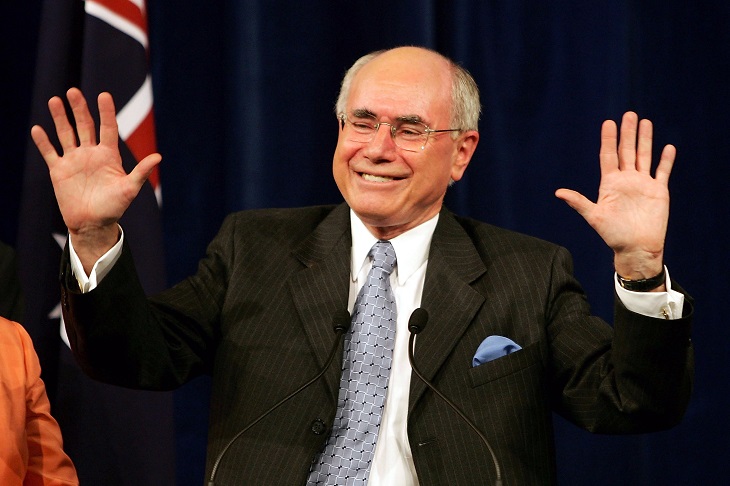
The Hawke government introduced Medicare in 1984. Once John Howard replaced Andrew Peacock as Opposition Leader in 1985, Howard repeatedly criticised Medicare as not being fit for purpose.
In his biography John Howard, Prime Minister, the late David Barnett records that Howard promised in December 1986 that, in his new Coalition family policy, ‘Bulk-billing under Medicare would go, except for those classified as disadvantaged, and there would be the option of belonging either to [the revamped] Medicare or to a private health fund.’
After the loss at the 1987 election, in December 1988 Howard produced the policy blueprint, Future Directions. In that document, the following was said regarding Medicare:
‘Australia’s health care system is in a shambles. The real villain is Labor’s doctrinaire commitment to a universal government health insurance system, Medicare. By discouraging self-provision, by increasing health funding from the taxpayer and removing disincentives to overuse of medical services, Medicare has created a system obsessed with cost at the expense of quality, security and comfort.
‘It is almost inevitable that a largely government-funded system will be a government-controlled system […] Our policy will confront these questions, reduce the role of government in the provision of health insurance, and restore effective choice.’
History records that in May 1989, Howard was cruelly dumped as Liberal leader, and Future Directions was also dumped. As Barnett wrote, the change in leadership was a mistake, since it became unclear what the Coalition stood for (sound familiar?). He also noted removing Howard was a gift for the Hawke government:
‘Hawke, his government and the minders could hardly believe their luck. Colin Parks, a former ABC journalist who was subsequently to become Hawke’s senior political adviser, was dumbfounded. ‘Why have they done that?’, he wondered, when Barnett told him what had happened. ‘Our research showed us the Future Directions was starting to bite.’
After its loss at the 1990 election, the Coalition, under the leadership of John Hewson, went to the 1993 election with a health policy that was very similar to Future Directions and Howard’ statement in 1986. Unfortunately, as John Howard wrote in his autobiography, Lazarus Rising:
In my opinion the Coalition’s health policy proved to be a very heavy liability, particularly amongst women voters. The severe restrictions proposed for bulk billing and other elements of the policy […] were immensely unpopular. 1993 was the last time that the Liberal Party would propose major changes to Medicare.
Even though Medicare was popular with voters, since it was, at the time, not yet 10 years in existence, it was, unfortunately, difficult to comprehend how prophetic Howard’s words would be in terms of Medicare’s failures.
The Coalition, therefore, under Howard’s leadership, went to the 1996 election with a signature policy to keep Medicare but also introduce a private health insurance rebate, in order to facilitate choice and encourage people to take out private health insurance. It is a policy that both sides of politics have kept in the 27 years since then. As Howard stated in Lazarus Rising:
If the incentive is withdrawn, or too heavily means-tested, then there will be a decline in the number of people being insured, which in turn will push more people into the public hospital system at an increased cost to the taxpayer. That would be a bad public policy outcome.
Howard’s predictions about the cost blowouts of the Medicare system have since been borne-out, with both sides of politics contemplating introducing a co-payment for GP visits. When the Abbott government introduced legislation in 2014 for a co-payment, Labor, as is its want, does (or says) one thing in government and then the complete opposite in opposition, and blocked the co-payment.
Since then, no government has thought about, let alone engaged, in serious policy discussions regarding Medicare. As we know, throwing more money at the health system, just like anything else, does not solve the problem. In many ways, it makes it worse. Anyone who thinks the current public hospital system around the country is working brilliantly, in the words of Kerry Packer, needs their head read. Ambulance ramping at record levels and still going up, record wait times in emergency wards, nurses on strike, staff shortages, and that is just in Western Australia.
However, even more critically, it seems Howard’s predictions all those years ago about the quality of medical services and the level of government control due to Medicare have also come true.
As noted in a recent missive from the Australian Medical Network, the Grattan Institute recently analysed Australia’s health system and found Medicare is broken to meet the needs of doctors and patients in the 21st century. They suggest a radical makeover of Australia’s public healthcare system to rectify the problem with general medicine and bring it up to date with the rising number of chronic disease cases in the nation.
According to the report, general practitioners are more difficult to reach, there are more patients overall, and presentations are getting more acute and complicated. GPs should spend more time with patients rather than moving in the opposite direction and cutting back on consultations, as is being advocated.
The institute cites a lack of funding and a serious skills shortage where doctors are not drawn to a career as a GP. Read the full report here.
The Grattan institute’s model raises the following questions (as noted on page 68 of the report):
- Why is the individual and their health needs not currently at the centre of the model instead it is at the bottom?
- Why is the government deciding what is best for health and not doctors and patients?
- GPs are leaving in droves because medicine has become heavily regulated, and they are unable to treat their patients with the individual care they deserve.
To address these questions, the report suggests, among other things, true leadership from government, rethinking financial resources and incentives, and a removal of regulatory barriers. This brings to mind another declaration from Howard in Lazarus Rising: ‘Our hospitals need more beds and fewer bureaucrats.’
Whether any political party has the courage to address the serious problems with Medicare identified by the Grattan Institute that John Howard foresaw in the 1980s, is unfortunately, highly debatable at the least. And in the meanwhile, the health system continues to worsen.