The world laughed last week when news spread that the Green-run government of Germany’s North Rhine-Westphalia approved the removal of a wind farm to make way for the urgent expansion of a coal mine.
Europe’s energy crisis, partly caused by Russia’s invasion of Ukraine and subsequent disruption of fossil fuel supplies, has revealed critical weaknesses in the Utopian promise of renewable energy.
In order to salvage the energy grid before Winter, politicians have been rapidly scaling up nuclear, coal, oil, and gas to make sure their people don’t freeze to death or stage a revolution.
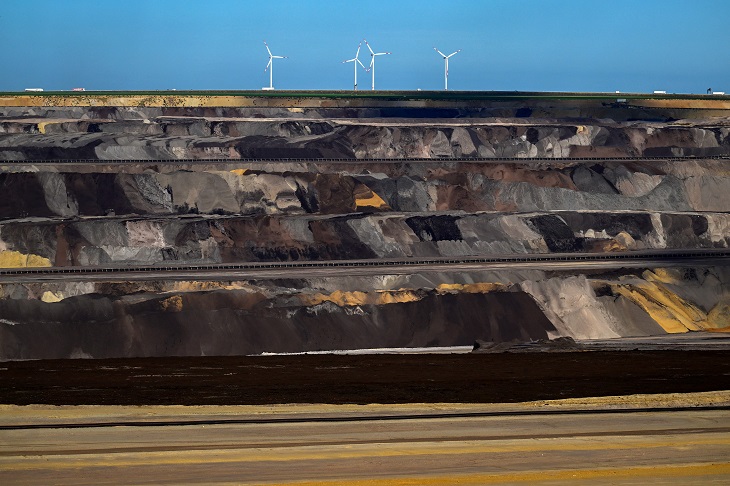
In North Rhine-Westphalia, this means plucking wind turbines out of the ground to make way for the Garzweiler lignite mine.
Eight wind turbines constructed in 2001 are marked for death with one already felled.
Guido Steffen, spokesperson for German energy company RWE, noted that, ‘We realise this comes across as paradoxical, but that is as matters stand.’
Or ‘deal with it’, as the internet meme goes.
‘The three lignite units each have a capacity of 300 megawatts. With their deployment, they contribute to strengthening the security of supply in Germany during the energy crisis and to saving natural gas in electricity generation.’
In comparison, the turbines produce 1 megawatt per hour if a wind speed of 15 metres per second is maintained, making them a woeful second to lignite.
The German Cabinet approved the decision to give the lignite mine and three reserve power plant units a second lease on life despite being tagged for decommissioning in 2023. Reality has usurped green policy, forcing politicians to act sensibly rather than ideologically.
Not everyone is happy. The Ministry for Economic and Energy Affairs in North Rhine-Westphalia wants RWE to ‘reconsider’, with a spokesperson telling the Guardian that they want the wind turbines to left in operation for as long as possible.
That probably won’t happen. The German government subsidies that led to the construction of the wind turbines have expired – which means that the so-called ‘cheap energy’ doesn’t have much to offer when compared with the lignite beneath its blades.
After 20 years in operation, the Keyenberg wind farm owned by Energiekontor is approaching its end of life and will probably require what they call a ‘repowering’. It’s written to sound like wind farms have some sort of mythical eternal life, but ‘repowering’ is a fancy way of saying ‘ripping it out and rebuilding it’ and serves as a reminder for how wasteful and short-lived wind power really is.
The energy crisis isn’t bringing about the ‘end of wind’. Germany continues to burn through billions of taxpayer dollars in its political desire to sate an overwhelmingly ‘green’ voter base. There are plans afoot to double onshore wind by 2030 as part of Germany’s desire for an 80 per cent renewables energy mix. This includes legislation that requires 2 per cent of Germany’s land to be earmarked as a wind farm.
If ever there was an argument against renewable energy, it would have to be the sheer land volume required for such a pitiful and unreliable return on power. Another would be that it is an industry majority controlled by Chinese mines and manufacturers.
Is relying on China for wind turbines any safer than trusting Russia with gas?
It’s the same story with solar panels and batteries. The entire renewables industry requires Western nations to trust a communist dictatorship bent on violent expansionism that is rumoured to use ethnic slave labour with some of its resources mined in the third world by children.
Sounds ‘green’ to me.
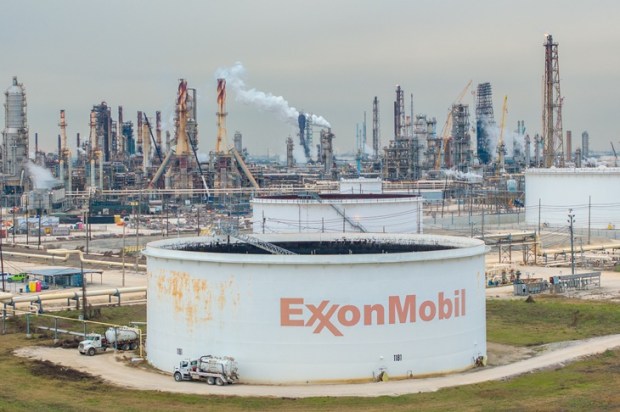
As for the Garzweiler coal mine, it produces 25 million tonnes of lignite a year in Germany with enough sitting in the ground to last until 2045 (although Germany pinky-promises to stop using fossil fuels by 2030). It is transported a short distance to the Neurath thermal power planet where it creates real, reliable baseload energy for an otherwise shaky market.
In comparison, solar panels and wind turbine blades have to be shipped vast distances around the world, negating any ‘carbon’ savings during transport.
Lignite, mined under the wind turbines, is a type of brown coal that forms when peat is compressed. It’s the lowest grade quality of coal – a long way from Australian coal exports – but needs must.
Germany is so desperate for coal that not only is it dismantling the pesky wind farm – the entire township of Lützerath is being demolished.
Climate Change activists are furious, calling it a cynical and hypocritical betrayal – and they might be right – but energy demands must be met and wind turbines, while great at shredding birds, are less successful in closing the energy gap.
Instead of outrage, the general reaction in Germany appears to be one of ‘thank goodness for common sense’.
EcoWatch asked if ‘clean energy’ is in a ‘backslide’, lamenting that ‘energy security has sometimes taken precedence over clean energy’.
The only reason energy technology is constructed is to create ‘energy security’. If clean energy is not fulfilling the requirement of ‘energy security’ then the world needs to admit that wind turbines, solar panels, and battery farms are insecure and insufficient to meet demand.
If that is the case, wind turbines only have one future – as rusted sticks poking out from the fields, seas, and cities of the world.