Ian Chappell was a peerless captain and has provided cricket tragics – whether readers, viewers, or (now) listeners – with searingly honest analysis of the game for many decades.
Perhaps his most perceptive insight was his claim that a cricket coach should only ever be thought of as the bus that takes the players from the airport to the hotel. Such was, and remains, his strong and correct view about the utility of cricket coaches for adult cricketers. (Admittedly, at least some of Chappelli’s dismissal of cricket coaches flowed from his well-known animus towards his first test captain, Bob Simpson. He probably gets on so well with another great Aussie captain, Mark Taylor, because Tubby famously put the coach Simpson in his place back in the 90s.)
Taylor once opined that the main job of the cricket coach was ‘to make the drills interesting’. But if you have to have a coach, perhaps we should try a little harder to make best use of them? And treat them professionally, since cricket and all corporate sport is meant to be ‘professional’ now. Where professional, alas, means getting paid exorbitant salaries rather than the more traditional use of the term, that is, treating people well and in a proper, businesslike fashion.
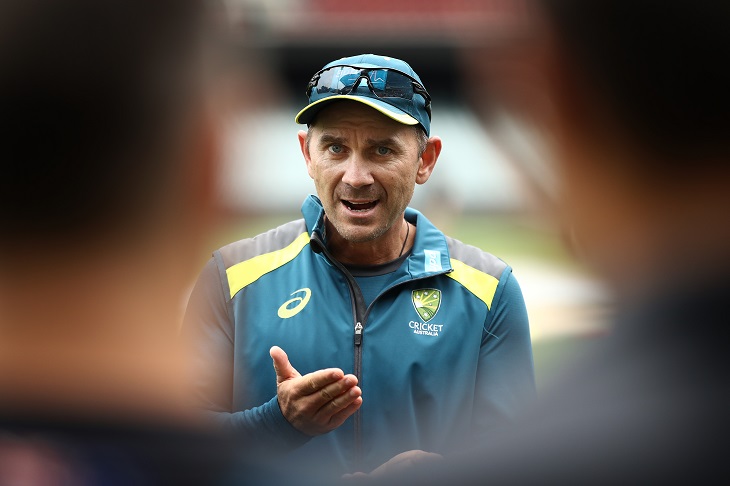
Speaking of cricket coaches and buses… We have just thrown a massively successful coach under the proverbial. The latest goon-show performance by Cricket Australia, which has seen the cringe-worthy departure of one of the better examples of the coaching genre, is a stark reminder of the many things wrong with the administration of cricket here.
When Cricket Australia, naturally given a funky corporatist name, started calling ‘the team’ ‘the playing group’ and resorting to all manner of business-speak, like ‘high-performance environment’, those among us with a hankering for things traditional instantly knew the writing was on the wall. Everything that has occurred since CA’s ‘pivot the language’ strategy (to use a term recently popularised in another context by the head of America’s Centers for Disease Control) took shape has simply been mopping up operations.
Those who run Australian cricket know nothing about the game. Well, to be honest, and despite their corporatist pedigrees, they clearly know precious little about management either. (At least the Poms have kept to the script of having actual former cricketers running things.) The game is run by those whose names nobody knew until five minutes ago, employed by people who think that boardroom knowledge and management nostrums are the main things that matter in big sport. It is well known in just about every industry that those who do not understand the particular business but think they know ‘management’ – what might be called MBA syndrome – will inevitably lead the business over the nearest cliff.
Just ponder for a minute. Why is cricket and all institutionalised sport now so woke? Because it is corporate. Perhaps there should be a new version of John O’Sullivan’s Law, along the lines – whenever an organisation of whatever kind is corporatised, it will inevitably turn woke. Look at the churches, or party politics, or local government or the media, for example. Hence the now inevitable welcomes to country at our cricket grounds, the use of the phrase ‘men’s team’, and calling batsmen ‘batters’ – surely the most egregious emasculation of the Queen’s English since Oliver Cromwell was a boy – and all the rest.
Here is a proposal to end the nonsense. Sack every CA employee and start again with a voluntary board and nothing else.
If clueless bureaucrats shouldn’t run cricket, well, neither should the players. Ironically, it was the same Ian Chappell who stuck it to his other bete noir, Sir Donald Bradman, back in the seventies, in the name of ‘player power’. The thing that is now said by many to be dogging Australian cricket fifty years on. The bad old days, as some would have it. When cricket was still a game.
The Kerry Packer revolution, led by Chappell and his fellow stirrers, let loose a monster – a monster that is now roaming free. Now we routinely have players who already earn gazillions yet who deem it necessary each year to abandon their States and the Sheffield Shield, Australia’s test cricket nursery, and head off to the Indian Premier League or other meaningless money spinners so as to be able to fund their ten-million-dollar Coogee mansions (Pat).
Cricket Australia’s latest mess neatly bookends the summer, which began with the humiliation of our former captain over a private matter of no concern to anyone except Tim Paine and his wife. This would be the captain who, along with the now sacked coach, literally saved Australian cricket in 2018 when we were found to be bungling cheats. Overpaid, bungling cheats. Two of the cheats remain in the team. Sorry, playing group. One is deemed worthy still to be vice-captain. Did his time. Back now at, or near, the top. Still earning millions. While the captain and the coach who saved our bacon after Sandpapergate and the horrors of Newlands have both been unceremoniously shown the door. Figure that one out.
The disastrous corporatist model is everywhere.
Australian universities, too, have been turned into corporations run by dunderheads who think that education is a business (for the masses) and that students are customers. And, as we know from Business Studies 101, the customer is always right. At least in the manuals. Let everyone in, then treat them with kid gloves. Let them create the courses and get their professors sacked if they are too demanding.
These days, to get on as an academic, you have to have a consistent record over time of positive student reviews. This really happens. Academics in at least one university of my acquaintance must get an average 4.5 out of 5 ‘grade’ from their students over multiple semesters in order to get a permanent contract. I am not making this up. The American scholar Valen Johnson has argued that ‘higher grades do lead to better course evaluations’. He found that students ‘preferentially enrol in classes (and subject areas) with instructors who grade leniently’. Who knew? Students pick courses and teachers that don’t stretch them. Fancy that.
The legendary Charles Murray, in his 2008 book Real Education, concurred: ‘In important respects, it is now the professors who must accommodate themselves to the preferences of the students, not the other way around.’ And this: ‘Being a tough teacher does not lead to enthusiastic evaluations.’ The results are entirely predictable. Standards collapse. Outcomes dive.
It is all a bit like the attributes players look for in an Australian cricket coach, as it happens. They can’t be too mean, too demanding. They can’t have a temper. The have to be nice to us. Not moody. The players have ‘input’ into the employment of the coach, it seems. Make that veto power. Just like our mollycoddled uni students. What if the next guy (assuming the new coach is a male; do not assume anything on that front, in these woke times) isn’t liked by some of the prima donna players? Will he/she go the way of Langer? After all, if students run university programs, why not have cricketers running the show?
Ah, the high-performance environment that is Cricket Australia. Perhaps Langer’s training drills just weren’t interesting enough. He just had to go. Thrashing the Poms in the Ashes and winning the T20 World Cup just doesn’t cut it anymore. Don’t be surprised if the next sound Langer hears is ‘London calling’.
Recently, there was a suggestion, not entirely tongue-in-cheek, that Tony Abbott might polish up his CV and send it to Tory HQ in London. Well, with England suddenly having a coaching vacancy and newly re-appointed English cricket boss, Andrew Strauss, leading the charge in discussions about one Justin Langer, it might be timely to consider a two-for-one package from down under.
Langer still has many friends. Sadly for us, though, none of them work for Cricket Australia, on or off the field.