Last week in London’s West End I saw The Standard of Living, James Graham’s play about the life of John Maynard Keynes. It was a brilliant and mostly affectionate portrait, although the affection had its limits. Between the Bloomsbury Group, the ballet and the pursuit of the good life, Keynes was portrayed as a man whose economic ideas were enmeshed with his artistic and emotional enthusiasms. To my great surprise, Graham gave Friedrich Hayek some good lines.
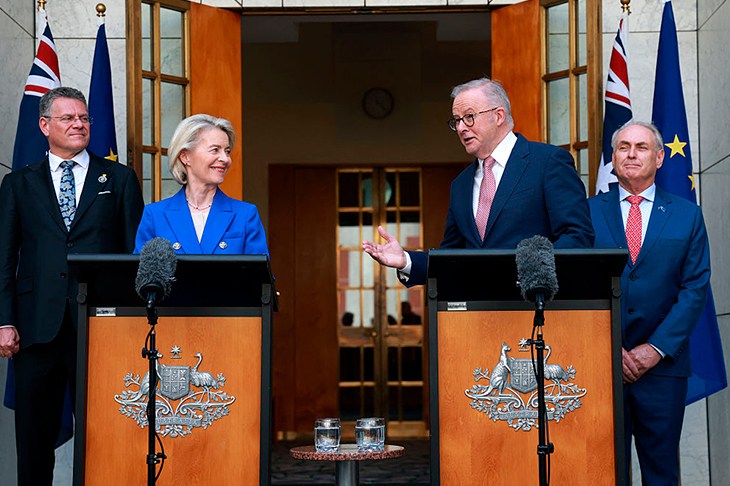
‘Economics is not poetry!’ he protests. Australian farmers might say the same thing about the proposed deal we’re all calling the European free trade agreement. Of course, it is nothing of the sort. Let’s instead call it the Brussels Knows Best Agreement. BKB for short.
Hayek had something to say about international economic planning. In The Road to Serfdom, he supported international guardrails that restrained government power so that free traders could prosper – but warned against global authorities directing how nation states used their own resources. This distinction lies at the heart of the rot in the BKB Agreement.
It is a shocking deal for farmers, who have been shouldering the burden of Australia’s climate crusades for decades. The rise of One Nation is often explained by immigration and the cost of living. But in many farming communities – usually the most geographically and metaphorically distant from power – there are bigger, decades-old grievances.
The first hit was native vegetation regulation, reinforced by the value of reduced clearing under the Australia Clause negotiated at Kyoto by the Howard government. Three decades later, with the administrative state – aka the swamp – firmly in charge, affected farmers face near total lockdown of native vegetation on private rural land. The worst affected farmers have endured decades of economic servitude so oppressive it is now causing widespread environmental destruction on productive farmland. It is simply too costly to manage land in the way required by the state so many farmers no longer manage impacted land at all. Impacted country is now an environmental wasteland. This is the ‘poetry’ that began with international climate goals.
Then came large-scale renewables – or in Barnabyspeak, the ‘swindle factories’: more centrally planned poetry courtesy of global climate goals. Labor’s draconian 82-per-cent renewable electricity target turned a trickle into a juggernaut. In renewable energy zones, landholders face towering turbines, seas of black glass or compulsory acquisition across their country for transmission lines. On top of the gut-wrenching loss of amenity there are billions in deliberately hidden costs, thousands of kilometres of transmission lines yet to be built and still no universal requirement to secure money up front from developers for future remediation.
But now comes the real doozy: the BKB Agreement. If implemented, Australian farmers, already carrying disproportionate burdens in a way no other country has even imagined, will now find their export opportunities enlisted to enforce even more climate goals.
The Paris Agreement comes in for a lot of criticism. However, achieving each country’s own self-declared emissions target is not binding. There are no Paris tariff penalties for missing the number. In that respect, Paris is a paper tiger and the reason so many recalcitrant countries signed up.
But the BKB Agreement makes Paris binding. The proposed Article 18.6 requires the effective implementation of Paris, expressly including commitments concerning nationally determined contributions.
Nor does the Agreement stop at what countries have promised under their Paris-based Nationally Determined Contributions. It prohibits weakening environmental or labour protections to encourage trade or investment. Consider the predicament of a government elected to remove burdens it believes are holding back enterprise. Its very explanation for necessary reform – more investment, more competitive exports – could become evidence in a complaint under the BKB Agreement against it.
There are also ILO-based labour rules and – you guessed it – gender provisions in the BKB Agreement. Article 18.4 requires the parties to implement their existing international obligations on women’s rights and gender equality. You thought Don Farrell was negotiating the rules for trade on meat, wheat and cheese? No, Brussels and our current government have a more serious agenda. Who on earth thought this would ever pass muster?
Naturally, the BKB Agreement provides a route to temporary suspension of trade obligations for conduct ‘materially defeating’ Paris’s object and purpose. New Zealand is already showing us how this would play out. On 29 September, Dutch environmental organisation Both ENDS, supported by a bunch of activists, lodged a complaint with the European Commission. It challenges the NZ government’s backsliding on agricultural emissions-pricing obligations, its weaker methane target, its renewed offshore oil and gas exploration and legislation which prevents climate-related negligence claims.
These are decisions taken by a democratically elected New Zealand government about how it runs its economy and regulates its farmers.
No breach has yet been established and the proceeding is a European Commission complaint, not a court case. But we can see where this all goes: year upon year of consultations through to a disputes panel and, for specified serious violations left unresolved, suspension of trade preferences. Like all things out of Brussels, the process will be the punishment. And it will be weaponised by global and local activists for years.
So any future Australian government seeking to relieve farmers of current climate-related restrictions would face a similar complaint. And we thought that only in Orwell or Huxley could you read about this stuff.
For the first time in a long time, the National Farmers’ Federation is standing up. In recent times it has rolled over when governments sought to use farmers as sacrificial lambs. Now it is showing spine. It argues correctly that the bargain itself offers inadequate market access and locks in disadvantage while European producers enjoy enormous subsidies. In other words, it would undermine our farmers’ advantages as amongst the best, most productive farmers in the world.
Matt Canavan says the deal would weaken Australia’s sovereignty on climate change policy. Angus calls it a dud. That is an understatement. The BKB Agreement would give Brussels another lever over decisions Australians should make for themselves. That the Prime Minister and Minister Farrell thought we would roll over on this demonstrates how far out to lunch they are. For Australian farmers the BKB Agreement is another step on the road to serfdom as Australia’s unpaid climate workforce. More scarily, the text of the agreement tells us that we still have a fight ahead in defending a global order that seeks to preserve rather than extinguish the very concept of a sovereign nation state.
Got something to add? Join the discussion and comment below.
You might disagree with half of it, but you’ll enjoy reading all of it. Try your first month for free, then just $2 a week for the remainder of your first year.