Architecture can’t be exhibited, other than indirectly in drawings, models and photographs. But this is even more true for Gordon Matta-Clark and his anarchitecture: drastic, geometric cuts carved out of derelict buildings that exist fleetingly, before being demolished with the buildings soon after. For the bulk of us not lucky enough to have experienced their monumentality in the flesh, his notoriety is established by his records. A new exhibition at the De La Warr Pavilion presents a modest slice of his vast archives.
Matta-Clark’s architectural training at Cornell must have left him with a healthy contempt for the architectural establishment. In his correspondence with collaborators, in which he fleshed out the concept of anarchitecture with manic scribblings, he rebelled against the modernist doctrines he was taught: ‘a machine for not living’, ‘form fallows function’.
Matta-Clark found value and opportunity perched on the precipice of destruction
De La Warr is perhaps the ideal place for this show. Like a gunboat moored on the Sussex coast, it was an early envoy to Britain of the optimistic promises of modernism. Indeed, it’s a textbook example of what Le Corbusier expounded in his manifesto, Vers Une Architecture, and Matta-Clark derided in a letter as the kind of ‘virgin machine [Le Corbusier] wants us all to live in’. As it undergoes an expensive facelift after being battered by almost 100 years of sea air, its chaste lines are corrupted with scaffolding and its immaculate staircase has been disrobed of its curved glazing. It is halfway between deconstruction and rebirth, and Matta-Clark would no doubt have recognised the anarchitecture here too.
As a student in the 1960s, Matta-Clark saw Corbusier-inspired town planning sweep across America – and its broken promises. In his earliest building cuts, he rebuts modernism’s fetishisation of the tabula rasa. In the blighted tenements of the Bronx condemned to slum clearance, he found value and opportunity perched on the precipice of destruction. Selectively removing walls, floors and landings, he created a spatially disorienting death trap in what was once familiar and domestic. In ‘Splitting’ (1974) he extended this to a whole suburban house, cleaving it in two.
I’d hate to think what health-and-safety culture would have done to smother his artistic ambitions. It’s just as well that Matta-Clark preferred forgiveness, not permission. ‘Day’s End (Pier 52)’ (1975) was created in secret. Matta-Clark broke into an abandoned shipping shed in Manhattan and, over two months, made sweeping, crescent-shaped cuts through the corrugated steel walls and floor, revealing the glimmer of the Hudson below. His illicit intervention was only discovered by the authorities at the show’s opening and was promptly shut down. It now exists solely as these evocative yet frustratingly inscrutable photographs, where his geometric incisions cast shadows of light across an inky industrial cavity.
Matta-Clark would occasionally deign to follow the rules, but only to mock them. In ‘Reality Properties: Fake Estates, “Long Island City”’ (1974), a pauper’s property empire becomes art. He had acquired – via municipal auction – residual slivers of land across New York, created by bureaucratic accident. Lovingly mounted and framed were a photomontage of his useless patches of dirt, official boundary maps and the title deed paperwork dutifully completed by a municipal officer, who surely must have known he was participating in a farce.
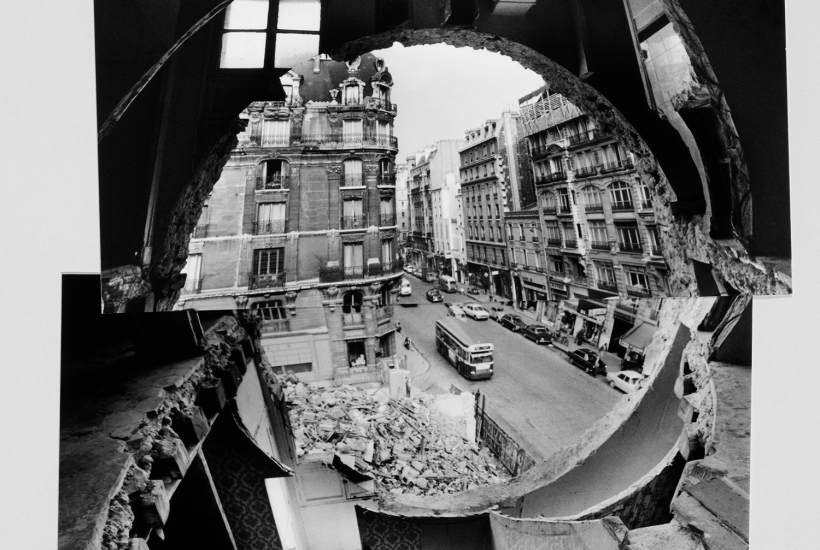
The highlight is undoubtedly ‘Conical Intersect’ (1975). It was created for the Paris Biennale, and saw Matta-Clark intervene in Les Halles – another neighbourhood that was on death row before its cultural ‘revitalisation’. Punching through two 17th-century townhouses with a perfect conical hole, he created a building-sized viewfinder pointing at the culprit in the background: the new Centre Pompidou emerging from the rubble.
Occupying the smaller upstairs gallery, the show feels achingly incomplete, and I leave craving more
Though deceptively simple, to make this work required a methodical choreography of trades: from those who could chisel elliptical geometries, saw through beams, prop up floors, to those who had the satisfaction of swinging sledgehammers. In the film you can see the bewilderment of passersby, as once-private interiors and structural bowels are eviscerated and put on public view on rue Beaubourg. At the end of it all, Matta-Clark’s bold gesture is gradually unmade, as the rest of the houses are demolished to make way for what would become one of many egomaniacal grands projets.
Matta-Clark’s work is by nature contradictory. His anarchitecture, while it existed, had a visceral radicalism to it. Now we must piece it all together from fragments to gain even a glimmer of their full impact. Occupying the smaller upstairs gallery, the show feels achingly incomplete, and I leave craving more. I can hear Matta-Clark’s posthumous taunt: ‘You had to be there.’
Got something to add? Join the discussion and comment below.
You might disagree with half of it, but you’ll enjoy reading all of it. Try your first month for free, then just $2 a week for the remainder of your first year.