When you hear that that something represents the best of Britain, treat it as nonsense. The phrase ‘best of British’ has been used to describe the Royal Navy’s new Astute-class nuclear submarine the HMS Agamemnon, as well as Waitrose’s pork loin medallions.
But turning things, people and institutions into flattering national allegories is addictive, and there’s one institution that pops up all the time: Arsenal football club.
Arsenal’s sophistication, its urbane nature, its diversity, is regularly cited as a good example of British multiculturalism. A current exhibition at UCL East, ‘Black Arsenal’, says that the club has a ‘unique’ relationship with black British culture. Arsenal’s cosmopolitanism is meant to, if not be representative of the country, be the best example of what Britain should be. Last week, while Suella Braverman was arguing that she shouldn’t identify as English, the New Statesman’s Oli Dugmore said simply ‘Ian Wright. Bukayo Saka.’
Wright and Saka, both Arsenal men, were and are brilliant footballers, and are definitely likeable people. But they aren’t necessarily typical of the average assimilation story, nor can their personalities be neatly slotted into a happy-clappy story of the reconciliation of liberalism and multiculturalism. They’re much stranger individuals than you might think.
Take Saka: he’s said before that his success is because ‘I just choose to put my faith in God’. He reads the Bible every night before bed, and said at the Qatar World Cup that ‘it is really important to have the presence of God in me all the time’. This would already put him out of step with a culturally secular modern Britain, but his denomination emphasises that point even more.
Saka was raised as a member of the congregation of the Kingsborough Centre in Uxbridge, which is part of the Redeemed Christian Church of God, a Pentecostal church. Their doctrines are rather more intense than a typical Church of England parish. There’s a strong focus on supernaturalism: they hold a suspicion of medicine, with the RCCG arguing that sickness ultimately derives from Satan. Swearing is forbidden, and a fasting-and-prayer guide from this year urges congregants to have ‘victory over sexual sin’, such as homosexuality and lesbianism. Now, we can’t say that Saka accepts every one of his church’s doctrines, but immersion in a group that believes that acid reflux is the work of Satan is perhaps not quite part of the catch-all, tolerant vision Dugmore and others might like.
Wright is an awkward fit too, seemingly representing modern Britain by living in an enormous house in Notting Hill, and drinking in his favourite pub the Cow (owned by Sir Terence Conran’s son). Some of his political tendencies too have not been entirely in line with liberal Britain’s: he was a longtime columnist for the Sun newspaper, and argued that footballers who refused to play for England should have to phone the parents of soldiers killed in Afghanistan to explain themselves.
Saka’s recent sanctification happened at the wrong time and for the wrong reasons. It should have begun when it became clear he is one of the best English footballers of this century, but it started early, coming patronisingly after he missed the crucial penalty in the Euro 2020 final against Italy (who still associates him with that moment anyway?).
His status was elevated amid a storm. Channel 4 News said that some 2,000 offensive tweets, 167 of them high-risk, were sent to Saka, Marcus Rashford and Jadon Sancho, the (all black) players who missed in that shootout: all, of course, disgusting, but amounting to a small figure in a population of 66 million. Additionally, the Centre for Countering Digital Hate found that only five of the 105 abusive Instagram accounts could be identified as being from Britain. Other estimates suggest that 70% of the abuse came from abroad. The reaction to Saka’s miss was deeply unpleasant in quarters, but was less visceral than when David Beckham got a red card in the 1998 World Cup (a much lesser footballing crime), and was declared the most hated man in England. An effigy was also hanged of him outside a London pub, and the Daily Mirror printed a Beckham dartboard.
Wright, meanwhile, has only become truly fashionable lately. His canonisation took place as the world conformed to him. He quit Match of the Day to some criticism in 2008 as he complained that he was used as a ‘comedy jester’. But when he returned to the programme in 2015, he was fortunate to find a world where all pundits now out-banter each other to compete for that role.
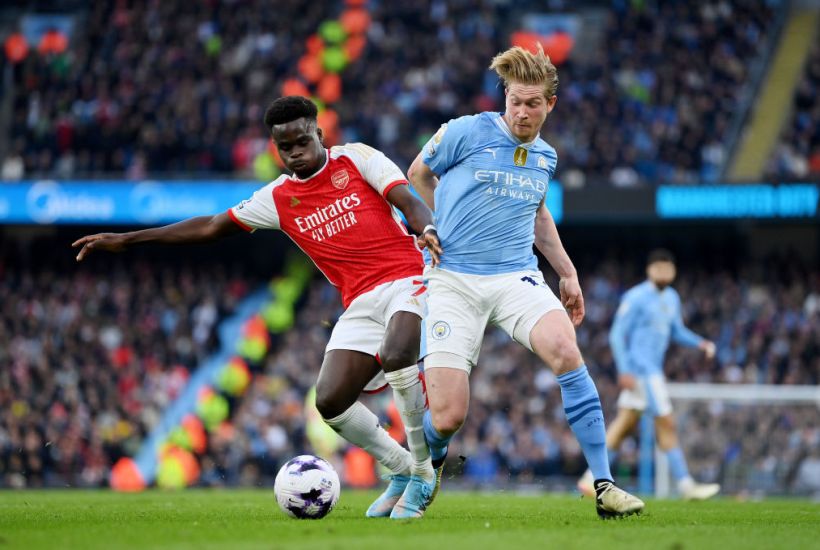
We project too much onto Wright and Saka, and we project too much onto their club. Nailing down what it is about Arsenal that represents modern Britain is like trying to focus on an eye floater. We are led to believe a club with a stadium called the ‘Emirates’ and the shirt sponsor ‘Visit Rwanda’ is a humanitarian enterprise. The club’s lack of consistency is obvious when you look at their famous supporters: Anne Hathaway, Keir Starmer, Justin Bieber, Dua Lipa, Piers Morgan, Osama bin Laden, Zohran Mamdani, Danny DeVito and Mick Jagger. If anything unites that group, it is the vaguest of left-liberal vibes, although we can probably exclude Piers Morgan from that charge, and perhaps bin Laden too.
If Arsenal ever represented modern Britain, it was in the 2010s, the late Arsène Wenger years, where their decadent uselessness rendered them quite quaint, where the idea of winning would have been vulgar. The fans’ humour during this time was self-deprecating, in the gallows and… yes, likeable.
If there is a football club that represents modern Britain, then it’s surely Manchester City: spivvy, morally wanting, bankrolled by petro-states
But their comeback has estranged them from their nation. The smugness, the self-satisfaction of their success, combined with the ugliness of their playing style, has led to their fanbase being the most disliked in the Premier League (and there’s data for that). Even their manager, Mikel Arteta, has been compared to another out-of-touch Gooner in Keir Starmer, given the two men’s shared dreary, procedural dispositions.
If there is a football club that represents modern Britain, then it’s surely Manchester City: spivvy, morally wanting, bankrolled by petro-states. It would be unpatriotic to say that Britain, like City, deserves to be relegated to a lower league of nations, but our seat at the highest table is looking more fortunate by the year. When an Iranian loitering munition hit an RAF base in Cyprus in March this year, we sent a single Destroyer that arrived three weeks later. It was delayed leaving Portsmouth because of fears that bits of it might just fall into the sea. Meanwhile, our £5.5bn Ajax tanks gave our soldiers hearing loss.
Man City’s ownership by Abu Dhabi is the perfect emblem of Britain’s attitude to its assets. The Qataris have 75% of Harrods, 20% of Heathrow, 95% of the Shard, and 50% of the Savoy. The London Gateway port is ultimately controlled by the government of Dubai, who also exert influence over P&O Ferries. Abu Dhabi, who own City, hold 9.9% of Thames Water’s parent company, as well as bankrolling offshore wind farms at Dogger Bank. Kuwait have to settle for co-owning London City Airport.
The new prime minister would have you believe that his blend of ‘Manchesterism’ is all down to some thrusting entrepreneurial northern spirit, but most of the seed capital came from Abu Dhabi. There is literally a tram stop in Manchester called ‘Etihad’. One of his first calls as PM was to Sheikh Mohamed bin Zayed al Nahyan. But wash it all with the aesthetics of Oasis and football, and pretend the GDP growth was all down to the buses.
When asked about the recent Manchester City ruling, Burnham said he would be ‘really concerned’ if City’s Abu Dhabi owners had to go, since ‘they’ve been such a huge partner in the building of modern Manchester’. We got rid of an out-of-touch Arsenal prime minister, and replaced with an Everton-supporting PM who is proud of Manchester City. Perhaps, in a way, Burnham really does understand what makes Britain tick.