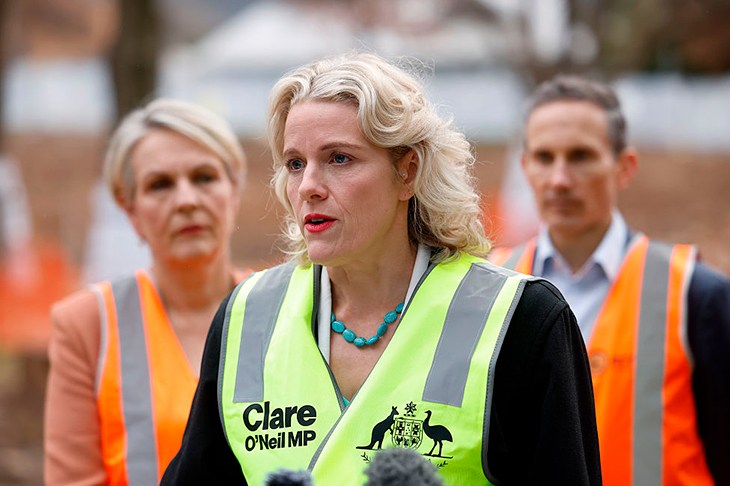
I think someone needs to tell the hapless Housing Minister, Clare O’Neil, that the government’s housing target of an additional 1.2 million well-located homes over the five years from July 2024 won’t be met.
Of course, it’s really neither here nor there given that the announcement was the point of the exercise rather than fulfilling the target. It’s at this point that the pre-prepared excuses are wheeled out.
You know the sort of thing – interest rates have risen, there is an uncertain global environment, there is a lack of cooperation from some local governments. It’s like dealing with a toddler refusing to tidy the toy room.
I should make one thing clear at this stage: the term ‘home’ is deliberately used rather than ‘house’. One dog box apartment in a high-rise building is one home. A single detached house is also a home although the federal and state governments take a dim view of that type of home. It might involve the dreaded urban sprawl and we wouldn’t want that.
Densification is the preferred route for progressive governments. Giving carte blanche to spivvy developers to build defect-ridden high-rise buildings in middle suburbs – code for electorates that typically don’t vote Labor – is the only way forward. Evidently there is a lot of underutilised infrastructure in these middle suburbs, although that’s not obvious to the current residents.
Support from think tanks like the Grattan Institute and the Centre for Independent Studies and Bob’s your uncle. Melbourne can be like Hong Kong or New York – how good would that be? We can all be jammed into small family-hostile apartments and give thanks to those wise politicians and town planners who see the overwhelming benefits of compressed settlement.
Anyone who objects to this grand plan is described as a selfish and evil perpetrator of Nimbyism – not in my backyard. Nimby people simply want to retain the ambience and quality of life in their suburbs – something they have paid for – but our political leaders are quite happy to dismiss their concerns.
To counteract their malevolent influence, including occasionally on local government councillors, Yimbyism has sprung into action – Yes, in my backyard. Call me suspicious but is this development not the one of the clearest cases of astroturfing ever?
Who funds these Yimby groups? How is it that they have detailed analysis to back up their specific cases? Where is the transparency around their operation? (It’s up there with the Russian government funding anti-fracking protest groups in the West to defend that country’s place in the global gas market.)
It’s worth outlining here some empirical scaffolding about Australia’s housing market and people’s preferences. The first thing to say is that most people prefer detached housing, particularly those with young families. Survey after survey tell us this and indeed the politicians know this.
Take a recent survey undertaken on Melbourne residents. Seventy per cent of respondents preferred a house. The next favoured structure was a townhouse; the least favoured was an apartment in a high-rise tower. And get this finding: most buyers favoured structure over location. In other words, they were happy to live a reasonable distance from the CBD if they could live in a detached house.
Just in case you’re thinking that this is all old hat, even recently arrived migrants have broadly similar preferences. In the case of some ethnic groups, there is strong liking for homes that can accommodate all the living generations in a family. Small, ‘well located’ – whatever that means – badly constructed apartments in central locations simply don’t make the grade.
The other reality is that most newly constructed apartments have only two bedrooms. For families with two children or more, this simply doesn’t work, particularly as the children grow older. But the developers would have you believe that there is no money in building three-bedroom (or more) apartments and so they don’t. And we wonder why the birth rate is falling like a stone?
And here’s another empirical feature that should worry the politicians: a very large number of these newly constructed apartment buildings are replete with faults, ranging from major to minor. Some buildings have been so defective that the residents have had to be evacuated, and it has taken years for the repair work to be completed to a satisfactory standard.
Cracking, structural faults, water damage, electrical dangers – you name it, these are examples. Those self-serving property developers are excellent at cutting corners, purchasing inferior materials and simply ignoring defective work if they can get away with it. Coupled with inadequate building inspection arrangements and it was always obvious that these problems would magnify as a larger number of facilitated high-rise developments proceeded.
It is surely the ultimate irony that the Nine newspapers should editorially campaign for densification while carrying lengthy articles about the trials and tribulations of residents caught up in the vicious cycle of dealing with faulty and often uninhabitable apartments. The expense, the worry, the capital loss – it’s all there described in detail.
But we still need more of those high-rise apartments, particularly in Sydney’s eastern suburbs. Those self-entitled residents can simply suck it up. Go figure.
I should also mention the ongoing problems with the body corporate arrangements that govern these apartments and the completely inadequate responses of government regulators. There is considerable scope for fraud, particularly through related party transactions, as well as misconduct, in general. Residents are overcharged; faults and defects are not fixed; maintenance is inadequate; sinking funds disappear. But aggrieved residents rarely have any recourse.
Again, it is ironic that the Nine newspapers carry stories on this topic. In one centrally located apartment building in Melbourne, there has been an ongoing dispute between two body corporate companies both claiming to have the contract for the building. Residents receive invoices from both companies covering the same services.
In the meantime, the state of the building has deteriorated dramatically as even the most basic services, such as keeping corridors and stairways clean and washing windows, are simply not undertaken. But here’s the thing: the Victorian government has not provided any clear administrative route to sort out this issue and so the ‘civil war’ continues while the residents just despair.
Round the corner in another ‘well located’ apartment building, a clear case of undisclosed related party interests has occurred. It involves the directors of the approved body corporate company purchasing a ground floor apartment using residents’ funds. But when one resident complained, he was merely directed to the VCAT – the administrative tribunal.
So, picture the scene: our Housing Minister Clare and her family settle in for the night in their comfortable suburban house. Does she worry that what is being foisted on home buyers does not really meet their preferences? Does she worry about those disgruntled residents living in dog boxes in defective buildings? Does she worry that those middle suburbs could soon become congested and unliveable? My guess is she is simply dreaming about her next portfolio.
Got something to add? Join the discussion and comment below.
You might disagree with half of it, but you’ll enjoy reading all of it. Try your first month for free, then just $2 a week for the remainder of your first year.