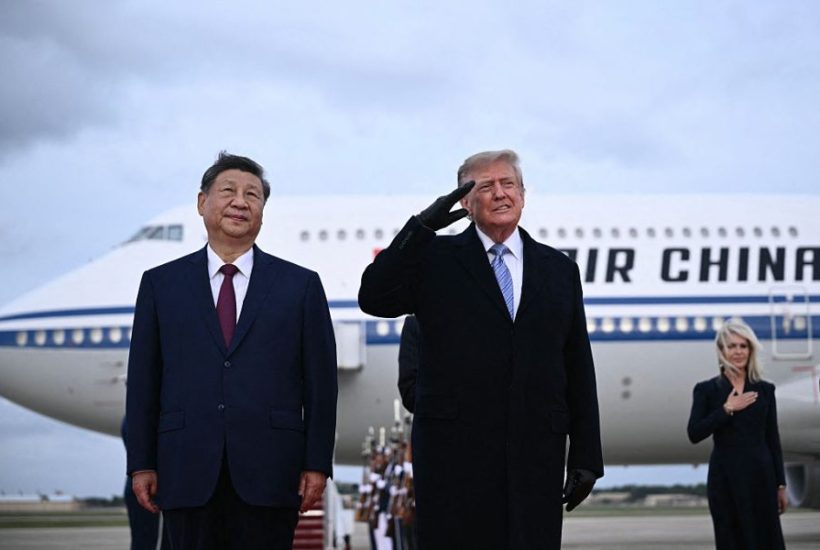
Moments before President Xi Jinping climbed down the steps of his aircraft to be greeted by Donald Trump, US marines were filmed on their hands and knees smoothing out the red carpet, Chinese officials looking down from the top of the steps. It was an uncomfortable image, ridiculed on social media for the symbolism of kowtowing to the emperor. But it set the tone for a summit which so far has been heavy on pomp and ceremony, rich in platitudes, but with very little in the way of substance.
A strong diplomatic case can be made for political fawning – where the power dynamics are lopsided against you, and if there’s a chance of a reasonable payback. After all, it’s what Trump’s democratic Western allies do a lot of the time in order to keep Trump on side, fend off his punitive tariffs and tame his caprice. But even allowing for Trump’s soft spot for autocrats and political theatre, his treatment of Xi has so far been cringemaking, the returns so minimal that it rather begs the question: what was the point?
There is still a day of this summit to go, so more substance could emerge
Their main achievement during the first day of the summit appears to be a two-month extension of a trade war truce. This was struck last November in order to end tit-for-tat sanctions that saw China weaponise its control over the global supply of rare earths, essential for high-technology products, in retaliation for sky-high US tariffs.
They also agreed that they should keep in touch over the threat to human existence from artificial intelligence – or ‘super intelligence’ as Trump calls it – while seemingly also agreeing that there was nothing much worth talking about. Xi said, ‘humans must remain in control over AI technology’, while the US president called it a ‘big topic’ of discussions, saying he and and his Chinese counterpart were happy to ‘leave it exactly where it is’.
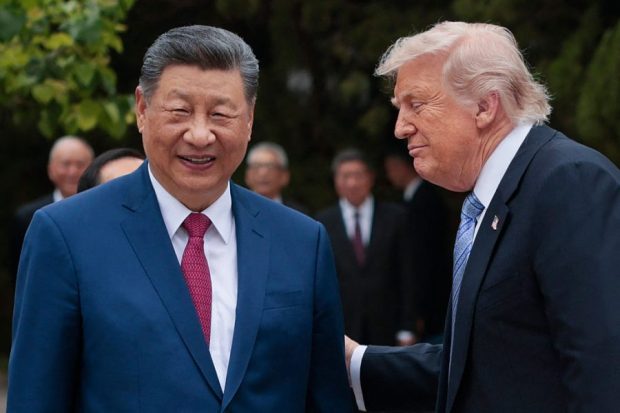
Trump met Xi in person at the foot of that smoothed-out red carpet – the first time that a sitting American president has greeted a foreign leader in Washington in person for 64 years. Xi never made the effort when the US president visited Beijing in May, during which the pomp and ceremony were much more low key. The two leaders began their bilateral meeting yesterday morning after a military performance that involved an ear-splitting flyover by a B-2 Spirit bomber and four F-22 Raptor fighter jets.
At the start of their meeting, Xi appealed for ‘healthy’ competition with the US and ‘not a wrestle in which one side wins or loses’, Trump said he had forged ‘a truly great friendship’ with the Chinese leader. The visit comes amid fresh rumours about Xi’s health – the 74-year-old skipped a dinner during the recent BRICS summit in Delhi and was rumoured to have been hospitalised on his return to Beijing. But in a Truth Social post, the US President wrote that Xi looked ‘strong. Vibrant and fit’.
At a lavish White House dinner last night, Trump said that the US and China had ‘never gotten along better’, while Xi said he and the US president had ‘sincere, in-depth’ exchanges and came to an understanding on many issues, though he did not elaborate. He said that Trump’s goal of ‘making America great again’ and his own commitment to ‘national rejuvenation’ were not necessarily incompatible. ‘These two goals are both ambitious and can surely be mutually reinforcing,’ he said.
Xi also served up some pandas – two of them, to be sent to Atlanta Zoo ‘in a few days’ as an ‘envoy of friendship’. Panda diplomacy has long been a feature of Chinese statecraft. They are rented, rather than given, since as with rare earths China has a monopoly and can recall them at any time – as it did in 2024 when four were taken back from Atlanta amid rising US tensions. They should beware of becoming too comfortable in their new American home. Trump presented Xi with a statue of a bald eagle, a national symbol of US, which he said was designed by himself and first lady Melania.
During the banquet, the two leaders sat at the top table alongside US technology leaders, including Elon Musk (Tesla), Jason Huang (Nvidia), Lisa Su (AMD) and Tim Cook (Apple). They represented the cutting edge in American technology leadership. No Chinese business people attended, since Xi reportedly chose not to bring a delegation with him to Washington, after initially indicating that he would do so. It was not immediately clear why, but many of China’s top companies are blacklisted for their links to the Chinese military.
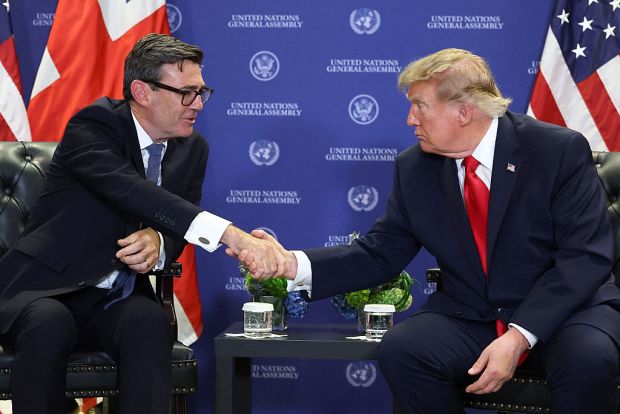
Earlier, hundreds of human rights activists marched in Washington, protesting against Xi’s visit and his repression against ethnic minorities and dissidents, and included Hong Kongers, Uyghurs and Tibetans. On the eve of the summit, Andy Burnham had reportedly implored Trump to bring up the case of imprisoned Hong Kong dissident Jimmy Lai, though it is unclear whether he did so.
There were many elephants in the ballroom last night – from the Iran war, where China has reportedly supplied targeting data to the Islamic regime, to Beijing’s support for Russia’s aggression against Ukraine, US support for (and China’s aggression against) Taiwan, China’s alleged copying of America’s AI models and China’s mercantilism, over-production and record-breaking trade surplus.
There is still a day of this summit to go, so more substance could emerge. During his banquet speech, Trump went off script and pointed to the construction of the new White House ballroom. ‘If we had it, we would have way more than 1,000 people,’ he boasted, inviting his guests to take a look. It is not clear whether any of them took up the offer. If they did, it could well have been the most interesting thing they’d done all day.