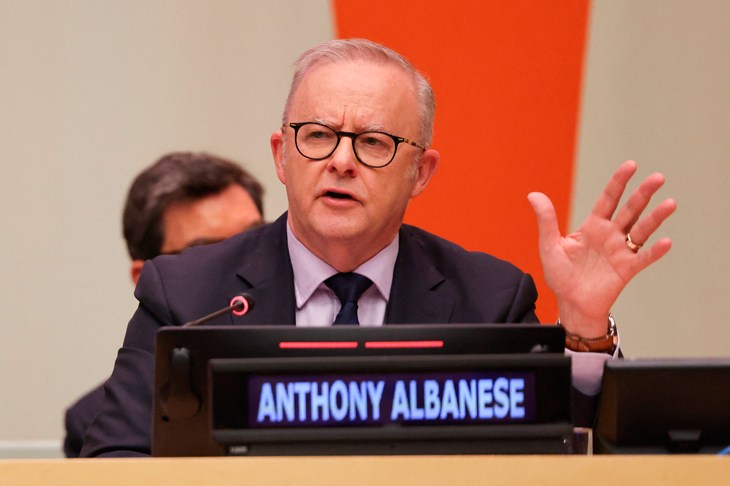
After several months of watching his popularity plumb new depths, Prime Minister Albanese must have been looking forward to an escape to the headquarters of the United Nations in New York, the Valhalla of business-class do-gooders.
One of the oldest divides in international relations is between realists, who see power as the ultimate currency, and idealists, who put their faith in international law and institutions. The UN is the tribal home of the latter and Labor feels a particular attachment to it because Australia was a founding member under the Curtin government, and its foreign minister, H.V. Evatt, played a leading role in shaping its Charter, eventually becoming president of the General Assembly.
Albanese had the visit all planned out. After bragging on the world stage last year about his ‘world-first under-16s social media ban’, he was planning to boast this year about his ‘world-leading digital duty-of-care legislation’, call for an international framework on AI safeguards, pick up a prize for being a good global citizen, and lobby for one of the rotating seats on the UN Security Council.
Unfortunately, even before he’d got anywhere near the UN podium, he was beset by one of the feistier members of the travelling press pack who asked, ‘Don’t you feel like a bit of a fraud accepting this award when, at home, you screwed up the response to the worst massacre since Port Arthur, in the polls, you are taking Labor to one point shy of Julia Gillard when you rolled her, and your net negatives (approval ratings) are worse than Scott Morrison?’
The PM looked rattled and spat out ‘No’. This wasn’t part of the plan. Back in Australia, Labor luvvies were outraged and called for the journalist to be banned from the ABC where she does the occasional shift.
It wasn’t any better at a press conference the following day. Defending Australia’s bid for a seat at the Security Council, Albanese launched into a rambling monologue saying, ‘If you had have (sic) asked a random group of Australians to find the Gulf of Hormuz on a world map last year’ less than 1 per cent could have found it.
It’s certainly safe to say that Albanese couldn’t have found the Gulf of Hormuz, but the truth is that no one can find the Gulf of Hormuz because it doesn’t exist, except in Albanese’s head. It’s truly impressive how, even after six months of war in Iran, Albanese can’t correctly name the critical chokepoint on global oil, muddling up the Strait of Hormuz with the Persian Gulf.
Another thing you won’t find in the official transcript of this press conference is a record of this cringeworthy gaffe because, like the Gulf of Hormuz, it isn’t there. Albanese seems to think that if he pretends something didn’t happen, then it didn’t, even if it happened in front of a room full of journalists. He told the press pack, ‘I’m in my fifth year as prime minister now.’ It’s a long time – and it feels like a long time – but it’s not long enough for him to acquaint himself with basic geography.
Albanese was no doubt hoping that this would all be forgotten when he addressed the UN on Wednesday and picked up his global citizen award in the evening. But he didn’t reckon with President Trump, who imbibed realpolitik with real estate on the mean streets of New York, delivering the bien-pensants a brutal lesson in power politics.
After the media had recently whipped up a storm of panic about the dangers of Artificial Intelligence, Trump told world leaders at the UN that he would oppose a push to create an international body to oversee AI regulation.
Instead, he said he would rename artificial intelligence ‘super intelligence’ and would not stifle the technology that could change the world more than the industrial revolution or the internet.
As Trump put it, ‘Whoever wins SI, who-
ever wins super intelligence, wins,’ pointing out that at the moment, America was winning.
You do not need ‘Super Intelligence’ to figure out that neither Trump nor China will allow the UN or anyone else to dictate how they use AI in their attempt to gain strategic superiority.
It was a body blow to the cabal of globalists who are intent on following the same playbook that has served them so well with climate change and pandemics: they use the threat of an impending apocalypse to entrench their power, enrich themselves and censor anyone who objects.
We have seen the disastrous results of Australia’s adherence to the UN dogma on climate change. We have sabotaged our comparative advantage in cheap energy, failed to ensure energy security, hobbled ourselves with an expensive, unreliable grid and exported our manufacturing to countries that don’t give a damn about pollution or emissions.
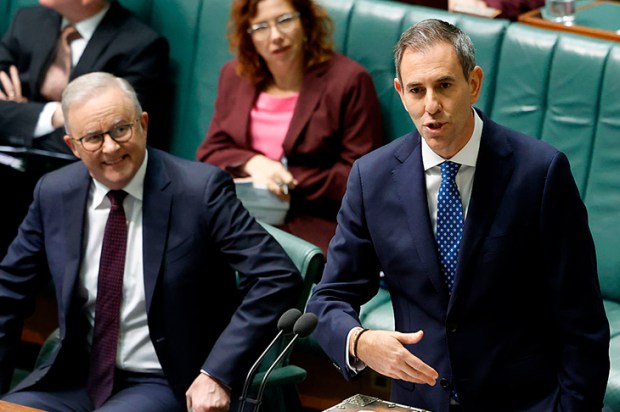
Treasurer Jim Chalmers says AI will turn around Australia’s moribund productivity, which has been stagnant for a decade and is now going backwards, but he plans to do it by forcing data centres to use renewable energy. Luckily, Queensland at least is ignoring him.
Trump’s speech to the UN came after the US Embassy in Canberra released a withering statement about Labor’s plan to censor-by-stealth the internet using its digital nanny-state’s sinister ‘duty of care’. The statement didn’t mince words: ‘The US government would likely consider such a measure as facilitating censorship.’ It was perfectly timed to cause maximum embarrassment for Anthony Albanese, with the release coming the day before Albanese was due to address the UN.
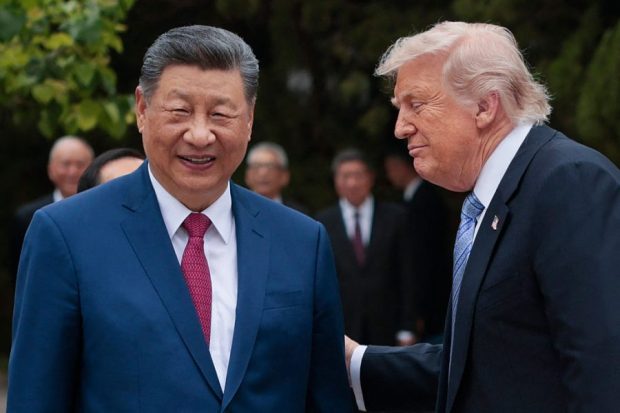
Over the weekend, Albanese called for Trump and Xi Jinping to use their meeting in Washington on Thursday to discuss regulating AI, after calls for a slowdown in the technology’s development due to safety concerns. One can imagine the belly laugh that gave Xi.
Albanese needs to summon whatever intelligence he can muster – artificial or otherwise – to grasp the strategic reality. Australia’s defence posture, tellingly called a ‘strategy of denial’, depends on American might deterring China. But a strategy of denial cannot be based on a denial of strategic reality. Australia needs the US to remain militarily and technologically ahead of China. And as Trump put it, America needs AI to win.
Albanese, the idealist, puts his faith in UN rules. Power decides
which rules are enforced — and against whom. Or as Thucydides put it, ‘Right, as the world goes, is only in question between equals in power, while the strong do what they can and the weak suffer what they must.’
Got something to add? Join the discussion and comment below.
You might disagree with half of it, but you’ll enjoy reading all of it. Try your first month for free, then just $2 a week for the remainder of your first year.