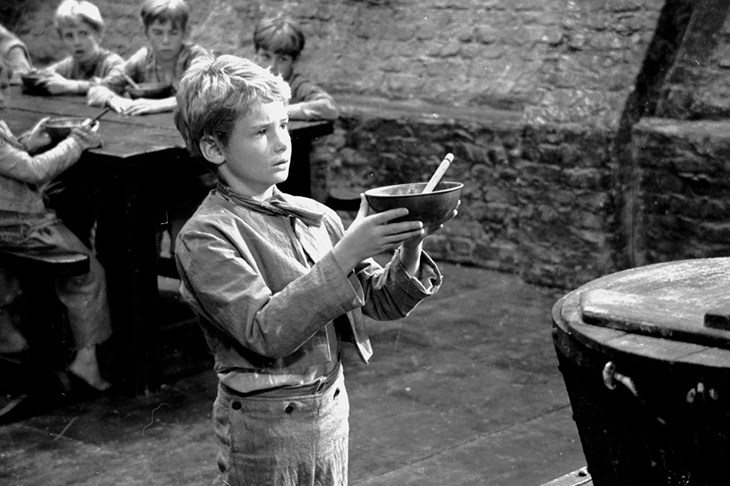
A recent cartoon in the Australian captures the confidence trick Labor politicians are playing on the workers they pretend to represent. Not surprisingly, very few Labor MPs were manual workers. Recasting Oliver Twist, Johannes Leak depicts a ragged worker holding out an empty bowl before a towering monster ‘custodian’ labelled ‘Super Funds’, a thug labelled ‘Unions’, and a childlike Anthony Albanese. Behind them is a cauldron overflowing with money. ‘Please sir, can I have some of my own money?’ ‘Yours?!!’ screams the monster ‘custodian’. You can almost hear the dismissive acuity of Lady Bracknell in Oscar Wilde’s most celebrated play.
Claimed by politicians as yet another ‘envy of the world’, the central conceit of Australia’s superannuation system is that it protects workers’ money from the people the elites apparently fear most: the workers who actually earned it and therefore own it.
Pauline Hanson has reopened the debate which the Albanese government, the unions, and the multibillion-dollar superannuation industry want to close: Just whose money are we talking about?
Pauline Hanson proposes that just as Labor’s staffers already can, Australian renters and mortgage holders be allowed to receive three percentage points of their future compulsory contributions as take-home pay for up to three years, leaving nine percentage points in super and existing balances untouched. The redirected amount would retain the effective superannuation tax rate of 15 per cent. One Nation says a worker earning $90,500 would gain about $2,300 annually – not a handout, but the partial restoration of his own earnings.
Critics warn of smaller retirement balances, greater reliance upon the age pension, and even inflation. But that does not establish that governments, unions, and fund managers ‘understand’ a worker’s interests better than the worker, particularly when reducing debt or securing a home may contribute more to retirement security than a larger superannuation balance.
The 12-per-cent compulsory superannuation contribution is effectively part of a worker’s wage diverted into a superannuation fund. The money belongs beneficially to the member. At retirement, the member can take an income stream, a lump sum, or both and spend it as he thinks best, subject to the means test and deprivation rules. If the member can exercise that discretion at retirement, why can’t he have a carefully controlled access earlier to secure a home or reduce expensive debt?
Limited first-home access already exists, but only up to $50,000 of additional voluntary contributions, not from the 12-per-cent compulsory employer contributions. Senator Hanson’s reform leads logically to a broader reform allowing members to use some of the 12 per cent to buy or keep a home which will be crucial for his retirement.
Senator Hanson’s proposal has been criticised by the Albanese government for not releasing any modelling. This is the same government whose leader admits to promising fifty times not to touch negative gearing or capital gains tax – especially on housing – but did precisely that in the last budget, claiming it would have little effect on prices and rents. While they claim this was based on ‘Treasury modelling’, they steadfastly refuse to release it, if it exists.
As to the value of modelling, the celebrated statistician George Box once observed: ‘All models are wrong, but some are useful.’ Models depend on assumptions about behaviour, prices, and take-up. Box is right; their apparent precision disguises the fact that nobody can possibly know what is really going to happen. The accepted convention should be that where a politician says he relies on ‘modelling’, he must release it. Until such a convention applies, the absence of published modelling is no answer to Senator Hanson’s established ability to develop policies she believes in and the people want.
This controversy also raises the larger question of whether Australian superannuation is working as originally promised. The fourth largest in the world, it controls trillions of dollars and supports a veritable army of highly paid executives, advisers, lawyers, accountants and consultants skimming enormous fees. Industry fund boards commonly include union and employer nominees, while former Labor politicians and union officials occupy influential, highly remunerated positions. While that does not prove political decision-making, it makes scrutiny indispensable. Funds and associated organisations can exert considerable influence through advertising, lobbying, sponsorships, payments to affiliated bodies, and the voting power attached to enormous shareholdings. Members are entitled to know how their money is being used, who receives it, and whether it produces a demonstrable financial benefit for them.
Large funds increasingly use their investment and voting power to advance the net zero folly and other political objectives. Trustees may properly consider genuine long-term financial risks, but their duty is to members, not to advance the Labor party. With Australia producing only about one per cent of global emissions, trustees should demonstrate that politically fashionable investments advance members’ financial interests.
Singapore offers a different model. Its centrally administered Central Provident Fund (CPF) directs compulsory employer and employee contributions not just to retirement, but also to housing and first-rate healthcare. Money in a member’s Ordinary Account may purchase a home or meet mortgage payments; other accounts provide for medical expenses, insurance, and retirement income. Singapore recognises what ordinary Australians know – home ownership is itself a central form of retirement security.
The CPF Board invests default savings in government-guaranteed securities, while members may make approved private investments. Australia need not adopt the Singapore model, but its system demonstrates that compulsory saving can remain available for security throughout life without funding an army of advisers, competing institutions and advertising campaigns.
Senator Hanson’s proposal is valuable not merely for the immediate relief it might provide. Its greater contribution is to challenge the assumptions that compulsory superannuation must remain beyond the reach of its owner, regardless of present hardship or the opportunity to obtain a home.
Superannuation belongs to the member. As Oscar Wilde’s Lady Bracknell might have said: to compel a worker to save part of his remuneration may be regarded as paternalism; to make him beg like Oliver Twist for access to his own savings looks very much like typical socialist confiscation.
Got something to add? Join the discussion and comment below.
You might disagree with half of it, but you’ll enjoy reading all of it. Try your first month for free, then just $2 a week for the remainder of your first year.