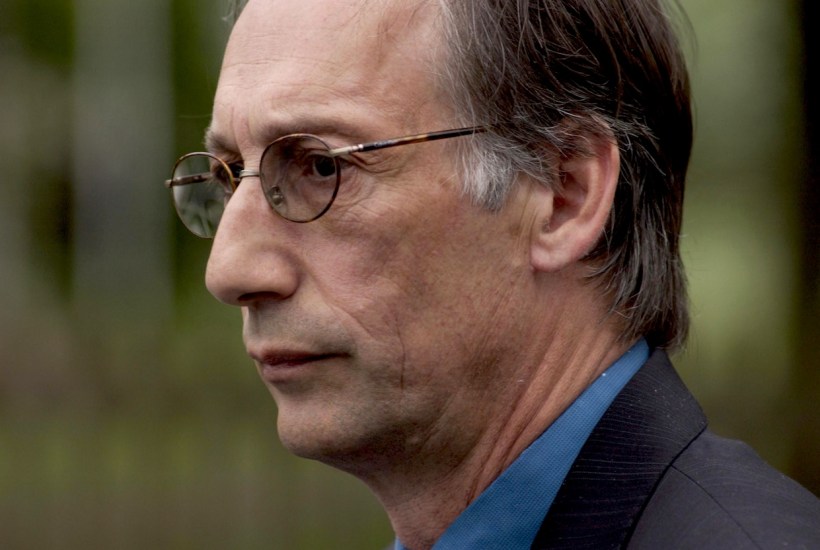
The death of the convicted sex offender, actor and writer Chris Langham of pancreatic cancer at the age of 77 brings to an unhappy end one of the most turbulent public careers of any English entertainer. Langham was jailed for ten months in 2007 after having been found guilty of downloading and possessing level five child pornography, and while his sentence was reduced to six months on appeal, the taint of his conviction clung to him for the remainder of his life.
While Langham continued to deny that he had accessed the material for anything other than research purposes – and to make sense of the child abuse that he claimed that he had suffered in his youth – the judgement of Detective Superintendent Paul Fotheringham of Kent Police proved to be the lasting one. ‘Langham doesn’t like the label, but I am satisfied that he is a paedophile.’
Even at the time of Langham’s high-profile arrest, trial and subsequent conviction, there was a sense that the still very much alive Jimmy Savile was untouchable because of his litigious ways and ostentatious charitable initiatives – which, as we now know, were largely designed for him to have access to vulnerable children – and that the industry needed a high-profile celebrity scapegoat.
It did not help that Langham was simultaneously accused of having had a sexual relationship with an underage girl, of which he was acquitted, but the sentencing remarks of the judge as regarded the material that the actor had downloaded lingered long in public memory. ‘Some of the children viewed are clearly prepubescent… The worst video was 15 minutes long and it showed in quite graphic detail the sadistic brutalisation of an eight-year-old girl in the UK, with some serious sexual offences against her.’
It is right to suggest that Langham was both arrogant and insensitive in many of the remarks that he made after his conviction, such as his declaration that ‘My life has been ruined, but my conscience is clear’, after his release from prison and his later statement, in a largely sympathetic interview with the Guardian, that ‘Everybody wants to see me working again – and nobody wants to hire me.’ He had a few tentative attempts at obtaining work, most notably in the Will Sharpe-directed low-budget Black Pond, but as he surmised, nobody was interested in hiring a man who was widely believed to be a convicted paedophile and so his career fell into abeyance long before his death.
The tragedy of Langham the actor, writer and comic star was that he was one of the most talented figures of his generation, who overcame alcoholism and a stuttering early career which included work as a writer on The Muppet Show to arrive at middle age as a brilliantly able deadpan comedian, only to throw it all away all over again. Whether audiences first noticed him play opposite Caroline Quentin and Amanda Holden in the sitcom Kiss Me Kate, which he co-wrote, as the bumbling (and seldom seen) Roy Mallard in the mockumentary People Like Us or as a diffident therapist in the Paul Whitehouse collaboration Help, he had a similarly ironic, shrugging quality to Bill Nighy (who, appropriately enough, was cast as his more dashing brother in Kiss Me Kate) and like Nighy, might have expected to go onto late-career stardom in other circumstances.
It is likely that Spectator readers will remember Langham most fondly for his Bafta-winning performance in the first and second seasons of The Thick Of It, in which he played the hapless yet strangely likeable Hugh Abbot, minister for the fictitious Department of Social Affairs and Citizenship. (It is one of the crushing ironies of his career that he was charged with downloading indecent images of children four days after he won the Bafta.) Langham only appeared in six episodes, and his character was written out after his arrest on 29 November 2005, but he made an indelible impression, whether it was impotently announcing ‘I’m the fucking daddy’, trying and failing to contend with Peter Capaldi’s splenetic spin doctor Malcolm Tucker or finding himself in yet another spot of political bother.
In a show that is full of indelible characters, not least Tucker, Roger Allam’s Peter Mannion and Tom Hollander’s briefly seen Cal Richards, aka ‘The Fucker’, Langham’s Abbott stood out for being both an entirely credible representative of a hapless late Blair-era minister but also for conveying a sense, fleeting and comic though it might have been, why anyone would willingly put themselves through the slings and arrows of public humiliation and go into politics. This was one of the many ironies and achievements of the show, and its creator Armando Iannucci was singled out by Langham as one of the few showbusiness friends who didn’t abandon him after his fall from grace, along with John Cleese and the late Mel Smith.
None of this can detract from the fact that he was also an extraordinarily funny and talented man
It says a lot for Langham’s toxicity that the first two series of The Thick Of It were removed from the iPlayer service in July 2021, apparently on the grounds that merely seeing the actor on screen would be enough to trigger viewers. (Help has been unavailable since it was initially broadcast.) It has since been restored, allowing viewers to see the show if they were sufficiently minded, although there was also a public warning from NAPAC, an association for those abused in childhood.
Nobody would want to make light of Langham’s crimes, or to feel that he deserved a greater comeback than the ignominious end to his public career that he faced. Post-Savile, it seems even more surprising that he was even given broadly sympathetic treatment by some sections of the media to state his case, including an interview with Pamela Stephenson. Yet none of this can detract from the fact that he was also an extraordinarily funny and talented man, whose comic gifts may, in time, come to be appreciated by future audiences – if, of course, they are prepared to accept the deep flaws of their possessor, too.